
Late night comics who mock the church may have set the tone of the government's current salvos against religious freedom. Who would have thought that the disdain for religion by the cheap-laughs crowd would become part of the federal agenda?
At least it seems that way. NBC lauds Jay Leno, who once joked that a news report of a priest violating celibacy with a woman was received at the Vatican with, "A woman? Thank God." David Letterman, who once said a report on the priest shortage proved "there is some good news in the world," still stars at CBS. Both comics feel free to diss the church, and the government follows their lead as it works to dismantle longstanding guarantees of freedom for religion.
For example, new regulations issued by the U.S. Department of Health and Human Services (HHS) under the Patient Protection and Affordable Care Act (a.k.a. health care reform) mandate coverage of contraception (including abortifacients) and sterilization in almost all private health insurance plans. HHS offers a religious exemption for some employers but only when most of the employees are of the same faith, when they serve primarily others of the same faith, and are proselytizing.
For Catholics, that means that feeding the poor counts as a religious ministry only when the hungry are co-religionists. One out of six people who need hospital care in the U.S. go to a Catholic facility - but HHS would qualify the hospital for a religious exemption only if it employed mostly Catholics, served mostly Catholics and, I suppose, taught the Ten Commandments in between sutures. When the government determines what is and is not a church ministry you have big-time interference with the exercise of religion.
Freedom for religion means that government cannot interfere with the internal governance of religious institutions. Whatever you think about sterilizations, for example, it means the government should not force Catholic organizations to pay for them, and therefore, promote them, through their insurance programs.
Unfortunately, the problems don't end with health care. In the effort to redefine marriage, we see the government threatening religious discrimination in the name of--you guessed it--preventing discrimination. The Defense of Marriage Act (DOMA), passed by Congress and signed by President Clinton, declares that marriage is between one man and one woman. But the Department of Justice, which is charged with defending Acts of Congress like DOMA against constitutional challenge, declared in March that it would stop doing so. In July, Justice went further and started filing briefs that attack DOMA's constitutionality. Most disturbing in this flip-flop is its rationale: DOMA's definition of marriage must be abandoned and then attacked because it is motivated by bias and prejudice, comparable to racism. That is, the Justice Department simply writes off as bigots those with longstanding support for traditional marriage. And if the Justice Department gets its way in court, those considered bigots by the federal government will be marginalized with the full moral, economic and coercive power of the state.
For example, an employer who provides unique employment benefits to the actually married risks being disqualified from government funding - and most other government cooperation - and likely being sued for "discrimination." A government clerk who expresses a conscientious objection to cooperating with same-sex civil union ceremonies risks a pink slip.
In short, this is what happens when the view that marriage is between a man and a woman becomes a violation of the U.S. Constitution. And this is what the Justice Department urges--apparently forgetting that imposing special disabilities on people and groups because of their religious beliefs offends the First Amendment at its core.
Comics draw laughs when they mock the church, stereotype nuns and scorn priests both for adhering to celibacy rules and occasionally flouting them. They may be playing for laughs, but it is something more when the government abandons its centuries-old truce with religion. Toying with freedom for religion bodes ill--not just for Catholics, but also for the Constitution and anyone who lives under it.
Thursday, September 22, 2011
Looks Like Leno, Letterman Setting Tone at HHS, Justice Department

Wednesday, September 14, 2011
Triumph of the Cross: Homily of Archbishop Timothy Dolan at Memorial Mass for Archbishop Pietro Sambi
“We adore Thee, O Christ, and we praise Thee! Because by Thy Holy Cross Thou hast redeemed the World!”
Cardinal Wuerl, Cardinal Baum, eminent cardinals;
My brother bishops;
Msgr. Lantheaume;
Brother priests and deacons;
Consecrated women and men religious;
Distinguished members of the diplomatic corps and public officials;
Brothers and sisters in Christ;
Friends in faith and prayer:
If I am not mistaken, it was at the installation of Peter Christensen as bishop of Superior, Wisconsin…
As Metropolitan Archbishop of Milwaukee I was with our still relatively new apostolic nuncio, Pietro Sambi, vesting before the Mass. When we joined the other bishops to vest, he asked me if we bishops here in America wore our pectoral cross on the inside or outside of the chasuble. I replied “Eccellenza, as a matter of fact, all the bishops will watch to see what you do and then follow suit!”
His eyes sparkled and he said, “Then I will keep changing it back and forth to confuse everybody.”
Then he commented, “As long as it is over our heart, it does not really make any difference.”
As long as the cross is on our heart, nothing else really makes any difference.
“We adore Thee, O Christ, and we praise Thee! Because by Thy Holy Cross Thou hast redeemed the World.”
That’s why it made so much sense to have the memorial Mass for our beloved nuncio, Archbishop Pietro Sambi, today: not just because so many of us still mourning bishops would be here in D.C. for the meeting of the Administrative Committee of our Conference; not just because people are all back to normal after summer vacations, but because it is the Feast of the Triumph of the Holy Cross.
In the luminous life and ministry of Pietro Sambi, to be sure, effective and memorable diplomatic service on behalf of the Apostolic See in Cameroon, Cuba, Africa, Nicaragua, Belgium, India, Burundi, Indonesia, Israel, and as we fondly and gratefully recall, here in the United States of America, radiantly stands out.
But we acclaim today that what is of far more profound meaning and of everlasting consequence in his life was that the cross of Christ, triumphant over sin, Satan, and death, was on his heart.
That he was baptized into the mystery of the cross of Christ four days after his birth in Forli, Italy, in 1938;
That he was nourished with the precious blood of Christ shed on the cross, and sacramentally sealed on his soul with the victory of the cross through the sacrament of confirmation; ordained a priest to spread the victory of the cross in 1964; and had the cross placed over his heart when ordained a bishop in 1985…
In lumine tuo, “in your light” he chose as his motto, professing the light of Easter morning, the triumph of the cross, after the darkness of Good Friday.
As Monsignor Lantheaume and other loyal members of his household can attest; as Cardinal Wuerl, Archbishop O’Brien, and I can verify—since we had the honor of tracing the cross upon him on his deathbed—Pietro Sambi knew the mystery of the cross as well in his final, unexpected illness.
But he had witnessed it too as he saw the cross in his varied diplomatic missions, in the poverty and oppression of peoples, in religious acrimony and war.
We bishops of the United States will never forget the warm, personable manner in which he summoned us to be ambassadors of the healing and reconciliation won by Jesus on the cross, and be ever grateful for the tender way he unfailingly responded to our own needs.
He certainly viewed his diplomatic vocation, as an ambassador of the vicar of the crucified one, as an extension of the invitation to mercy, reconciliation, unity, peace, and life inherent in the Triumph of the Cross;
He saw his diplomatic mission as an encouragement of the most noble virtues illuminated by the light of the cross: trust, honesty, and unity.
So today, as we celebrate the victory of the cross, we confess our faith in Jesus—in lumine tuo—that, “by dying, He destroyed our death; that by rising, He restored our life;”
We trust, that by His mercy, Pietro Sambi now shares in that triumph forever;
We praise God for the gift that our nuncio was to the Church, to the diplomatic world, to us here in the United States…as, like Archbishop Sambi, we place the cross over our hearts.
Eternal rest grant unto him, O Lord!
And let perpetual light shine upon him!
May he rest in peace! Amen!
May his soul, and the souls of all the faithful departed, rest in peace!
Amen!
“We adore Thee, O Christ, and we praise Thee! Because by Thy Holy Cross Thou hast redeemed the World!”
The Sambi Send-Off
 Over 85 U.S. bishops -- including seven cardinals -- gathered at the Basilica of the National Shrine of the Immaculate conception in Washington today for a memorial Mass for the late Archbishop Pietro Sambi, apostolic nuncio to the United States, who died July 27.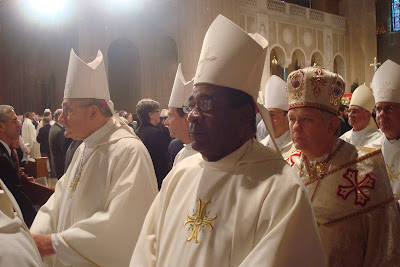
Monday, September 12, 2011
Jesus Won’t Pass Muster at HHS
HHS has a very limited definition of which church organizations can be exempted from having to pay for contraceptives, sterilization and other services that violate church teaching. Amazingly, to establish what HHS deems true religion, the agency turned to a definition concocted by the American Civil Liberties Union (ACLU) for a law in California. (For the record, a list of church-state lawsuits suggests ACLU does not look kindly on religious organizations’ active involvement in the public sphere.)
Following the ACLU lead, HHS argues that a religious exemption should be available just to some religious institutions, and only if they primarily serve and hire persons who share their religious tenets and restrict their charitable efforts to the inculcation of religious values.
Here Jesus loses out. His chief teaching about serving one’s neighbor highlights the Good Samaritan who took care of a woebegone stranger by providing medical care, food and lodging. Jesus did not say anything about checking the man’s religious affiliation beforehand. There was no catechism test afterwards. The point of the story is to help anyone who needs help.
Jesus met needs that were not necessarily catechetical. For the disconsolate father Jairus, Jesus raised his daughter from the dead. For the worried military leader whose servant had a paralyzing illness, he offered a cure. For the wedding couple at Cana, he turned water into wine. He met basic human needs. The church practice to give help when and where it is needed marks the work of religious institutions from clinics, hospitals and nursing homes to soup kitchens, food pantries and Catholic schools and universities. The goal is to help people in need because they are fellow children of God, whether or not they pray beside you on Sunday.
As the law reads now, to follow HHS rules and qualify for an exemption, many Catholic institutions would have to violate their very mission and refuse service to non-Catholics. They’d have to fire hard-working employees. To maintain their religious integrity, they could be forced to stop providing employee insurance benefits. Or they’d have to close down, a step that would not benefit a nation where one out of six persons seeks hospital care in a Catholic institution. It would also hurt the millions who receive social services and counseling through Catholic Charities; bread, milk and cereal from parish food pantries; and other types of assistance from additional church-run agencies.
You’d have to be pretty removed from American reality not to know that Catholic Charities, Catholic hospitals, Catholic schools and many other Catholic charitable organizations serve more than Catholics. Such service is part of the church’s mission, following the example of the Good Samaritan and Christians from the first disciples onward.
Catholics are called to help people in need whatever their religion. To imply that when Catholics reach out to help others they are not being Catholic shows a poor understanding of the role of religion in our society. Most citizens know enough about Jesus and his works to recognize that his followers' caring ministries deserve respect, even (or especially) when they benefit not just Catholics but the health and human services of the entire nation.
Thursday, September 8, 2011
Mass on 9/11: Scripture on the Mark
Scripture can speak personally to each of us, but this Sunday readings at Mass on the tenth anniversary of 9/11 seem to have been penned just for this occasion.
Catholic Churches worldwide use the same scripture readings each Sunday. They follow a set, repeated pattern—a three-year cycle— from week to week and year to year. People who go to Mass often hope to find special meaning in a reading and often do. When worried, they might hear Scripture’s oft-repeated message: “Be not afraid.” Yet there is a certain randomness to it all, which is why I was stunned to read the Scriptures for the tenth anniversary of 9/11. They are right on the mark.
The first reading comes from the book of Sirach and starts “Wrath and anger are hateful things.” It adds, “Could anyone nourish anger against another and expect healing from the Lord?” My first instinct is: Take that, you terrorists!
But on the same day the Gospel reading from the Book of Matthew delves into how often we must forgive others. It recounts the tale of the ungrateful servant who after his own debt was forgiven by the master unmercifully dunned a man indebted to him. When his master heard of his unforgiving behavior, he called him a “wicked servant” and asked, “Should you not have had pity on your fellow servant, as I had pity on you?” Looks like a word for the wronged here.
Scripture’s message of forgiveness begs for hearing at this critical time. As a nation, anger abounds against those deserving and undeserving. There is anger at raging Muslim terrorists who masterminded assaults. When they cannot be reached the anger is then turned on innocent and peaceful Muslims, just because they hold on to faith in Allah. In a most obvious example, some months ago it meant people opposed a Muslim center with a mosque two blocks from the 9/11 site in New York. Recently it has meant that New York’s Mayor Bloomberg won’t have a prayer at the city’s commemorative ceremony to mark 9/11 because he can’t figure out which religious figure, Christian, Muslim, Jewish, or other, would be acceptable to all.
In other areas, there is anger at bureaucracies because they ineptly armed firefighters and policemen with radio equipment that proved useless in New York skyscrapers. There’s anger at bureaucracies with such a proprietary sense that one government agency wouldn’t share information with another.
Overall, there is anger at anyone who is different, speaks with a foreign accent, or dares not speak English in America.
Scripture advises that anger clouds our vision and hardens our hearts. It makes us base rather than noble. It blinds us to our own failings and encourages a dangerous arrogance. It makes us forget we need forgiveness as individuals and as a nation.
In the coming days, media will captivate us with stories of heroes of 9/11, people who forgot themselves and rushed to help others. People terribly injured who struggled against the odds and became whole again. We’ll meet the children of 9/11 who lost a parent but gained a hero in heaven. We’ll meet many whose lives were changed by the experience.
Sadly, we’ll also see anger, some justifiable, but much the kind of anger that spawns a thirst for vengeance and weakens us as a people and as a nation.
Yet I am sure that as we mark 9/11, we will meet those who will inspire us because they embraced forgiveness. Some may have found the ability to forgive almost immediately; others, over time. They will be the ones who have touched into the divine and carry an unmistakable grace within them. Such forgiveness has not come easy for them, but those who have found it will stand as a touchstone of goodness for us all.
Friday, September 2, 2011
The Church's Noblest at Ground Zero
This became evident as the U.S. Bishops' Office of Media Relations interviewed and sought reflections from a few persons for The Catholic Church Remembers.
Cardinal Edward Egan, retired archbishop of New York, was one of the first responders that fateful morning. He headed for Ground Zero when he heard of the attack. As he was on the way, Mayor Rudolph Giuliani called and asked him to go instead to await the injured at St. Vincent's Hospital. Thus began the cardinal's critical service to a city in need.
The first person he met at St. Vincent's was a woman, burned from head to foot. The second was one of his priests, a fire department chaplain.
By rank, a cardinal is like a U.S. senator or a general, a big-time leader you don't expect to find on the front of any war. Cardinal Egan didn't see himself that way.
"I kept saying to myself, 'I'm not a fireman, a fire person, a firefighter,'" he recalled on video. "'I'm not a police officer. I'm not an emergency worker. I'm a priest and I'm going to do everything that a priest can do under these circumstances.'"
Afterwards, he worked at Ground Zero, a site so contaminated that officials told him to discard all his clothes when he returned home. He anointed bodies, listened to rescuers, and consoled both the disconsolate and their consolers. He celebrated funeral Masses at St. Patrick's Cathedral and led prayers when President George W. Bush arrive at Ground Zero and at an ecumenical service he organized Yankee Stadium.
Other priests sprang into action too. Msgr. Kevin Sullivan, head of Catholic Charities of the New York Archdiocese, saw that it was not just Wall Street people with significant finances who were affected. It was also those who live on the edge, such as the wait staff at Windows on the World, the restaurant atop one of the Twin Towers. Msgr. Sullivan contacted the unions and said Catholic Charities would pay the salaries for six months for restaurant workers there who were suddenly out of work -- enough time, he thought, for them to find another job.
Other priests made their way to the scene, most notably the fire department chaplain Franciscan Father Mychal Judge, the first officially recorded fatality of the attack. When rescuers found his body, firemen carried it from the rubble, not to a mortuary van but to the sanctuary of a nearby church.
Other clergy responded as priests too. The city established a site for those looking for missing family members, a place with counselors and social workers. The line went on for blocks and priests walked alongside it and helped people accept the inevitable: a loss of someone only to be found again in heaven. A veteran psychiatrist told Cardinal Egan that he was amazed when he interviewed families and saw how deeply they had been touched by their sidewalk conversations with priests.
The church knows the importance of chaplains and designates priests to help emergency workers such as police, firefighters and Federal Bureau of Investigation agents. These public servants need one of their own in crises and at 9/11 their own priests responded.
9/11's own, however, also turned out to be not just official chaplains but also priests in other ministries, like Msgr. Anthony Sherman, a Brooklyn pastor who counseled strangers and led funeral Masses for the dead from his parish, some whose bodies were never found. And Jesuit Father James Martin, an editor at America magazine, who worked with rescuers in the aftermath. And other unnamed and unrecognized priests who offered the sacraments, encouragement and human consolation. They rose to the heights of their calling in the depths of that tragedy.
Cardinal Egan calls Ground Zero, "Ground Hero." He speaks of a medical intern who stayed on duty though his father worked high in one of the twin towers, of a widow with babe in arms in the front pew of St. Patrick's for her husband's funeral, of the police who demanded for five days that the cardinal wear a gas mask to protect him from the contaminated air at the site but didn't wear their own because the masks impaired visibility.
New York's fire department, which lost 343 members, is known as "New York's Bravest," and the police department is known as "New York's Finest." Looking at the church's response to 9/11, the priests who responded would say they were "just priests," but surely they were "the Church's Noblest" too.
HHS Needs to Remove Itself from the Sanctuary
It is a clear message that government must not stick its proverbial camel's nose under the church tent. Now, however, the U.S. Department of Health and Human Services (HHS) has gone beyond nuzzling its nose where it does not belong. It has plunked itself right in the middle of the sanctuary. It is trying to define what a religion does and does not do.
This misguided move comes with a proposed HHS regulation to guide implementation of the Patient Protection and Affordable Care Act. The regulation for the new health care reform bill demands that all health plans pay for contraceptives, sterilizations and education to use both.
In a tacit acknowledgement that this violates the Constitution's cherished respect for religious liberty, HHS provides an exemption for religious employers -- but with a catch. The church agency can only claim exemption if it primarily serves people of its own faith. It also must meet other requirements, such as employing mostly people of its own faith.
This means HHS is setting itself up to determine what constitutes church ministry and who Jesus meant when he referred to serving "the least of my brethren."
Catholic hospitals, charities and educational institutions provide about $30 billion worth of service annually in this country. No one presents a baptismal certificate at the emergency room. The hungry do not recite the Creed to get groceries at the food pantry. Students can pursue learning at The Catholic University of America, Villanova or any other Catholic college without passing a catechism admissions test. The commitment to serve those in need, the sick, the hungry, the uneducated, is intrinsic to Catholicism. No federal rule (except now HHS's) says the church must limit its service to Catholics if it is to be true to its teaching. HHS doesn't get the parable of the Good Samaritan, who helped the stranger simply because he was in need.
Look at the numbers. Catholic hospitals admit about 5.6 million people annually. That's one out of every six persons seeking hospital care in the United States. Catholic Charities serves more than 9 million people annually. Catholic colleges and universities teach 850,000 students annually. Among those served are Catholics, Protestants, Jews, Muslims, atheists, agnostics and members of any other religious or irreligious group you can name.
For the time being HHS has given itself wiggle room, saying that the public in the next two months can suggest an "alternative" definition of a "religious employer." That's good because health care reform ought to increase access to basic care, not push religious groups to either violate their principles or abandon service to those in need whatever their religious beliefs.
Meanwhile, the sanctuary is getting crowded. It is time for HHS to remove itself.


