By Don Clemmer
When Pope Francis approved the canonization of Pope John XXIII, one reason given was that he is already universally proclaimed a saint around the world. Canonization is one way the Church says "this is a Christian life well lived and worth imitating." John XXIII offered much in that department: joy, humility, simplicity, patience, creativity and confidence, among other virtues.
The life of Angelo Roncalli also bears another hallmark of life: unfinished business. For much of his ministry, Father, then Archbishop, then Cardinal, then Pope Roncalli repeated several steps:
- Step 1: He would receive a difficult new assignment, often in a place very far away.
- Step 2: He won people over with the holiness of his witness, hard work, and personal charm.
- Step 3: Just as things are starting to hum along nicely, he'd get another new assignment.
- As a young priest in the Diocese of Bergamo, Father Roncalli was happily enmeshed in the life of his diocese when the letter came in 1920 that Pope Benedict XV was calling him to Rome to be the director of the Society of the Propagation of the Faith in Italy. This was a surprising assignment that called the young priest away from his home diocese and brought him, for the first time, into the Vatican's orbit.
- Five years later, Roncalli's life abruptly changed again when he appointed the first apostolic delegate to Bulgaria. While this meant he would be consecrated a bishop (which he was on March 19, 1925), it also meant he would leave a comfortable life in Rome for a strange new land fraught with political conflict and a divided Christian community of Bulgarian Orthodox, Byzantine and Roman Catholics, with the Catholics comprising a scattered minority. Archbishop Roncalli set to work, preaching love for one another and reaching out not only to the local Catholics but to the Orthodox as well. When Roncalli was appointed apostolic delegate to Turkey and Greece in 1934, he left a far more harmonious scene in his wake, with both Catholic and Orthodox sorry to see him go.
- When Roncalli got to Turkey in 1935, he faced another unfamiliar country, a government hostile to the Church, an Orthodox Church hostile to Catholics and a Catholic community fractured into numerous rites hostile to one another. In 1938 he was able to arrange a visit to Ecumenical Patriarch Benjamin I in Istanbul, which was a historic breakthrough for the times. In Greece, he faced another scattered, impoverished Catholic community. During these years, he also worked to save many Jewish refugees from the Nazis. Again it came as a surprise to him when he was abruptly named nuncio to France in 1944.
- In France, Roncalli faced the extremely situation of navigating a divided episcopacy, some of whom had resisted under Nazi occupation and some of whom had cooperated. Once again, it was his good humor, superb diplomacy and authentic loving concern for all people that empowered him to navigate perilous waters.
Elected pope on October 28, 1958, Roncalli was once more handed an impossible task: renewing the entire Church and readying it to face the challenges of the modern world. True to form, he immediately set about initiating change that no one would have thought possible in such a short time, announcing an ecumenical council only months after becoming pope and planting seeds of reform on issues including the liturgy, ecumenical and interfaith matters, and the role of the laity.
Also true to form, he was once more called away just as the work began to bear fruit, dying in June of 1963.
"In this life, all symphonies remain unfinished," said the Jesuit theologian Karl Rahner, who played an influential role at the Council. Pope John's life reflects this mystery, that Christians are called to serve God in their daily lives, but more often thatn not, what we start will inevitably end up someone else's concern. John XXIII had the holy serenity to see that the big, final picture was in God's hands alone.
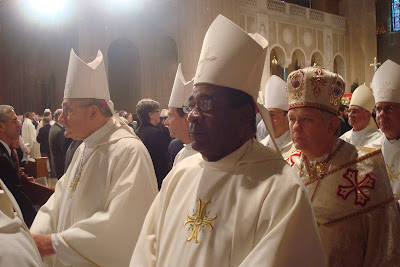
CNS Photo/Catholic Press Photo
Many biographical details for this post were gathered from "A Man Named John," by Alden Hatch, Hawthorn Books, Inc., 1963.
---
Don Clemmer is the USCCB's Assistant Director of Media Relations