Showing posts with label U.S. Conference of Catholic Bishops. Show all posts

Thursday, November 7, 2013

The Presidential/VP Slate, 2013

On November 12, the U.S. bishops -- gathered in Baltimore for their annual fall General Assembly -- will vote for their next president and vice president. The newly elected officers will begin their terms at the conclusion of the meeting (Thursday, November 14), when Cardinal Timothy M. Dolan of New York and Archbishop Joseph E. Kurtz of Louisville, Kentucky, complete their respective terms as president and vice president of the U.S. Conference of Catholic Bishops.

Ten candidates are nominated by their brother bishops for the presidency and vice presidency. Following, in alphabetical order, is a breakdown with some vital statistics of this year's slate:

1. Archbishop Gregory Aymond

Archbishop of New Orleans
  • Born November 12, 1949
  • Ordained a priest of New Orleans May 10, 1975
  • Auxiliary bishop of New Orleans, 1997-2000
  • Coadjutor bishop of Austin, Texas, 2000-2001
  • Bishop of Austin, Texas, 2001-2009
First native of New Orleans to serve as its archbishop. Currently wrapping up a term as chairman of USCCB's Divine Worship Committee, during which time he oversaw the implementation of the new English translation of the Roman Missal. Also serves USCCB Committees on Communications and Domestic Justice and Human Development.

2. Archbishop Charles J. Chaput, OFM Cap.

Archbishop of Philadelphia
  • Born September 26, 1944
  • Ordained a priest of the Capuchin Franciscan Order, August 29, 1970
  • Bishop of Rapid City, South Dakota, 1988-1997
  • Archbishop of Denver, 1997-2011
Currently chairs the Subcommittee on Native American Catholics. Serves on the USCCB Committee on Cultural Diversity in the Church and as a consultant to the Pro-Life Activities Committee.

3. Bishop Blase J. Cupich

Bishop of Spokane, Washington
  • Born March 19, 1949
  • Ordained priest of Omaha, Nebraska, August 16, 1975
  • Bishop of Rapid City, South Dakota, 1998-2010
Previously served as chairman of the USCCB Committee on Child and Youth Protection (2008-11), overseeing release of John Jay Causes and Context Study. Currently chairs the Subcommittee on the Church in Central and Eastern Europe and is a member of the National Collections Committee.

4. Cardinal Daniel N. DiNardo

Archbishop of Galveston-Houston
  • Born May 23, 1949
  • Ordained priest of Pittsburgh, July 16, 1977
  • Coadjutor bishop of Sioux City, Iowa, 1997-1998
  • Bishop of Sioux City, Iowa, 1998-2004
  • Coadjutor bishop/archbishop of Galveston-Houston, 2004-2006
  • Elevated to cardinal, 2007
First cardinal from Texas. Chairman-elect of the bishops' Committee on Divine Worship. Former chairman of the Committee on Pro-Life Activities (2009-2012) and current member of that committee, as well as National Collections Committee and Subcomittee on Health Care Issues. Participated in the March 2013 conclave to elect Pope Francis.

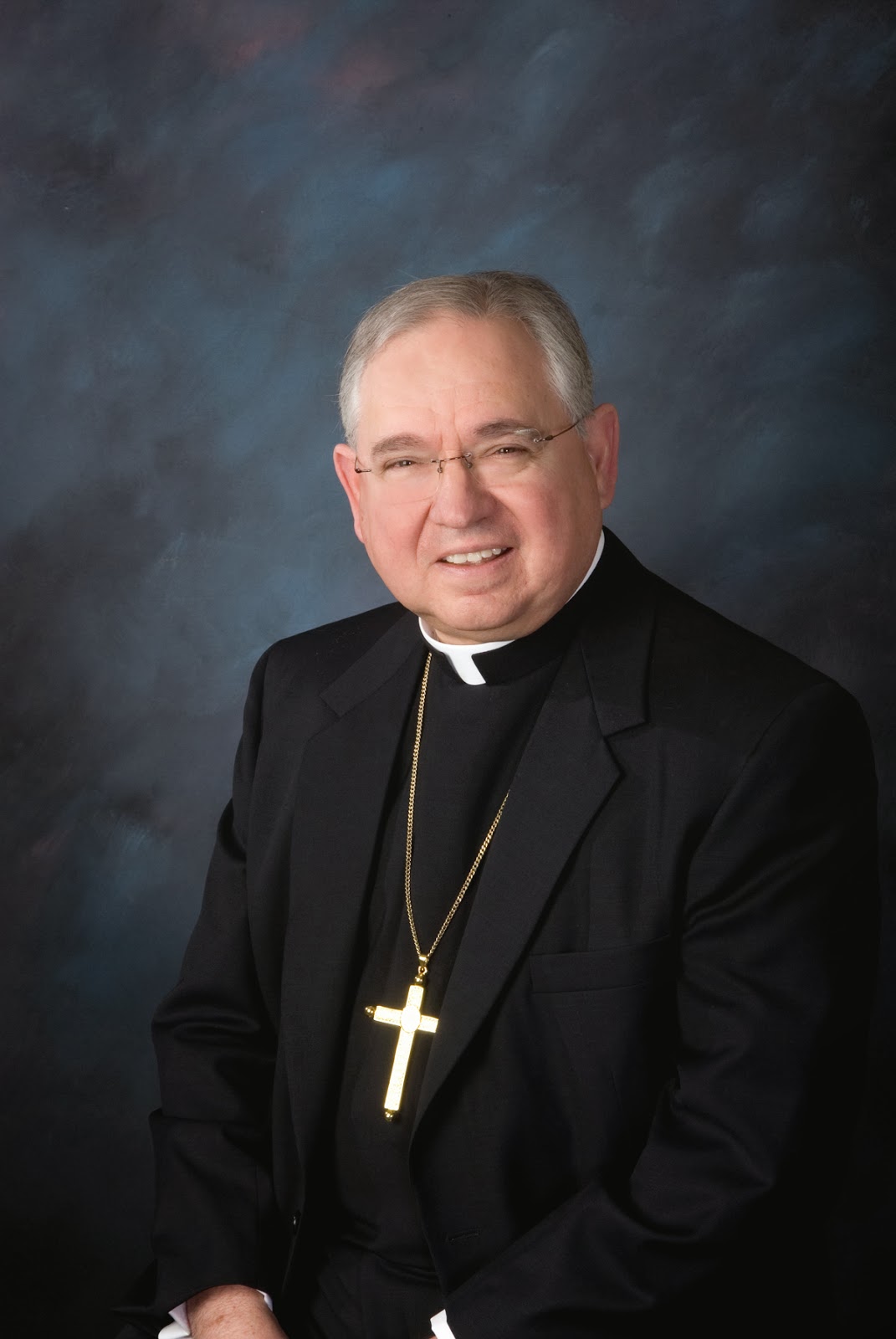
5. Archbishop José H. Gomez

Archbishop of Los Angeles
  • Born December 26, 1951
  • Ordained priest of Opus Dei, August 15, 1978
  • Auxiliary bishop of Denver, 2001-2004
  • Archbishop of San Antonio, 2004-2010
  • Coadjudutor archbishop of Los Angeles, 2010-2011
Head of the largest diocese in the United States. Member at large of USCCB Executive Committee. Chairman of Committee on Migration. Member of Subcommittee on Divine Worship in Spanish, the Subcommittee on the Church in Latin America and consultant to Committee on International Justice and Peace.

6. Archbishop Joseph E. Kurtz

Archbishop of Louisville, Kentucky
  • Born August 18, 1946
  • Ordained priest of Allentown, Pennsylvania, March 18, 1972
  • Bishop of Knoxville, Tennesee, 1999-2007
Vice president of USCCB since 2010. Former chairman of USCCB's then-Ad Hoc Committee on the Defense of Marriage.

7. Archbishop William E. Lori

Archbishop of Baltimore
  • Born May 6, 1951
  • Ordained priest of Washington, May 14, 1977
  • Auxiliary bishop of Washington, 1995-2001
  • Bishop of Bridgeport, Connecticut, 2001-2012
Serves as chaplain of the Knights of Columbus. Chairman of the bishops' Ad Hoc Committee for Religious Liberty. Member of the Committee on Pro-Life Activities, the Committee on Budget and Finance and the Subcommittee for the Promotion and Defense of Marriage. Consultant to the Committee on Doctrine.

8. Archbishop Dennis M. Schnurr

Archbishop of Cincinnati
  • Born June 21, 1948
  • Ordained priest of Sioux City, Iowa, July 20, 1974
  • Bishop of Duluth, Minnesota, 2001-2008
  • Coadjutor archbishop of Cincinnati, 2008-2009
Organizer of World Youth Day Denver in 1993 and served as general secretary of the U.S. bishops from 1995-2001. Chairman of the Committee on National Collections. Member of the Committee on Budget and Finance.

9. Archbishop Allen H. Vigneron

Archbishop of Detroit
  • Born October 21, 1948
  • Ordained a priest of Detroit, July 26, 1975
  • Auxiliary bishop of Detroit, 1996-2003
  • Coadjutor bishop of Oakland, California, 2003
  • Bishop of Oakland, California, 2003-2009
First Detroit native to head the archdiocese. Member of the Committee on Doctrine and the Subcommittee on the Catechism.

10. Archbishop Thomas G. Wenski

Archbishop of Miami
  • Born October 18, 1950
  • Ordained priest of Miami, May 15, 1976
  • Auxiliary bishop of Miami, 1997-2003
  • Coadjutor bishop of Orlando, Florida, 2003-2004
  • Bishop of Orlando, 2004-2010
First Miami native to head the archdiocese. Chairman-elect of the Committee on Domestic Justice and Human Development. Member of the Committees on Migration and International Justice and Peace and the Subcommittee on the Church in Latin America. Consultant to the Committee on Pro-Life Activities.

Thursday, January 24, 2013

Power up for Lent


               Post on Facebook. Send a tweet. Less than a month before Ash Wednesday Pope Benedict XVI has called on Catholics to get into social media. He blesses the world of Twitter, Tumblr, Pinterest and Facebook. He calls social media the new “agora,” the “open public square in which people share ideas, information and opinions, and in which new relationships and forms of community can come into being.”

            The pope lauded the latest communications breakthroughs in his 47th World Communications Day message, “Social Networks: portals of truth and faith; new spaces for evangelization.” World Communications Day is marked in the U.S. on May 12.

            For Pope Benedict social media is opportunity. A Lenten exercise for us may be to help social media be worthy of the papal endorsement. We need to sanctify the net. Here are some steps:

            Go positive to counter the negative. The Web is filled with snide and snarky comments, so offer a counter balance. When you see meanness, an untruth or bias, gently correct for the record.

            Pray for the nay-sayers and character assassins who hide behind anonymity. Writers marked by mean speech reflect inner pain.  

            Resist knee-jerk responses. Ask how someone on the receiving end will feel before flinging a verbal slice and dice.

            Lent is a time for alms-giving so seek out worthy charities to which to donate. Catholic Relief Services’ Operation Rise Bowl is one. Catholic Charities agencies are always in need.

Share where you’ve seen God during the day and use pics. God’s there in the kids who make us laugh, the beauty of a flower, the images of love that touch our hearts. God’s also there in starving children and fragile elderly begging for help.

            Research sites that help you pray. The U.S. bishops at www.usccb.org/bible offer daily readings from Scripture with a reflection. The Irish Jesuits at www.sacredspace.ie use simple music and reflections to draw one to contemplative ground. Share what you’ve found with friends.

            Remember that how you say something may be even more important than what you say.

            Converse with people with whom you do not agree and seek common ground from which both of you can move on.

            Establish you own creed for social media behavior e.g.  Don’t deal in put downs, think before you type, find something positive to contribute to the conversation, don’t text while driving and don’t text while someone is sharing real time with you.

            Have the strength to power down. If social media get in the way of your relationship with God, family or friends, let yourself power down. Don’t check the computer until you’ve said good morning to God. Let the day’s last thoughts center on thanking God for his graces rather than a news flash from the Drudge Report.

            Send a tweet to Pope Benedict at @pontifex and download his app to your cellphone or I-pad so you can easily check in with him for his wisdom.

            Social media can touch hearts, notes Pope Benedict in the 2013 World Communications Day address. “When we are present to others, in any way at all, he says, “we are called to make known the love of God to the furthest ends of the earth.”

Thursday, January 10, 2013

The Face of Poverty


January is Poverty Awareness Month. To help raise awareness among Catholics of poverty and its underlying issues, USCCB has updated its website, www.PovertyUSA.org, and launched a Spanish counterpart, www.PobrezaUSA.org. Our blog is also running a series of posts by guest bloggers reflecting on poverty in our country and the world today. Today’s post is by Bishop Richard E. Pates.


Poverty has a face; it is the face of Christ in poor people. As Jesus taught: “Whatever you did for one of these least brothers of mine, you did for Me.” The Gospel reminds us that the hungry, the thirsty, the stranger, the naked, the ill, and those in prison are Christ. 

Christ is present in the hungry child in Malawi, stunted and sickly from a lack of proper nutrition. Christ is in infants on the verge of death from preventable water-borne illnesses due to a lack of clean water supplies in Zambia. Christ is visible in refugees and strangers who flee famine, war or persecution, as in Syria today. We meet Christ in the naked child whose body is racked with toxic poisons from a polluted water source near an unregulated mining operation in Peru. Christ gazes out of the dull eyes of a mother dying of AIDS in South Africa, too sick to care for her children, soon to be orphans. We come upon Christ in a father separated from his children for a non-violent drug offense in a U.S. prison, the nation with the highest rate of incarceration in the world. 

Earlier this year, I saw the face of Christ in an unlikely place of poverty: a sprawling seminary in Nigeria. I was there to preside over the ordination to the priesthood of 10 Nigerian Spiritans and 15 to the transitional diaconate. Spiritan priests from Nigeria have faithfully served the Diocese of Des Moines for many years. The high school seminary has 600 students, approximately 10 percent of whom will likely become priests. The seminary provides a broad and good education, but what struck me was that while the seminary was rich in faith, it was poor in resources. The classrooms were little more than shelters. There were few books and no technology. Living quarters were below standard. For me, this seminary became a symbol of the spiritual richness and physical poverty of the Church in Africa. Although the seminarians were much better off than many poor Nigerians, poverty was still evident. 

Of course, recognizing Christ in the poor is not enough. We must then meet Christ’s needs in His people. Our Diocese of Des Moines has begun in a small way to do just that. The schools of our diocese are reaching out to the seminary to provide cash assistance to address the seminary’s urgent need for resources. There is a person-to-person connection and an effort to support and enhance the resources at the seminary’s disposal. 

In the same way, the broader Church in our diocese and throughout the United States reaches out to the Church and people of poor countries in the developing world. The Church in Latin America collection and the Church in Africa initiative of the U.S. Conference of Catholic Bishops provide grants for pastoral activities. Catholic Relief Services, the bishops’ overseas relief and development agency, provides humanitarian and development assistance, often in partnership with the local Church, in about 100 countries. We can do our part by supporting this work. 

We can also raise our voices in the public square on behalf of the world’s poor.  Motivated by Christ’s identification with poor persons, we can encourage public officials to preserve and strengthen U.S. poverty-focused international assistance. This aid is less than one percent of the federal budget, but literally saves lives and creates livelihoods for the poorest people in the poorest places on earth all of whom are Christ. They are our brothers and sisters in the human family. 

More information on poverty can be found at the Catholics Confront Global Poverty website.
---
Bishop Richard E. Pates of Des Moines chairs the Committee on International Justice and Peace, United States Conference of Catholic Bishops.

Wednesday, December 5, 2012

Tweet the Pope


By Sister Mary Ann Walsh

With the push of a button, I sent a tweet with #AskPontifex to the pope at @Pontifex, the new Twitter account the Vatican set up for Pope Benedict XVI. It’s nice to go straight to the top. Kudos to the pope who saw that even at 85 years of age, he has to engage in social media.

Pope Benedict speaks many languages, his native German, of course, and Italian, French, English and other tongues too. But the most important language for him may be Digital, the one that reaches every nation in the world.

On Twitter, Pope Benedict will send messages in eight languages: English, German, Spanish, Portuguese, Polish, French, Arabic and Italian. His tweets debut December 12, the Feast of Our Lady of Guadalupe, who in an apparition startled the peasant Juan Diego by speaking to him instead of higher ups in mid-16th century Mexico.

When Pope Benedict joins Twitter, he endorses a community that exists on the Web, where people can even discuss matters of the soul. Its anonymity can free people to share deep concerns. It is not always pretty, of course. Recently, for example, on the USCCB Facebook page people debated whether or not there’s a religious obligation to help the poor. Arguments over such a mandate can be a healthy, though sometimes raucous religious exercise. Undoubtedly Pope Benedict will encounter cynicism, but he can handle that. He knows it is important to engage, even at personal cost.

The pope’s web leadership might encourage bishops and others to follow suit. This will be no small accomplishment. Resistance comes from more than the fact that social media is time consuming. It comes from the fact that blogging and the like defy what many have been taught. Priests and bishops, for example, learned early on: “it’s about the message, not you.” Now comes a communications vehicle where they are expected to get more personal. It jars them.

Church leaders also revel in finely nuanced theology. Tweets of 140 characters preclude nuancing. Some who think length equals profundity might pause at truths such as “God loves you,”  “Jesus died for you” and “I am with you always.” They’re short on words, deep in meaning and fit Twitter’s length restrictions.

Some fear the pope and other leaders might lose some mystique when they tweet with the hoi polloi. Yet plain speaking is not irreverent and being with the masses is not beneath a religious leader. After all, God did become man. Scripture proves simple speech can be holy. Think “Let there be light” at creation and Mary’s “Let it be done unto me according to thy word” at the Annunciation. Engaging the crowd means being with God’s children, such as the multitude Jesus addressed on the mountainside.

Social media reaches billions. Its brevity makes it accessible. It’s via the Internet, a new place people gather and that sometimes needs to be redeemed. It is interactive as it beckons web users to engage another, perhaps the antidote to the isolation many people feel today. As he wades into social media waters, the pope will encounter a sometimes cynical cyber-world, but by using Twitter with sincerity, he can elevate the medium. Some may doubt the wisdom of this papal venture, but fear has never stopped Christians from sharing their message through all available means.

---

Editor's Note: Got a question for Pope Benedict XVI on Twitter? Use the hashtag #askpontifex to @Pontifex.
 

Wednesday, August 8, 2012

Catholics and Social Media


By Sister Mary Ann Walsh

            A recent sign of technology in church was a man watching the Olympics on his Smartphone. He may be among those very few Catholics who, the Public Religion Research Institute says, “incorporate technology into their practice of worship.”     

Public Religion’s July 2012 report finds that few Americans use social technology for religion and that Catholics especially lag in this area: while 19 percent of Evangelical Christians reported having posted something about being in church on Facebook, only six percent of mainline Protestants and two percent of Catholics have done so. It added that while a quarter of Evangelicals have downloaded or listened to a sermon on line, just six percent of mainline Protestants and Catholics have done so.

However, there is much proof that Catholics are present in the new media world via blogs, Facebook, Twitter, web pages and other forms of social media.

            The U.S. bishops’ website, www.usccb.org attracts almost 100,000 visitors each day to its site for liturgical readings of the day, www.usccb.org/bible/readings. These visitors see and hear a brief reflection on the readings at www.usccb.org/bible/reflections.

            The bishops’ Facebook page, www.facebook.com/usccb, boasts about 40,000 followers and is growing. Posts on USCCBlog, found at http://usccbmedia.blogspot.com find their way into other corners of the blogosphere, both through church blogs, such as America Magazine’s “In all things…” and blogs in the secular arena, including Huffington Post, Politico, Washington’s Post’s “On Faith” and USA Today’s “Faith & Reason.”

            A recent social media foray is the church’s religious liberty texting campaign. The bishops urge people to text “Freedom” or Libertad” to 377377. Texters can sign up for brief messages about religious freedom, a key issue now.

            Church blogs abound. Gossip blogs offer “inside” information, such as who might become a bishop next. Several blogs feed a liberal or conservative base, and, I fear, stoke church polarization in this election year.

            Some bishops blog. Bishop Gerald Kicanas of Tucson, Arizona, files a “Monday Memo” at www.tucsondiocese.org. Cardinal Timothy Dolan of New York often makes news at http://blog.archny.org. Cardinal Sean O’Malley of Boston lets people know what he’s doing on his travels with www.cardinalseansblog.org. Others, such as Bishop Christopher Coyne, apostolic administrator of the Archdiocese of Indianapolis, and Bishop Anthony Taylor of Little Rock, Arkansas, post homilies, or at least 140 characters from their homilies, on Facebook or Twitter.

            Catholics who use the Web for spiritual development can go to many sites, including not only the USCCB site but also sites geared to meditation, such as the Irish Jesuits’ http://www.sacred space.ie and Franciscan Father Richard Rohr’s Center for Action and Contemplation in Albuquerque, New Mexico, www.cac.org.

            The church has a long history of wise use of media technology. Once Johannes Gutenberg invented movable type in the mid-15th century, the first book off his printing press was the Bible. Radio became popular in the United States in the early 20th century, and one of its first shows was “The Catholic Hour,” which ran from 1930-1950, and featured the priest/preacher Fulton Sheen. Television surged into popularity in the fifties and Sheen became an Emmy-Award-winning TV star for his program “Life Is Worth Living,” 1951-1957. The syndicated “Fulton Sheen Program” followed, 1961-1968. Given this history, despite the Public Religion Research Institute data, the Catholic Church won’t lag for long in use of the newest technological means of communication, social media.

Monday, February 6, 2012

Six Things Everyone Should Know About the HHS Mandate

1. The mandate does not exempt Catholic charities, schools, universities, or hospitals. These institutions are vital to the mission of the Church, but HHS does not deem them "religious employers" worthy of conscience protection, because they do not "serve primarily persons who share the[ir] religious tenets." HHS denies these organizations religious freedom precisely because their purpose is to serve the common good of society—a purpose that government should encourage, not punish.


2. The mandate forces these institutions and others, against their conscience, to pay for things they consider immoral. Under the mandate, the government forces religious insurers to write policies that violate their beliefs; forces religious employers and schools to sponsor and subsidize coverage that violates their beliefs; and forces religious employees and students to purchase coverage that violates their beliefs.


3. The mandate forces coverage of sterilization and abortion-inducing drugs and devices as well as contraception. Though commonly called the "contraceptive mandate," HHS's mandate also forces employers to sponsor and subsidize coverage of sterilization. And, by including all drugs approved by the FDA for use as contraceptives, the HHS mandate includes drugs that can induce abortion, such as "Ella," a close cousin of the abortion pill RU-486.


4. Catholics of all political persuasions are unified in their opposition to the mandate. Catholics who have long supported this Administration and its healthcare policies have publicly criticized HHS's decision, including columnists E.J. Dionne, Mark Shields, and Michael Sean Winters; college presidents Father John Jenkins and Arturo Chavez; and Daughter of Charity Sister Carol Keehan, president and chief executive officer of the Catholic Health Association of the United States.


5. Many other religious and secular people and groups have spoken out strongly against the mandate. Many recognize this as an assault on the broader principle of religious liberty, even if they disagree with the Church on the underlying moral question. For example, Protestant Christian, Orthodox Christian, and Orthodox Jewish groups--none of which oppose contraception--have issued statements against the decision. The Washington Post, USA Today, N.Y. Daily News, Detroit News, and other secular outlets, columnists, and bloggers have editorialized against it.


6. The federal mandate is much stricter than existing state mandates. HHS chose the narrowest state-level religious exemption as the model for its own. That exemption was drafted by the ACLU and exists in only 3 states (New York, California, Oregon). Even without a religious exemption, religious employers can already avoid the contraceptive mandates in 28 states by self-insuring their prescription drug coverage, dropping that coverage altogether, or opting for regulation under a federal law (ERISA) that pre-empts state law. The HHS mandate closes off all these avenues of relief.