Showing posts with label Pope. Show all posts

Wednesday, March 19, 2014

When a Pope Meets a U.S. President: 2014

Note: This post is an update of an earlier piece we wrote in anticipation of President Obama's July 10, 2009 meeting with Pope Benedict XVI.

President Obama's upcoming meeting with Pope Francis at the Vatican, March 27, marks the 28th time  a sitting U.S. President has met with a pope. The meetings, which will now include 12 presidents and 6 popes, are replete with historical odds and ends:

1. Woodrow Wilson met Benedict XV, the Vatican, January 4, 1919. Meeting just after the end of World War I, Wilson had pushed for a lasting peace via his League of Nations proposal, and Pope Benedict had been a powerful advocate for peace throughout the war.

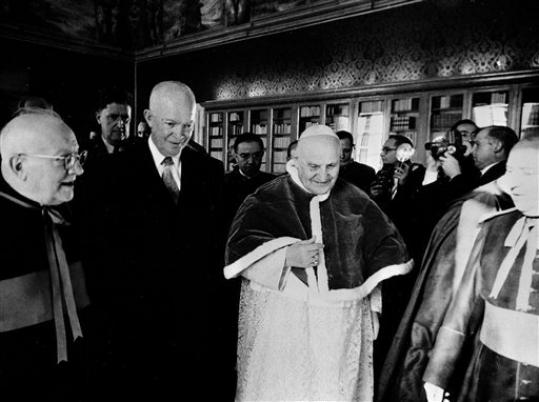
2. Dwight D. Eisenhower met John XXIII, the Vatican, December 6, 1959. Following a 40-year hiatus, this meeting would begin in earnest the precedent of every pope (except John Paul I) and every president meeting. While apparently very genial, this meeting also faced the challenge of Eisenhower not knowing Italian and John XXIII not knowing English.

3. John F. Kennedy met Paul VI, the Vatican, July 2, 1963. While Jacqueline Kennedy met John XXIII in a private audience, JFK missed him by a month, instead visiting the newly-elected Pope Paul. They reportedly discussed civil rights.

4. Lyndon Johnson met Paul VI, New York, October 4, 1965. This meeting took place in the historical context of the first visit by a pope to the United States. Paul VI would visit and address the United Nations while he was in town.

5. Lyndon Johnson met Paul VI, the Vatican, December 23, 1967. This was the first repeat encounter between a particular pope and president. Johnson's record will be matched by Nixon and shattered by the likes of Reagan, Clinton and George W. Bush. Pope Paul will go on to meet two more presidents.

6. Richard Nixon met Paul VI, the Vatican, March 2, 1969.

7. Richard Nixon met Paul VI, the Vatican, September 29, 1970.

8. Gerald Ford met Paul VI, the Vatican, June 3, 1975. Ford was the fourth and final U.S. president met by Pope Paul. John Paul II would meet five.

9. Jimmy Carter met John Paul II, the White House, October 6, 1979. Along with being the first of 15 meetings between Pope John Paul and a sitting president, this was the first time a pope visited the White House, which would go unrepeated until 2008.

10. Jimmy Carter met John Paul II, the Vatican, June 21, 1980.

11. Ronald Reagan met John Paul II, the Vatican, June 7, 1982.

12. Ronald Reagan met John Paul II, Fairbanks, Alaska, May 2, 1984. Pope John Paul was stopping to refuel on his way to Seoul. President Reagan was on his way back from China. While quick and in passing, this meeting still allowed the two to speak about the pressing issues of the time. It also followed shortly after the U.S. and the Holy See formally opened diplomatic relations.

13. Ronald Reagan met John Paul II, the Vatican, June 6, 1987.

14. Ronald Reagan met John Paul II, Miami, September 10, 1987.

15. George Bush met John Paul II, the Vatican, May 27, 1989.

16. George Bush met John Paul II, the Vatican, November 8, 1991.

17. Bill Clinton met John Paul II, Denver, August 12, 1993. Pope John Paul was in town for World Youth Day.

18. Bill Clinton met John Paul II, the Vatican, June 2, 1994.

19. Bill Clinton met John Paul II, Newark, October 4, 1995.

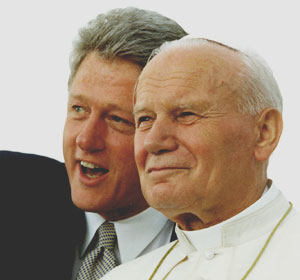
20. Bill Clinton met John Paul II, St. Louis, January 26, 1999. President Clinton met with the pope more times on American soil than any other president. Of course, one could argue a traveler like JPII made it easy for him.

21. George W. Bush met John Paul II, Castel Gandolfo, July 23, 2001. This is the first and only time a pope received a president at the papal summer residence in Italy.

22. George W. Bush met John Paul II, the Vatican, May 28, 2002.

23. George W. Bush met John Paul II, the Vatican, June 4, 2004. President Bush presented Pope John Paul with the Presidential Medal of Freedom.

24. George W. Bush met Benedict XVI, the Vatican, June 9, 2007. It's worth noting that Bush, along with former Presidents Bush and Clinton, also attended the funeral of Pope John Paul II in April of 2005, which was also attended by then-Cardinals Joseph Ratzinger and Jorge Mario Bergoglio, S.J., the future Pope Benedict XVI and Pope Francis, respectively.

25. George W. Bush met Benedict XVI, the White House, April 16 2008. Bush also greeted Pope Benedict upon his arrival at Andrews Airforce Base. The White House reception included a birthday celebration for the pope.

26. George W. Bush met Benedict XVI, the Vatican, June 13, 2008. Until next week's meeting, Bush holds the distinction of being the only sitting U.S. president to meet two popes. He has also met with the pope the more times than any sitting president, six.

27. Barack Obama met Benedict XVI, the Vatican, July 10, 2009. Obama held a roundtable discussion with religion writers at the White House in anticipation of the meeting. Benedict presented Obama with a gift of the Vatican's recent document on bioethics.

CNS Photo.

Hat tip to AP for the list of historic dates and places.

Friday, September 13, 2013

Six Months and an Eighth Commandment Pope

Six months ago today the Holy Spirit swooped down and showed us all what "doing your job" really looks like. Since that time, Pope Francis has taken the world by storm with gestures as big as a peace vigil in St. Peter's Square and as small as a compact car. He's preached to millions gathered on Copacabana Beach and to Vatican employees at daily Mass in the Domus Sanctae Marthae, the Vatican guesthouse where he lives.

The daily forum of the Domus Mass, recently restarted after a summer hiatus, has carried some especially vivid soundbites from Pope Francis. This morning he tackled gossip, calling it cowardice and saying it "kills the image of God" in other people.

This isn't the first time Pope Francis took on the damaging power of words. On June 13, he memorably noted, in reference to slander, that "the tongue can also kill." On April 15, he said calumny is more than mere sin and is, in fact, the work of Satan. And on March 27, a mere two weeks after his election, Pope Francis cautioned Christians against engaging in the "dark joy" of gossip.

It's probably safe to say that no one imagined the Eighth Commandment would get such a workout under the new pope. But here's Pope Francis, consistently sounding off throughout his short pontificate, warning of the dangers of a hierarchy of speech-driven sins:

1. Calumny -- deliberately lying about a person to destroy his or her reputation
2. Detraction -- saying something true about someone, but for the purpose of destroying his or her reputation
3. Gossip -- more petty trash talk about a person behind his or her back

Even the least of these, according to the pope, is at odds with the "Culture of Encounter" he seeks to promote, in which every person sees every other person they encounter as a human being, loved by God. If gossip "kills the image of God" in others, then we really are less inclined to encounter them as real human beings.

Stepping back against the backdrop of U.S. culture with voices on TV, radio, print and the Internet spouting endless accounts of the failures of other people, the vision and standard Pope Francis holds for society suddenly becomes jarring and daunting. Even more so the value that he suggests people use in place of trash talk: mercy.

With the election of Cardinal Bergoglio, someone predicted by almost none of the pundits and experts, the thought occurred: "Well, kudos to the Holy Spirit for pulling off the relatively mild trick of outsmarting cable news." With his call for an end to gossip, badmouthing and endless attacks on other people, it would seem the election of Pope Francis calls the cable news worldview into serious question in other ways too.

(CNS Photo/Paul Haring)

Tuesday, June 25, 2013

World Youth Day: Twenty Years Ago


By Sister Mary Ann Walsh

Twenty years ago this August Denver hosted World Youth Day, the first time the world event took place in the U.S. As WYD director of communications, I was on a core team from Washington with Father Dennis Schnurr, WYD executive director and now archbishop of Cincinnati, and Paul Henderson, WYD director of programming and now director of planning and communication operations at the USCCB. We’ve remained friends, with the kind of friendship borne of going to war together.

When I speak about WYD, I compare it to an elephant, one you gently prod to move where you’d like it to go, but knowing at any moment it could overpower you. If we knew how big WYD would become, we would have been afraid. With blissful ignorance, we set off for a fun adventure.

Though founded in Rome in 1985, WYD hadn’t quite caught on. The Vatican thought that holding the event in the USA would establish it. They counted on the immense media presence and U.S. ingenuity and organization. Their confidence was well placed.

As a reporter in Rome, I had traveled with Pope John Paul II. But sitting on a plane with him was a far cry from organizing media for an event to draw about 2,000 journalists and setting up a structure for TV and radio coverage. Early on, I took my concerns to Tim Russert, enthusiastic Catholic and host of NBC’s Meet the Press. With an analysis reflective of a man used to working within walls of power, he explained how to work with the media. “You own the pope, so you’re in charge,” he said.

Now if you want to be empowered, convince yourself you own the pope. When TV producers would balk at our plans, I would remain calm because, as Russert had assured me, I owned the pope. Russert also offered the help of veteran NBC special events producer Bob Asman, who had just organized the TV pool coverage of the Democratic National Convention in New York City. “We’ll call him the ‘secret missionary for God,’” Russert laughed. Asman so impressed the TV stations in Denver that had formed a consortium to deal with the largest event they’d ever known, that they hired him almost as soon as they met him.

When Catholic youth heard about WYD, they responded in force and surprised the bishops. Youth begged to go to the church event instead of church leaders begging them to go. Bishops who traveled with them found it life changing. It was a booster shot for the shepherds to be surrounded by energetic sheep. Their enthusiasm caught reporters up short. Media geared up for protests, but they never materialized. When one reporter asked a girl about her feelings on birth control and abortion, she told him teen-style, “Get a life!” The days were for prayer, not protest. The Washington Post reported the event was like Woodstock, with all of the good and none of the bad of the 1969 rock concert at a farm in the Catskills.

When I returned home, I had WYD on my mind. I must have overdone it because a friend told me one evening as we went down to Washington’s Union Station that all I talked about was World Youth Day. “I’m sure it was wonderful for you,” she said, “but let it go.” When we got to the station, a teenager bounded toward me across the Main Hall. “Hey, Sister Mary Ann,” he shouted. “Remember me? We met at World Youth Day. It was great.” My friend laughed, “Case closed,” she said, “I guess it was an event to last a lifetime.”


Wednesday, May 15, 2013

Today, a Social Teaching Triple Header

One of the pope's most prominent and important roles is to be a moral voice in the face of suffering and confusion in the world. That's the lesson the Church celebrates in triplicate today.

On May 15, three popes made major contributions to the development of Catholic social teaching: Pope Leo XIII with his landmark encyclical letter Rerum Novarum (1891), Pius XI with Quadragesimo Anno (1931) and John XXIII with Mater et Magistra (1961). The last two encyclicals honored the first on its 40th and 70th anniversaries, respectively.

So what did Leo XIII say that was so worth commemorating?

New Things

"It must not be supposed that the Church so concentrates her energies on caring for souls as to overlook things which pertain to mortal and earthly life," Pope Leo wrote in Rerum Novarum. In the wake of the Industrial Revolution, the world faced issues it hadn't faced before. Even the name of the encyclical translates "new things."

As some called for outright socialism while others insisted on an unrestrained laissez faire economy, Leo XIII applied the moral voice of the papacy and the timeless teachings of the Church to this upheaval. In doing so, he launched the modern era of Catholic social teaching, the hallmarks of which include:
  • The right of workers, which include fair wages, time off for religious and family life, safe working conditions and the ability to organize.
  • The duties of workers to perform their duties and refrain from vandalism and violence.
  • The rights and duties of property ownership.
  • The preferential option for the poor.
  • The common good.
Forty Years and What a Mess

When Pope Pius XI sat down to reflect on the 40th anniversary of Rerum Novarum, he did so against a backdrop of the worldwide economic turmoil of the Great Depression. And it shows: "Unbridled ambition for power has succeeded greed for gain; all economic life has become tragically hard, inexorable, and cruel."

In Quadragesimo Anno (literally "Forty Years"), Pius XI reaffirmed the earlier teaching on just wages, unions and the role of government (paragraph 71). He critiqued both unbridled capitalism and communism (paragraph 46). He also introduced the principle of subsidiarity (paragraph 79), which states that decisions affecting the common good of a society be made at the lowest possible but highest necessary level of authority. This means delegating to the grassroots level in some situations and action by national and international bodies in others.

Enter John

When John XXIII honored the 70th anniversary of Rerum Novarum, he didn't face the disaster of the Great Depression, but a spirit of optimism and a world feeling more confidently equipped to tackle challenges like global hunger and the development of nations.

As a result, in Mater et Magistra (literally "Mother and Teacher"), Pope John took the global view: "The solidarity which binds all people together as members of a common family makes it impossible for wealthy nations to look with indifference upon the hunger, misery and poverty of other nations whose citizens are unable to enjoy even elementary human rights. The nations of the world are becoming more and more dependent on one another and it will not be possible to preserve a lasting peace so long as glaring economic and social imbalances persist."

Down to Present Day

The development of the Church's social doctrine continued with John's Pacem in Terris (1963), issued 50 years ago in April. Subsequent popes have also carried it on in encyclicals including Paul VI's Populorum Progressio (1967) and John Paul II's Laborem Exercens and Centesimus Annus (for the 90th and 100th anniversaries of Rerum Novarum,  in 1981 and 1991, respectively). More recently, Benedict XVI's Caritas in Veritate (2009) responded to the financial crisis of 2008.

Pope Francis has already entered the narrative too, albeit in a considerably shorter length than an encyclical, a tweet on May 2 that read, "My thoughts turn to all who are unemployed, often as a result of a self-centered mindset bent on profit at any cost." However, with a name choice guided by a concern for the poor, peace and the environment, it would seem only a matter of time before he says more.

UPDATE: May 16

Well, that didn't take long.

Just this morning, Pope Francis addressed the world financial and economic crisis, telling an audience of diplomats that the source of these problems "is in our relationship with money and our acceptance of its power over ourselves and our society."


(CNS photos)

Tuesday, January 22, 2013

Bridging Unity and Love: the Pope and Other Christians

Easily the most significant issue dividing Catholics from other Christians is the role, and even the mere existence, of the pope. Even popes have weighed in on this. In 1967, Pope Paul VI acknowledged that the papacy was "the gravest obstacle in the path of ecumenism."

The tragedy here is that the papacy is a ministry of unity, not division. While most of the world looks at the pope and sees some kind of "supreme ruler," the actual papal job description, if you will, is more like the hub of a wheel that connects all the spokes, the point that brings everything together. This is why, in Catholicism, local dioceses and their bishops are said to be "in communion" with the bishop of Rome. Even the Latin name for the pope, Pontifex Maximus, means "chief bridge builder."

Which is why Pope John Paul II tackled the thorny question of the papacy and other Christians in his 1995 encyclical Ut Unum Sint (That They All May Be One). The challenges of this letter will be one focus of the next round of the Catholic-Reformed dialogue in the United States, beginning January 28.

What John Paul II said

Pope John Paul issued an invitation to other Christians to dialogue with him about the nature of his office. How could he exercise his authority as pope, he wanted to know, in a way that would promote unity among all Christians, not just Catholics?

To illustrate what he meant, the pope described the papacy in biblical and pastoral terms, as a ministry of love that helps the authentic voice of Christ to be heard. He added that the pope must have the authority necessary to carry out this role and ensure unity among Christians.

Other Christians respond

  • The Church of England responded in 1997, noting that their dialogue with Catholics had already agreed on the need for a universal primate at the center of the Church. Such a bishop, they said, would work in communion with the rest of the world's bishops and ensure that local or regional churches didn't strike out on their own or take positions abhorrent to the rest of the Church.
  • The Lutheran bishops of Sweden noted in their response that, despite the historically negative view of the papacy taken by Lutherans, progress was possible if the pope's ministry were clearly integrated into the college of bishops. Even Martin Luther, they said, wrote that the papacy would be acceptable if it were clearly subordinate to the Word of God and if an agreement could be reached on the question of justification (which happened in 1999).
  • The Presbyterian Church-USA welcomed the inviting spirit of John Paul II's encyclical, as well as the new language he used to describe his ministry. They expressed doubt over concepts like infallibility and entrusting a universal ministry to one person, but left room for an essentially spiritual ministry exercised by a person of "extraordinary spiritual insight and incandescent personhood."
  • Orthodox Christians have never officially responded to the encyclical, but in 2007, an international dialogue of Catholics and Orthodox approved the Ravenna Statement, which agreed the bishop of Rome held a place of honor among bishops in the ancient Church, and that he should also exercise some sort of primacy in the Church today. While much more dialogue between Catholics and Orthodox is required, this document is still a breakthrough.

The way forward

As Catholics and Reformed Christians meet this month to discuss this challenge from John Paul II, perhaps the best response from Catholics and other Christians is to take seriously the Week of Prayer for Christian Unity (January 18-25) and ask God to help the leaders and scholars gathered in dialogue to see old questions with new insight and move closer to each other as they move closer to Christ.

This post is adapted from "A Pope for All Christians?" a resource developed by the Committee for Ecumenical and Interreligious Affairs of the U.S. Conference of Catholic Bishops, which is available from USCCB Publishing.

Wednesday, November 21, 2012

The Council at 50: Training Seminarians for Post-Vatican II


Welcome to one of the series of blogs on the Second Vatican Council. Each piece reviews one of the 16 documents produced by the Council Fathers during the extraordinary occasion in Church history. Vatican II, which drew together the world’s bishops, opened fifty years ago in St. Peter’s Basilica, October 11, 1962.

(Photo courtesy of Catholic News Service)


Bishops voted for the changes urged by the Second Vatican Council, but it would be the clergy who would have to bear responsibility for their implementation in the parish communities. Thus, the Council’s “Decree on the Training of Priests,” Optatam Totius (Desired of the Whole), though one of the shorter documents of Vatican II, is arguably most significant.

Renewal of the seminary system proved vital, for the church needed priests prepared to guide greater participation of the laity in the Church’s mission. The decree laid down the basic principles for priestly formation which have guided the formation of priests since then. The watershed document of Pope John Paul II in 1992 on priestly formation, I will give you Shepherds, expanded on the decree and stressed the human formation necessary for priestly formation today. 

The decree called for bishops’ conferences to establish local seminary norms so priests could meet the pastoral requirements where they minister. The Pope and his assistants in Rome provided general regulations from which all local conferences of bishops established the local rules. In the United States, the Conference of Bishops promulgated the first Program of Priestly Formation in 1971. It has been revised four times since then and the Bishops’ Conference continues to review and revise the norms to insure top formation for priests.

The Council emphasized spiritual formation in seminary training so that seminarians would “learn to live in intimate and unceasing union with God the Father through his Son Jesus Christ, in the Holy Spirit,” the decree said. This requires faithful meditation on the Word of God and regular participation in the Mass, confession, the Liturgy of the Hours and devotions to the Blessed Virgin. Seminarians are to be taught to seek Christ “in the bishop by whom they are sent and in the people to whom they are sent, especially the poor, little children, the weak, sinners and unbelievers.”

The Council emphasized the primacy of Scripture in intellectual formation. The relationship between the Scriptures and the doctrines of the Church, a theme treated in the Council’s Dogmatic Constitution on Divine Revelation, finds expression here. “Students should receive a most careful training in holy Scripture, which should be the soul, as it were, of all theology,” the decree noted.

An emphasis on pastoral training reflected the Council’s overall concern for effective engagement with the world. Such training demands a willingness to listen to others and the capacity to open their hearts in a spirit of charity to the needs of other people. The decree noted that seminarians must learn the art of the exercising the apostolate not only in theory but in practice, with pastoral work as part of their studies. Given the rapid growth in the cultural diversity of the Church in the United States in recent decades, the current norms of the Program for Priestly Formation strongly encourage seminarians to develop language skills and intercultural competency to be more effective pastoral ministers.

Finally, what is implicit in the decree but made explicit in Pope John Paul II’s I Will Give You Shepherds, is the need for human formation. Blessed John Paul stated that future priests are to cultivate a series of human qualities, both for their own good, and also with a view to the priestly ministry. These qualities enable them to be balanced, capable of bearing the weight of pastoral responsibility and to have the requisite affective maturity to live and cherish the gift of celibacy. The seminarian’s capacity to relate to others as a “man of communion” is essential for the priesthood in our day.

---

Archbishop Paul S. Coakley of Oklahoma City is a consultant to the U.S. bishops’Committee on Clergy, Consecrated Life and Vocations.