Showing posts with label encyclical. Show all posts

Wednesday, June 17, 2015

'Laudato Si' Media Conference Live Stream

Archbishop Joseph E. Kurtz of Louisville, Kentucky, president of the U.S. Conference of Catholic Bishops, and Cardinal Donald W. Wuerl, archbishop of Washington, welcome Pope Francis' new encyclical "Laudato Si," Thursday, June 18, 8:30 a.m., at the National Press Club in Washington.


The event will also be streamed over Twitter via Periscope. Those on Twitter can watch by following the USCCB’s Twitter account. Shortly before the event begins, the Twitter.com/usccb will share a link via Periscope. Downloading the Periscope app via Apple and Android app stores will allow you to watch the app by following @USCCB there as well.

USCCB resources on the encyclical and environmental justice can be found at: www.usccb.org/environment

Friday, July 12, 2013

The Radical Vision of Jesus: How Pope Francis Lives His First Encyclical

By Bishop John Wester

One of the numerous surprising moments of Pope Francis' young pontificate was the announcement that on Holy Thursday, March 28, he would celebrate the Mass of the Lord's Supper at Rome's Casa Del Marmo Youth Detention Centre. There, in an unforgettable moment, he washed the feet of 12 young inmates. In anticipation of the pope's visit, one of them said, "At last I shall get to meet someone who says he is my father!"

This observation captures the power of the pope's gesture. "True power is service," Pope Francis said in his inaugural homily and later on Twitter. And the power of this particular act of service is that it cast a light where there was darkness, a light that allowed a young person the world had forgotten to experience a father's love for the first time.

In Pope Francis' first encyclical, Lumen Fidei (Light of Faith), published July 5, the pope says that faith is a light that comes directly from an encounter with God. "The light of faith is unique," the pope writes, "since it is capable of illuminating every aspect of human existence."

This includes the past and all the people who have walked the path of faith before us, but also the promises for the future that God makes and keeps because he is faithful. And of course it includes Jesus, the embodiment of God's fulfilled promises.

"Faith does not merely gaze at Jesus, but sees things as Jesus himself sees them, with his own eyes," Pope Francis writes. Christ's way of seeing the world "enables us to grasp reality's deepest meaning" and constantly guides us toward God. It is through this experience of Christ that our lives become "radically open to a love that precedes us, and love that transforms us from within, acting in us and through us in radical, often surprising ways."

It's not a stretch to think that Pope Francis washed the feet of the young inmates because he sees the world with the radical vision of Jesus, who sees that God loves these inmates as much as he love any other person. It also reflects the call of Jesus to serve those at the margins.

Like a light shining forth, faith makes a person go forth into the world. A person of faith must be ready "to come out of himself and find the God of perpetual surprises," Pope Francis writes. Even the Ten Commandments, he writes, aren't about rule keeping so much as "concrete directions for emerging from the desert of the selfish and self-enclosed ego in order to enter into dialogue with God, to be embraced by his mercy and then to bring that mercy to others."

Those who believe in the light of faith, he says, come to see themselves as members of a body, in an essential relationship with others. This relationship goes beyond powerful symbolic gestures like washing feet and applies the same love to big-picture issues like just economic systems, care for creation and forgiving one another. But little gestures are vital, because they allow the light of faith to spread, even reaching places it hasn't been for a long time or maybe has never been before.

Whether it's his Holy Thursday Mass in prison or the July 8 Mass for migrants on Lamedusa Island, how many people have responded to the gestures of Pope Francis with surprise, followed by an enthusiasm for faith and even an openness to Christ and his Church that wasn't there before? What a perfect example for the Church during the Year of Faith. The light of faith is powerful enough to help the whole world to see like Jesus.

Bishop Wester is bishop of the Diocese of Salt Lake City and chairman of the Communications Committee of the U.S. Conference of Catholic Bishops.

(CNS Photo/L'Osservatore Romano via Reuters)

Thursday, July 11, 2013

The Pope's Instructions for Building a City of Love

By Jill Rauh

Pope Francis, as pontifex maximus, is called to be a bridge builder. But his first encyclical, Lumen Fidei (Light of Faith) suggests he's a city planner too. Faith, the pope says, compels us to build a city that is rooted in relationship with God and one another.

Faith is not about a "completely private relationship" between the individual believer and God, he says. It is instead about "we" as a Church community called to be together in relationship with God, one another, and the world around us.

The Church celebrates the sacraments as a living community whose faith is communicated across generations of witnesses. At baptism, we become a member of this community, embracing a new way of living and acting. We celebrate the Eucharist together and encounter Christ's self-giving, which we strive to imitate. We recite the Creed as a united body, and then we go out to live God's commandments of love as set forth in the Sermon on the Mount (Mt. 5-7) -- in which Jesus calls the poor, meek and merciful blessed, and in which all are called to be salt and light to the world.

Pope Francis reminds us: faith doesn't "draw us away from the world or prove irrelevant to the concrete concerns" facing humanity. Rather, it calls us to follow the example of St. Francis of Assisi and Blessed Mother Teresa who drew near to those who suffer.

What does this mean for us during the Year of Faith, a year in which we are called to faith, worship and witness?

It means allowing the power of God's love to "penetrate to the core of our human experience." It means celebrating the sacraments -- and then living sacramentally by being people who are poor, merciful, seekers of peace and righteousness, and salt and light to the world. The USCCB Department of Justice, Peace and Human Development has new resources that can help us do so.

It means, again, being attentive to human suffering and responding in the model of St. Francis, Mother Teresa and so many other saints.

It means working to care for creation, and striving for development that prioritizes human dignity and care for creation above "utility and profit." It means ensuring that government serves the common good.

As Pope Francis says, the light of faith "does not simply brighten the interior of the Church, nor does it serve solely to build an eternal city in the hereafter." It challenges us to build societies now that reflect God's vision of justice. Let's begin now!

Rauh is assistant director of education and outreach for the Department of Justice, Peace and Human Development of the U.S. Conference of Catholic Bishops.

(CNS Photo/Paul Haring)

Wednesday, July 15, 2009

Anti-Catholicism Makes Cartoon of New Yorker

The New Yorker, the magazine of urbane Americans, proves once again that anti-Catholicism still lurks in U.S. society. This time it’s in an article by the playwright Paul Rudnick, who seems to get his kicks by bashing religion. It is bizarre that someone who uses his literary skills to decry prejudice and stereotyping of gays opts to indulge his own prejudice against another group, Catholics. Catholics in the United States have had to fight such ignorance for more than 200 years (It came over with the Pilgrims). Rudnick’s recent rap on Catholics comes in snide remarks about religious sisters in “Fun With Nuns,” in the July 20 issue of the New Yorker.

Apparently the editors, who even are heralding the essay on the New Yorker Web site, don’t find any problem with Rudnick’s gratuitous slam: “Nuns can be dictatorial, sexually repressed, and scary—and therefore entertaining.” Nor did they bother to edit out a remark about which nuns should be “f…able.” A comment on a discussion at Disney about “Catholic teaching on vows of silence, poverty, and chastity” suggests editors at the New Yorker ignore inaccuracy as well as prejudice and poor taste.

Historian Arthur Schlesinger Sr. once noted that anti-Catholicism "the deepest-held bias in the history of the American people." Anti-Catholicism also has been called the “anti-Semitism of the liberal.” It seems on the rise now, perhaps because when a society feels troubled, as U.S. society does in the throes of the current economic crisis, prejudices arise. Feeling out of control, people grasp for security but making their world small, creating a mental enclave where they shut out everything they do not like, or understand, and/or fear.

Last week, the USA Today Faith & Reason blog was rampant with anti-Catholic comments in response to Pope Benedict XVI’s ground-breaking encyclical on the economy “Caritas in Veritate” (“Charity in truth”). Because the blog has a “Report Abuse” button and a staffer who monitors comments for such things as obscenity, name-calling and hate speech, some of the initial offensive remarks are gone. Yet more than a week later, mindless souls hiding behind the blog’s anonymity can still be read asking if you spell pope with “one or two ‘o’s,” advising the pope to do something that’s unprintable here and ought to be unprintable in a family newspaper’s blog, remarking that “someone needs to give the pope his meds” and opining that “the pope is disgusting and sickening,” adding for good measure, “Catholic is DISGUSTING.” Even more slurs and canards to be found on the Website, including “I guess the Vatican is finally going public with its plot to control the world.”

Maybe it is because anonymity emboldens cowards that blog postings on religion evoke rabid rantings. USA Today might want to consider its responsibility in publishing such tripe on the Web, though it is to be commended for not carrying the remarks in newsprint. They wouldn’t go down well with orange juice, toast and coffee at most hotels.

At least USA Today can be blamed only for not keeping up with its obligation to watch what bloggers post. The New Yorker, on the other hand, despite its history of fine literary criticism, intentionally runs Rudnick’s comments and even boasts of them on its Web site. It’s neither wise nor witty and makes the New Yorker a cartoon of a magazine.

Thursday, July 9, 2009

El nombre lo dice todo

The following is a Spanish version of the earlier post, "What's in a Name?"

Caritas in veritate, la caridad en la verdad, son las palabras que dan comienzo y nombre a la nueva encíclica social de Benedicto XVI. El título en sí recoge ya el mensaje central de la carta, dejando que el resto del texto lo desarrolle como los hilos de una madeja que se va desenrollando o piezas de un rompecabezas del cual ya tenemos una foto completa en la cubierta de la caja.

El nombre lo dice todo. Sin la verdad, la caridad, también traducida como amor, no tiene significado ni propósito, se convierte en mero sentimentalismo, “un envoltorio vacío que se rellena arbitrariamente” (3), dice el papa. “La caridad es el don más grande que Dios ha dado a los hombres, es su promesa y nuestra esperanza” (2). A menos que entendamos que el hombre, creado a imagen y semejanza de Dios, ha sido hecho para dar y recibir amor no podremos entender que la solidaridad es más que una opción personal y que cuidar de la creación es más que un estilo de vida.

Pero ¿por qué “en la verdad? Y ¿qué verdad? En el modo relativista de pensar actual parecen no haber cabida para verdades absolutas, ni parámetros de pensamiento y acción válidos para todos. Mi verdad no es tu verdad. Y así, la afirmación “la caridad en la verdad” no parece tener mucho sentido en un mundo desprovisto de significado último y verdades transcendentes.

Como voz que clama en el desierto, el papa Benedicto continúa predicando el evangelio de la verdad y sostiene que sí existe una Verdad última de la cual se derivan todas las demás verdades. Sí, existen cosas que dañan y destruyen a la humanidad y existen otras que la elevan y la llevan a alcanzar su pleno potencial. Sí, existen principios y valores universales que pueden ser percibidos por la razón y la fe y que deben guiar todos nuestros actos.

Sólo si aceptamos la verdad de la dignidad del hombre y la mujer, que éstos están hechos para el amor y la comunión, y que esta verdad se antepone a cualquier otra, tendrán sentido la búsqueda de la justicia y del bien común. Sólo entonces seremos capaces de ver que cualquier cosa que viole la dignidad de una vida humana, que le impida alcanzar todo su potencial o la transforme en capital dispensable, es una “injusticia” que reclama la restauración de la justicia, y que todos tenemos una responsabilidad en ello.

Wednesday, July 8, 2009

The Pope's Press and "Caritas in Veritate"

Along with the great reading that the pope's new social encyclical provides on its own, the release of Caritas in Veritate has also provided some fascinating reading in the media. This is a little surprising, as the frenetic pace of the 24-hour news cycle and the slow and steady, deep-thinking approach of the Catholic Church -- and particularly a document like an encyclical -- often don't mix well.

This clash has been evident this year in various Vatican media meltdowns, from the controversey surrounding the de-excommunication of the SSPX bishops, to the outrcry following Pope Benedict's comments on condoms and AIDS in Africa, to the unimpressed Israeli reactions to his speech at the Yad Vashem Holocaust Memorial.

So it's almost puzzling to see this encyclical arrive and see the pope getting exceptionally good press. Even more striking is that some of media outlets seem to be curling up with the encyclical and taking the time to mine some of its deeper meaning and nuances.

For instance, an article in the New York Times opens by saying the pope is calling for "radical rethinking of the world economy" that urges the creation of a world political authority to oversee the economy and work for the common good.

Radical? Creating something new? These aren't the usual words that get tossed about when the media discusses the words and thoughts of Benedict XVI.

Like a lot of other coverage of the encyclical, the article goes on to look at Benedict's call for a new, ethical way of managing business and the economy, which in the light of the economic crisis makes his teaching incredibly timely and just the voice of moral authority needed right now.

Not only does the New York Times article seem to acknowledge this, it also makes an effort to distinguish some of the finer points of Benedict's teaching, noting, as other outlets have, that "the Vatican does not comfortably fit into traditional political categories of right and left."

“There are paragraphs that sound like Ayn Rand, next to paragraphs that sound like ‘The Grapes of Wrath.’ That’s quite intentional,” the article quotes one theologian.

The article also makes note, as other media have, of the pope's call for a strengthened UN and a global economic oversight with "real teeth." Perhaps this suggestion is getting so much attention because, frankly, no one has made a suggestion on such a sweeping scale in the wake of the economic crisis -- and then for the person who suggests it to be the pope! Wild.

The article wraps up by touching on Benedict's call for better care of the environment, calling him "arguably the most environmentally conscious pope in history." The New York Times may see this as cutting edge for a pope, but the reality probably has more to do with the strength of Benedict's mind and his ability to synthesize seemingly disparate issues into a consistent ethic.

The media coverage of Caritas in Veritate goes from good to great when it's viewed through the lens of coinciding with the G8 Summit in Italy (and the pope's subsequent meeting with President Obama). Now the encyclical has a new audience -- not only is it addressed to the world's bishops, priests and people of good will, it's addressed to the world's leaders, who are convening to discuss these very issues. What timing!

Not that it's something new to see Pope Benedict going over well in the media. This is the pope who wowed everyone during his April 2008 visit to the U.S., with his solemn visit to Ground Zero and emotional meeting with survivors of clergy sexual abuse. But the first half of 2009, with the crises listed above, was something of a PR slump for the Holy Father.

That downward trend could be ending with Caritas in Veritate, as the pope deftly addresses the world with teachings that engage the problems at hand and leave some of his audience stunned by how "with it" this pope can be.

Why the Italics?

May be a little tea-leaves reading here, but I’m musing on why Pope Benedict XVI chose to highlight some parts of his encyclical in italics. Caritas in Veritate has 30,468 words. They’re all important, but the pope signals some phrases for special thought. Below are key italicized sections. Any one of them could be a theme for an address; all seem worth pondering.

… two important truths. The first is that the whole Church, in all her being and acting — when she proclaims, when she celebrates, when she performs works of charity — is engaged in promoting integral human development…. The second truth is that authentic human development concerns the whole of the person in every single dimension. (11)

Testimony to Christ's charity, through works of justice, peace and development, is part and parcel of evangelization, because Jesus Christ, who loves us, is concerned with the whole person. (15)

Integral human development presupposes the responsible freedom of the individual and of peoples: no structure can guarantee this development over and above human responsibility. (18)

The (economic) crisis thus becomes an opportunity for discernment, in which to shape a new vision for the future. (21)

The world's wealth is growing in absolute terms, but inequalities are on the increase. (22)

Yet it should be stressed that progress of a merely economic and technological kind is insufficient ... (23)

... the primary capital to be safeguarded and valued is man, the human person in his or her integrity. (25)

It is therefore necessary to cultivate a public conscience that considers food and access to water as universal rights of all human beings, without distinction or discrimination. (27)

Openness to life is at the centre of true development. (28)

Human costs always include economic costs and economic dysfunctions always involve human costs. (32)

Without internal forms of solidarity and mutual trust, the market cannot completely fulfil its proper economic function. (35)

Today's international economic scene, marked by grave deviations and failures, requires a profoundly new way of understanding business enterprise. (40)

business management cannot concern itself only with the interests of the proprietors, but must also assume responsibility for all the other stakeholders who contribute to the life of the business: the workers, the clients, the suppliers of various elements of production, the community of reference. (40)

In this way it will be possible to experience and to steer the globalization of humanity in relational terms, in terms of communion and the sharing of goods. (42)

The sharing of reciprocal duties is a more powerful incentive to action than the mere assertion of rights. (43)

Morally responsible openness to life represents a rich social and economic resource. (44)

States are called to enact policies promoting the centrality and the integrity of the family (44)

… there is a pressing moral need for renewed solidarity, especially in relationships between developing countries and those that are highly industrialized. (49)

The way humanity treats the environment influences the way it treats itself, and vice versa. (51)

The Church has a responsibility towards creation and she must assert this responsibility in the public sphere. (51)

when “human ecology” is respected within society, environmental ecology also benefits. (51)

In order to protect nature, it is not enough to intervene with economic incentives or deterrents; not even an apposite education is sufficient. These are important steps, but the decisive issue is the overall moral tenor of society. (51)

The development of peoples depends, above all, on recognition that the human race is a single family working together in true communion, not simply a group of subjects who happen to live side by side. (53)

Reason always stands in need of being purified by faith: this also holds true for political reason, which must not consider itself omnipotent… For its part, religion always needs to be purified by reason in order to show its authentically human face. (56)

the governance of globalization must be marked by subsidiarity (57)

The principle of subsidiarity must remain closely linked to the principle of solidarity and vice versa, since the former without the latter gives way to social privatism, while the latter without the former gives way to paternalist social assistance that is demeaning to those in need. (58)

Cooperation for development must not be concerned exclusively with the economic dimension: it offers a wonderful opportunity for encounter between cultures and peoples. (59)

In the search for solutions to the current economic crisis, development aid for poor countries must be considered a valid means of creating wealth for all. (60)

In the face of the unrelenting growth of global interdependence, there is a strongly felt need, even in the midst of a global recession, for a reform of the United Nations Organization, and likewise of economic institutions and international finance, so that the concept of the family of nations can acquire real teeth. One also senses the urgent need to find innovative ways of implementing the principle of the responsibility to protect and of giving poorer nations an effective voice in shared decision-making. This seems necessary in order to arrive at a political, juridical and economic order which can increase and give direction to international cooperation for the development of all peoples in solidarity. To manage the global economy; to revive economies hit by the crisis; to avoid any deterioration of the present crisis and the greater imbalances that would result; to bring about integral and timely disarmament, food security and peace; to guarantee the protection of the environment and to regulate migration: for all this, there is urgent need of a true world political authority, as my predecessor Blessed John XXIII indicated some years ago. (67)

A person's development is compromised, if he claims to be solely responsible for producing what he becomes. (68)

Technology, in this sense, is a response to God's command to till and to keep the land (cf. Gen 2:15) that he has entrusted to humanity, and it must serve to reinforce the covenant between human beings and the environment, a covenant that should mirror God's creative love. (69)

But human freedom is authentic only when it responds to the fascination of technology with decisions that are the fruit of moral responsibility. (70)

Development is impossible without upright men and women, without financiers and politicians whose consciences are finely attuned to the requirements of the common good. (71)

Entranced by an exclusive reliance on technology, reason without faith is doomed to flounder in an illusion of its own omnipotence. Faith without reason risks being cut off from everyday life. (74)

The question of development is closely bound up with our understanding of the human soul, insofar as we often reduce the self to the psyche and confuse the soul's health with emotional well-being. (76)

There cannot be holistic development and universal common good unless people's spiritual and moral welfare is taken into account, considered in their totality as body and soul. (76)

God's love calls us to move beyond the limited and the ephemeral, it gives us the courage to continue seeking and working for the benefit of all, even if this cannot be achieved immediately and if what we are able to achieve, alongside political authorities and those working in the field of economics, is always less than we might wish. (78)

Development needs Christians with their arms raised towards God in prayer Christians moved by the knowledge that truth-filed love, caritas in veritate, from which authentic development proceeds, is not produced by us, but given to us. (79)

Thursday, July 2, 2009

New Encyclical -- Anybody Got a Copy?

Pope Benedict XVI’s new encyclical, “Caritas in veritate,” is due out July 7, but has been leaking out in Roman newspapers for several days now. Alas, it has not splashed across the pond and here in the United States we’re left making educated guesses about its contents.

We’re not even sure of its English-language title since Latinates can translate it either as “Charity in truth” or “Love in truth.” Vatican Radio on June 29 used the former, so my money’s on that translation. It is said that every translator is a traitor and no one wants to be the traitor with what may be a key encyclical of Pope Benedict XVI’s papacy.

Encyclical titles are tricky because their names come from the first few words of the text. Sometimes that works well in translation. Pope John XXIII’s Pacem in Terris (Peace on Earth) in 1963, revealed its content in its title. Pope Pius XI’s Quadregesimo Anno, issued in 1931 to mark the 40th anniversary of the much acclaimed Rerum Novarum, 1891, from Pope Leo XIII, is about reconstructing the social order. People don’t remember it as easily. Its title doesn’t help.
John Carr, director of the U.S. bishops’ Department of Justice, Peace and Human Development, made some attempts to figure out what’s coming in the encyclical. Media Relations asked him to do so to help us handle inquiries from reporters who want to get a start on their work before the July 4th weekend. His essay is on the USCCB Media Relations page.

As we get ready for the weekend many of us wish we had a preview copy. We’d even read it at the beach. Carr made his educated guesses after reading comments the pope himself has made on the coming encyclical as well other allusions from Pope Benedict to the current economic crisis. Social encyclicals usually build on previous ones and since “Caritas in Veritate” was said to originally be intended to mark the 40th anniversary of Populorum progressio, Pope Paul VI’s encyclical on the Development of Peoples, issued in 1967, a look at that encyclical offers signposts for this next one.

The environment was an issue for John Paul II and the issue has become even more urgent, so Carr suggests environmental issues will be important. After all, Benedict, who called for installation of solar panels at the Vatican, is the first “green pope.”

No surprise in the expectation that the pope will highlight the needs of poor people. What other world leader can speak for the majority of people who have only a minority of the resources? Pope Benedict is in a position where he can say that those having the largest share of the money are not automatically entitled to the largest share of the earth’s resources. We’re a world family, and in a healthy family, need determines who gets what.

Anybody with a bootlegged copy of the encyclical, send it my way.

When a Pope Meets a President

President Barack Obama's upcoming meeting with Pope Benedict XVI on July 10 at the Vatican marks the 27th time in history a sitting U.S. President has met with a pope. The meetings, which will now include 12 presidents and 5 popes, are replete with historical odds and ends. So we've done our best to generate a complete list below:

1. Woodrow Wilson meets Benedict XV, the Vatican, January 4, 1919. Meeting just after the end of World War I, President Wilson had pushed for a lasting peace via his failed League of Nations, and Pope Benedict had been a powerful advocate for peace throughout the war. Perhaps it's fitting that these two would meet and that their meeting would be the historic first ever of its kind.

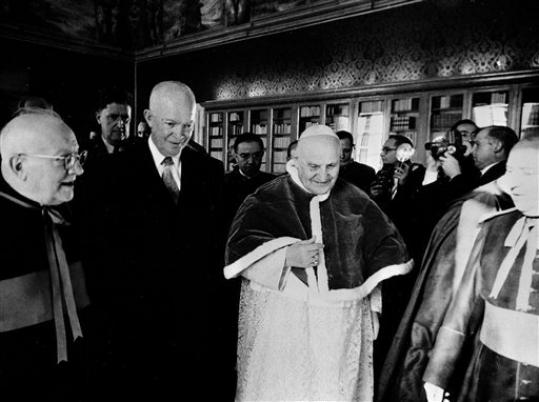
2. Dwight D. Eisenhower meets John XXIII, the Vatican, December 6, 1959. Following a 40-year hiatus, this meeting would begin in earnest the precedent of every pope and every president meeting. While apparently very genial, this meeting also faced the challenge of Eisenhower not knowing Italian and John XXIII not knowing English.

3. John F. Kennedy meets Paul VI, the Vatican, July 2, 1963. While Jacqueline Kennedy met John XXIII in a private audience, President Kennedy missed him by a month, instead visiting the newly-elected Pope Paul. The reportedly discussed civil rights.

4. Lyndon Johnson meets Paul VI, New York, October 4, 1965. This meeting took place in the historical context of the first visit by a pope to the United States. Paul VI would visit and address the United Nations while he was in town.

5. Lyndon Johnson meets Paul VI, the Vatican, December 23, 1967. This was the first repeat encounter between a particular pope and president. Johnson's record will be matched by Nixon and shattered by the likes of Reagan and Clinton. Pope Paul will go on to meet two more presidents.

6. Richard Nixon meets Paul VI, the Vatican, March 2, 1969.

7. Richard Nixon meets Paul VI, the Vatican, September 29, 1970.

8. Gerald Ford meets Paul VI, the Vatican, June 3, 1975. President Ford was the fourth and final president met by Pope Paul. John Paul II would meet five.

9. Jimmy Carter meets John Paul II, the White House, October 6, 1979. Along with being the first of 15 meetings between Pope John Paul and a sitting president, this was the first time any pope came to the White House, an event that would go unrepeated until 2008.

10. Jimmy Carter meets John Paul II, the Vatican, June 21, 1980.

11. Ronald Reagan meets John Paul II, the Vatican, June 7, 1982.

12. Ronald Reagan meets John Paul II, Fairbanks, Alaska, May 2, 1984. Pope John Paul was stopping to refuel on his way to Seoul. President Reagan was on his way back from China. While quick and in passing, this meeting still allowed the two to speak about the pressing issues of the time. It also followed shortly after the U.S. and the Holy See formally opened diplomatic relations.

13. Ronald Reagan meets John Paul II, the Vatican, June 6, 1987.

14. Ronald Reagan meets John Paul II, Miama, September 10, 1987.

15. George Bush meets John Paul II, the Vatican, May 27, 1989.

16. George Bush meets John Paul II, the Vatican, November 8, 1991.

17. Bill Clinton meets John Paul II, Denver, August 12, 1993. Pope John Paul was in town for World Youth Day.

18. Bill Clinton meets John Paul II, the Vatican, June 2, 1994.

19. Bill Clinton meets John Paul II, Newark, October 4, 1995.

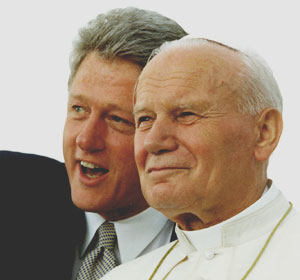
20. Bill Clinton meets John Paul II, St. Louis, January 26, 1999. President Clinton met with the pope more times on American soil than any other president. Of course, one could argue a traveler like JPII made it easy for him.

21. George W. Bush meets John Paul II, Castel Gandolfo, July 23, 2001. This is the first and only time a pope received a president at the papal summer residence in Italy.

22. George W. Bush meets John Paul II, the Vatican, May 28, 2002.

23. George W. Bush meets John Paul II, the Vatican, June 4, 2004. President Bush presented Pope John Paul with the Presidential Medal of Freedom.

24. George W. Bush meets Benedict XVI, the Vatican, June 9, 2007. It's worth noting that President Bush, along with former Presidents Bush and Clinton, also attended the funeral of Pope John Paul II in April of 2005.

25. George W. Bush meets Benedict XVI, the White House, April 16 2008. President Bush also greeted Pope Benedict upon his arrival at Andrews Airforce Base. The White House reception also included a birthday celebration for the pope.

26. George W. Bush meets Benedict XVI, the Vatican, June 13, 2008. President Bush holds the distinction of being the only sitting U.S. president to meet two popes. He has also met with the pope the more times than any sitting president, six.

27. Barack Obama will meet Benedict XVI, the Vatican, July 10, 2009. Coming on the heels of the G8 Summit and the pope's new encyclical, one could expect global economic issues to be a topic of discussion. President Obama held a roundtable discussion with religion writers at the White House in anticipation of the meeting. Check Catholic News Service for updates as the meeting unfolds.

Hat tip to AP for the list of historic dates and places.

Tuesday, June 30, 2009

Social Encyclical Primer

Since it looks like Pope Benedict's long-awaited social encyclical, Caritas in Veritate, will be appearing any day now (he reportedly signed it Monday), it's probably a good time to take a look at the history of Catholic social teaching, specifically as it has been expressed through papal encyclicals.

Here are the highlights:

Rerum Novarum (Of New Things) 1891, Pope Leo XIII -- essentially the Big Bang of Catholic social teaching, truly groundbreaking, and the standard that popes have looked back to ever since (see below). This encyclical tackles the turmoil surrounding labororers in the wake of the Industrial Revolution, touching on issues including socialism, unbridled capitalism, a living wage, the relationship between laborer and employer, and the relationship between classes. Pope Leo also makes a first mention of the preferential option for the poor.

Quadragesimo Anno (After Forty Years) 1931, Pope Pius XI -- following Rerum Novarum by exactly 40 years, this encyclical offers an update on the state of labor and industrialization, also offering strong critiques of communism, unrestrained capitalism and classism.

Mater et Magistra (Mother and Teacher) 1961, Pope John XXIII -- issued 70 years after Rerum Novarum, this encyclical looks to the Church as the "Mother and Teacher," calling the world to salvation and better social relationships with one another. It looks at science and technology, noting both their power to improve the human condition, but also to limit human freedoms, calling on governments to safeguard against this and ensure human rights. The encyclical calls on wealthier nations to help poorer ones. It also criticizes ideologies (not specifically naming communism) that promise to create a paradise in this world, while disregarding religion.

Pacem in Terris (Peace on Earth) 1963, Pope John XXIII -- issued only two months before the pope's death, this encyclical is the first ever to be directed to "all men of good will," instead of just the world's Catholics. In a response to the Cold War, the encyclical outlines necessary conditions for a lasting world peace, looking at the rights of individuals, the relationships between individuals and states, the relationships between states, and the relationship between leaders and the whole world.

Populorum Progressio (On the Development of Peoples) 1967, Pope Paul VI -- this encyclical, which Benedict's new encyclical is believed to echo, looks at the economy on a global level and addresses the rights of workers to unionize and to have secure employment, decent working conditions.

Laborem Exercens (On Human Work) 1981, Pope John Paul II -- issued in honor of the 90th anniversary of Rerum Novarum, this encyclical once again looks at the rights and dignity of workers, with emphases including disabled workers, emigration, materialism, and the spirituality of work.

Sollicitudo Rei Socialis (On Social Concern) 1987, Pope John Paul II -- this encyclical honored Populorum Progressio on its 20th anniversary, offering a then-contemporary reading of the challenges first addressed in the earlier encyclical.

Centesimus Annus (The Hundredth Year) 1991, Pope John Paul II -- on the 100th anniversary of Rerum Novarum, John Paul II reflected on the current state of issues that Leo XIII had assessed in his day. Leo XIII had issued warnings about socialism before it had developed into a movement. John Paul II wrote in the immediate wake of the fall of communism.

Evangelium Vitae (The Gospel of Life) 1995, Pope John Paul II -- an affirmation of the gift of human life and the need to protect it, this encyclical dealt with widespread abortion, the threat of euthanasia and renewed use of the death penalty.

Deus Caritas Est (God is Love) 2005, Pope Benedict XVI -- Benedict's first encyclical, that could have been an abstract or scholarly treatise, instead dug deep into the concept of love and cited the connections between love of God and love of neighbor. Pope Benedict said the Church could no more neglect charity than it could Scripture or the sacraments and even called charity a manifestation of Trinitarian love.

Caritas In Veritate (Charity in Truth) 2009, Pope Benedict XVI -- anticipated since 2007, this encyclical is believed to follow up on the themes of Populorum Progressio. Dealing with the ethics of contemporary economics, it's reasonable to think that the global economic crisis will weigh in heavily on what the pope has to say.