Showing posts with label Second Vatican Council. Show all posts

Thursday, April 30, 2015

Walking With Others: the Nostra Aetate Conference at CUA

By Father John Crossin

The Second Vatican Council’s document on interreligious relations—Nostra Aetate—was one of the last of the Council's documents to appear, one of the shortest, and one with incredible impact. The May 19-21 Symposium at The Catholic University of America will explore the past, present and future of interreligious dialogue.

Three distinguished Cardinals, two from Rome and one from New York, will keynote the Symposium. Cardinals Tauran, Dolan and Koch provide leadership in Catholic relationships with the Muslim and Jewish communities-- among others.

I believe that this is the kind of Symposium where one can gain a lifetime of learning from the distinguished speakers. And one can gain lots of practical knowledge by speaking to people at lunch or in the corridor or over a cup of coffee [all food will be kosher--halal].

There will be an initial offering on dialogue for the person who feels he or she knows nothing. But the key will be that the presenters—both scholars and church leaders—have the experience that allows them to summarize effortlessly, illustrate aptly, and project the future realistically.

In a time when interreligious relations appear in daily headlines in all media, this Symposium will offer constructive paths for the future. In 1965, Nostra Aetate offered a positive challenge to walk together, to leave prejudices and misperceptions behind, and to build real understandings of others.

In 2015, this challenge is even more relevant. We are still seeking a world in which collaboration, not conflict, is the norm.  With Pope Francis, we believe that if we walk together sharing our lives and listening intently to one another, we can come to the deeper understanding that makes for peace.

Father John Crossin is an Oblate of St. Francis De Sales and executive director of the Secretariat for Ecumenical and Interreligious Affairs of the U.S. Conference of Catholic Bishops.

Sunday, November 16, 2014

For Christian Unity to Occur, We Have to Convert (Seriously)

By Father John Crossin, OSFS

Before the Second Vatican Council, the Catholic Church had a simple solution to the challenge of achieving Christian unity: all the other Christians could convert.

The Second Vatican Council offered a new pastoral lens for approaching this issue. It is through this lens that the Council's Decree on Ecumenism (Unitatis Redintegratio) -- or the Restoration of Unity -- should be viewed. The decree calls for positive relationships with Christians outside the Catholic Church, and it calls for inward reflection and renewal of our Catholic tradition.

In other words, Catholics are also called to conversion.

This is because, in order to effectively mission to those outside our tradition, there had to be internal examination of our broken relationships with other Christians. For a long stretch of history, Christians of differing denominations ignored or were hostile to each other. The communication, cooperation, and collaboration that has been a hallmark of the ecumenical movement hardly existed in years leading up to the Council. The decree puts in stark terms why that had to change, namely that Christian disunity "openly contradicts the will of Christ, scandalizes the world, and damages the holy cause of preaching the Gospel to every creature."

The decree doesn't pretend that this self reflection necessary for inward renewal will be easy. But it makes clear that this is a prerequisite for entering into ecumenical relationship and is also a "duty"-- "to make a careful and honest appraisal of whatever need to be done or renewed in the Catholic household itself, in order that its life may bear witness more clearly and faithfully to the teachings and institutions which have come to it from Christ through the Apostles."

This means ecumenism is not just for the intellectual elite and clergy of Catholic institutions. The Council demands that every Catholic "recognize the signs of the times and to take an active and intelligent part in the work of ecumenism."

Of course, healing wounds and divisions that have been in place for centuries is a daunting task. That's why, thankfully, it's not ultimately up to us, but to the Holy Spirit. The Holy Spirit plays a key role in every step of the ecumenical process. Recognition of the movement of the Holy Spirit in other Christian traditions is how the Catholic Church was ever able to get to a place where it could engage other Christians “with love for the truth, with charity, and with humility." The Council fathers wrote that “anything wrought by the grace of the Holy Spirit in the hearts of our separated brethren can be a help to our own edification. Whatever is truly Christian is never contrary to what is genuinely belongs to  the faith; indeed, it can always bring a deeper realization of the mystery of Christ and the Church."

Echoing the Council, Pope Francis says unity is a gift we need to ask for, and the Holy Spirit accompanies us on the path toward unity and continual conversion.

"Unity will not come about as a miracle at the very end. Rather, unity comes about in journeying; the Holy Spirit does this on the journey," Pope Francis said in January. "If we do not walk together, if we do not pray for one another, if we do not collaborate in the many ways that we can in this world for the People of God, then unity will not come about! But it will happen on this journey, in each step we take. And it is not we who are doing this, but rather the Holy Spirit, who sees our good will."

Father John Crossin, OSFS is executive director of the Secretariat of Ecumenical and Interreligious Affairs for the U.S. Conference of Catholic Bishops. He is a consultor to the Pontifical Council for Promoting Christian Unity. He tweets @crossinusccb.

Friday, November 14, 2014

Fifty Years of Dialogue, as Told by a Lutheran

By Rev. Donald J. McCoid

When I entered seminary in 1965, it became very evident that the Second Vatican Council was influencing theology, liturgy, and ecumenism for Catholics and for other Christians. What was changing was a new way to renewal in the church and an intentional opportunity to build relationships among Christians. With the establishment of the Pontifical Council for Promoting Christian Unity, there was a clear signal to other Christian communities that ecumenical conversations, dialogues, and relationships would be the direction for the future.

Through serious bilateral dialogues, much has been learned and much has been realized in the last 50 years. In Lutheran-Catholic dialogues in this country and with the Lutheran World Federation-Vatican dialogue, we have mutual faith agreements as a result of Vatican II. We are talking with one another, learning from one another and affirming that we hold much in common.

The bilateral dialogues have addressed subjects that would not have been touched before Vatican II. Common statements in the U.S. dialogues were developed and were widely distributed and embraced. They included: Scripture and Tradition; The Condemnations of the Reformation Era – Do They Still Divide?; The Status of the Nicene Creed as Dogma of the Church; One Baptism for the Remission of Sins; The Eucharist as Sacrifice; The One Mediator, the Saints and Mary; Teaching Authority, and the Joint Declaration on the Doctrine of Justification. This is a joint declaration on how we are forgiven and how we are saved. We are no longer saying to one another that one of us is going to hell … at least automatically because of our church affiliation.

As Catholics saw changes in church life and liturgy, so did Lutherans. As I grew up, it was the practice of most Lutheran congregations to celebrate Holy Communion only five or six times a year. There was a movement in the early sixties to increase this frequency to once a month and festivals. With a renewed understanding of the centrality of Word and Sacrament, the frequency has moved to the weekly celebration of Communion in most congregations. Along with this centrality around the Eucharist, liturgical renewal has also unfolded. The Prayer of Thanksgiving rather than the Words of Institution became the widespread practice. The use of Eucharistic vestments, musical settings, and increased lay involvement in the liturgy have been welcomed changes.

Vatican II most certainly influenced Lutheran churches in practices and in relationships with other Christians. Through dialogues, the Evangelical Lutheran Church in America (ELCA) has had 50 years of dialogues with Catholics, Orthodox and other Christians. We have full communion agreements with six Christian Churches (Episcopal, Moravian, Presbyterian, United Church of Christ, Reformed Church in America and the United Methodist Church). Vatican II opened the way to dialogues and relationships.

As members of the ELCA remember Vatican II, we remember what happened in the hearts and minds of Christians. There was a change in attitude, spirit, and cooperation that was born out of Vatican II’s commitment and call for unity and understanding. It was a change that was a gift of the Holy Spirit to Christ’s family, and the fruits continue to blossom.

Rev. Donald J. McCoid is director for Ecumenical and Inter-Religious Relations of the Evangelical Lutheran Church in America. This post is part of a series commemorating the 50th anniversary of Unitatis Redintegratio, the Decree on Ecumenism of the Second Vatican Council.

CNS Photo/L'Osservatore Romano via Reuters -- Pope Francis greets a delegation from the Lutheran World Federation at the Vatican in October 2013.

Friday, October 17, 2014

Something Nice for Paul VI

On October 19, at the close of the Extraordinary Synod of Bishops on the Family in Rome, Pope Francis will beatify Pope Paul VI (1963-78), who oversaw most of the Second Vatican Council and its implementation.

To commemorate this milestone, this blog is featuring posts on Pope Paul -- honoring his legacy by reflecting on his individual and lasting contributions to the life of the Church. These posts are authored by bishops and lay Catholics:
and a bonus...

Note to diocesan editors and webmasters: These commentaries are free for your reprinting and posting. Please note the source as this blog, linking back where possible.

(CNS Photo/Giancarlo Giuliani)

Friday, October 10, 2014

Paul VI and Dialogue -- We Wouldn't Be Here Without Him

By Bishop Denis Madden

When Pope Paul VI, who will be beatified October 19, inherited the Second Vatican Council from John XXIII in 1963, his challenges included fulfilling the late pope’s wishes to “open a window” in the Church and to reach out to “our separated brethren.” Pope Paul’s approach to both of these was to introduce the concept of dialogue.

The Church hasn’t been the same since.

John O’Malley recounts in his book “What Happened at Vatican II” that the Council’s early draft on ecumenism didn’t use the word dialogue once. Then Pope Paul issued his first encyclical, Ecclesiam Suam (On the Church) on August 6, 1964. In it, he repeatedly stressed the importance of dialogue, stating, “The Church must enter into dialogue with the world in which it lives. It has something to say, a message to give, a communication to make.” The Council championed dialogue from then on.

November 1964 saw the Council’s Decree on Ecumenism (Unitatis Redintegratio), which called on “all the Catholic faithful to recognize the signs of the times and to take an active and intelligent part in the work of ecumenism,” that is, dialoguing with, praying together and simply building friendships with non-Catholic Christians.

In October 1965, the Council took dialogue beyond other Christians and applied it to the world’s religions with Nostra Aetate, a brief but groundbreaking document that swept away centuries of erroneous negative teaching about the Jewish people and held up examples, essentially starting points for dialogue, where the Catholic Church saw positive elements of Hinduism, Buddhism and Islam. The document noted that all religions seek answers to the big questions: What is the meaning of life? Why do people suffer? What is the road to true happiness? All of these call for dialogue.

Pope Paul put the call for dialogue with the world into action through his apostolic journeys to places including India, Portugal, the United States, Colombia, Turkey and the Holy Land. His reason for taking the name Paul as pope was to emulate the journey of the missionary disciple. His historic January 1964 meeting with Eastern Orthodox Ecumenical Patriarch Athenagoras in Jerusalem renewed the Catholic dialogue with Orthodox Christians and led the following year to the mutual rescinding of the excommunications of 1054 that had divided the churches.

In October 1965, during his visit to the United States, Pope Paul became the first pope to address the United Nations. His remarks, essentially to the entire world, included the famous call: “No more war, war never again!” The implications are clear. The Catholic Church does not simply engage in dialogue for dialogue’s sake, but because the fruits of dialogue—engagement, friendship, respect, recognizing the human dignity of people different than ourselves—are the seeds of peace and the Kingdom of God.

Through our dialogues with others, the Catholic Church has seen much good fruit over the past 50 years. We owe it to the grace of the Holy Spirit. But in a very practical way, we also owe it to Pope Paul.

Bishop Madden is an auxiliary bishop of Baltimore and chairman of the U.S. bishops' Committee on Ecumenical and Interreligious Affairs.

Monday, September 8, 2014

Listen to the Popes on the Value of Muslim-Catholic Dialogue


(CNS photo/Karen Callaway, Catholic New World)
By Father John Crossin, OSFS


When the pope says an issue is vital to the stability of the human family, that carries a lot of weight. When the U.S. bishops’ Committee on Ecumenical and Interreligious Affairs wrote their recent statement reaffirming the Church’s commitment to dialogue with Muslims, they found that not only one pope had stressed this idea, but three. In fact, there was such an abundance of verbiage affirming Muslim-Catholic dialogue, from the Second Vatican Council down to Pope Francis, that the bishops dedicated an entire section of their statement to Vatican and papal quotes.

These statements have a clarity that demands our attention. At a time when some encourage violence, the popes speak of friendship and peace. In their combined teaching, themes emerge. We can start with the importance of engagement and friendship, build into common concerns like human dignity and peace, and finally cast a hopeful eye to the future.

Let’s listen attentively for just a few moments…

“Christians and Muslims can work together, bearing witness before modern civilization to the divine presence and loving Providence which guide our steps. Together we can proclaim that he who has made us has called us to live in harmony and justice,” said John Paul II to a delegation of Muslims in 1990. In 2006, Benedict XVI expressed his wish “wish to continue establishing bridges of friendship with the adherents of all religions, showing particular appreciation for the growth of dialogue between Muslims and Christians.”

In dialoguing and bearing witness together, we discover what we have in common. “I believe that we, Christians and Muslims, must recognize with joy the religious values that we have in common, and give thanks to God for them,” said John Paul II in 1985. And having this in common, he argued, would contribute to peace.

(CNS photo/Arturo Mari, L'Osservatore Romano)

“No matter how difficult, no matter how long, the process of seeking peace must continue,” John Paul II said on a visit to Jordan in 2000. “Building a future of peace requires an ever more mature understanding and ever more practical cooperation among the peoples who acknowledge the one true, indivisible God, the Creator of all that exists. The three historical monotheistic religions count peace, goodness and respect for the human person among the highest values.”

Pope Francis reaffirmed this a mere nine days after his election in 2013, stating, “It is not possible to build bridges between people while forgetting God. But the converse is also true: it is not possible to establish true links with God, while ignoring other people. Hence it is important to intensify dialogue among the various religions.”

While these papal quotes are scattered across the Church’s recent history, it’s quickly apparent that the real focus is on the future and the people who will inhabit it.

“It is crucial for the young to be taught the ways of respect and understanding, so that they will not be led to misuse religion itself to promote or justify hatred and violence. Violence destroys the image of the Creator in his creatures and should never be considered as the fruit of religious conviction,” John Paul II said, visiting the Umayyad Great Mosque in 2001.“I am convinced that the future of the world depends on the various cultures and on interreligious dialogue,” he said in Cairo the year before.

In 2005, in an address to Muslim communities in Cologne, Benedict XVI put everything in perspective, declaring, “Inter-religious and inter-cultural dialogue between Christians and Muslims cannot be reduced to an optional extra. It is, in fact, a vital necessity, on which in large measure our future depends.”

Let’s meditate on these most important values — and seek to live them.

Father Crossin is executive director of the Secretariat of Ecumenical and Interreligious Affairs of the U.S. Conference of Catholic Bishops.

Friday, October 11, 2013

John XXIII and Francis: What They Do, But Also How They Do It

October 11 marks not only the anniversary of the Catechism and the opening of the Second Vatican Council, but the feast of John XXIII, the great instigator of Vatican II and one of two popes to be canonized April 27 of next year by Pope Francis.

John XXIII hold the respective distinctions of ushering in the most significant reforms the Catholic Church had seen in a millennium and being the first Latin American and Jesuit pope. But both men are also witnesses to how Christian holiness permeates daily life in moments big and small and that it's not just what a person does, but how he or she does it, that matters.

Sure, both men provide visions of The Big Picture. John XXIII gave his recipe for sustainable global peace in his final encyclical Pacem in Terris (1963). And Pope Francis has put in place with lightning speed his program of global solidarity and a Church that goes out to the margins to serve.

But Francis has also focused much of his preaching and teaching energy -- exemplified by his daily Mass homilies especially -- on the "small things," behaviors of everyday life like gossip, laziness and cynicism. These are not lofty theological concerns, but pitfalls of human behavior that apply to everyone. And he doesn't criticize them lightly. Often the devil gets dragged into it. It's as if the last thing Pope Francis wants is a Church that "believes correctly" but is populated by otherwise miserable people.

While this may sound like "papal micromanaging" to some, it's more like a cheat sheet for the Christian life. Yes, you know the 10 Commandments and the Catechism, but just in case there was any doubt, the end result should look like this...

John XXIII had his rules for dealing with the small stuff too. His famous managerial maxim (recently quoted by Pope Francis in his interview with the world's major Jesuit journals) was "See everything. Overlook a great deal. Correct a little." His guide to living together in harmony (attributed to St. Augustine) had a similar spirit: "In essentials, unity. In doubtful matters, liberty. In all things, charity."

Pope John's leadership style was on full display at the Council. He didn't participate, wishing to promote freer discussion among the bishops, but watched the proceedings from his apartment on closed circuit television. However, when the curia proposed a highly unpopular draft for the document on divine revelation and the bishops did not have quite enough votes to reject it outright, Pope John, to the Council fathers' surprise, intervened and threw out the draft. He didn't see the point in such an unpopular schema taking up so much of the Council's time and energy. See everything. Overlook a great deal. Correct a little.

Pope Francis exercised a similar sense of discernment and freedom in the act of moving ahead Pope John's canonization without the required second miracle. Look at the witness of his life! The world has already proclaimed him a saint! This system was meant to guide us, not hinder us. Pope Francis seems to be saying. And he is, after all, the pope.

From the model of John XXIII to the current admonitions of Pope Francis, Catholics everywhere can learn from these men how to discern what is truly important in matters large and small and learn follow their lead in in exemplifying the key to a Christian witness: "See how they love another." Both men extended that love, in word and deed, to the entire world.

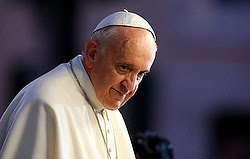
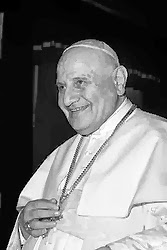
(Photo of Pope Francis CNS Photo/Paul Haring. Photo of John XXIII CNS file photo.)

Sunday, July 7, 2013

John XXIII and John Paul II: New Models for Holiness


By Sister Mary Ann Walsh

Friday morning’s stories about Lumen Fidei, the first encyclical from Pope Francis, quickly yielded top news report to the Vatican announcement that Pope Francis will declare Pope John XXIII and Pope John Paul II saints. The Vatican spokesman suggests it could happen within the year.

Saints show us how to live. Making it to the papacy is less a criterion for sainthood than leading a life of holiness that others can imitate. The holiness of Angelo Roncalli and Karol Wojtyla started way before their papacies.

Angelo Roncalli, as Pope John XXIII, had vision that showed in calling the world’s bishops together for the Second Vatican Council, 1962-1965. Vatican bureaucrats couldn’t believe the man who was elected pope when he was 77 was serious – they figured him for a do-nothing interim leader. (Worth pondering: Pope Francis was elected at 76. What will he do?) John XXIII didn’t see the Council conclude, but he still launched one of the most important modern-day events. Vatican II urged the Church to see it had a role in society, not apart from it. It prompted Catholics to move from spectators to participants in the Church. But the pope’s greatness showed even earlier.

Archbishop Roncalli had represented the pope as nuncio to Istanbul and later to Paris. In Turkey he worked closely with the Muslim and Jewish communities, forging bonds that have continued to develop ever since. In Paris, he strengthened bonds with the Jewish community. As nuncio first in Istanbul, then in Paris during World War II he worked to save many Jews from extermination. If we achieve peace in our troubled world now it will be because of religious groups working together. The possibility for such began decades ago and included the work of this saint-to-be.

Blessed John XXIII came from a peasant family but had the courage of his convictions and the simple faith to see that God’s love did, and his love should, extend to all, whatever their religious persuasion.

Blessed John Paul II stunned the world when the Pole became the first non-Italian pope in 455 years. He was a young pope by papal standards when he was elected in 1978 at age 58. He had a vision too, one which stunned Vatican aides. He wanted to spread the Gospel through media and mobility. He met resistance when he said he would travel the world. It just wasn’t done, but he became the frequent-flyer pope on a Gospel tour. He visited people, especially poor people, all around the world. He traveled to Latin America, Africa, India, the Philippines, the Holy Land – and brought his press entourage with him – and via media, the pope highlighted poverty for the entire TV viewing world to see.

Yet his greatness also began before his election as pope. As a young man in World War II Poland, Karol Wojtyla dared to take risks – he studied for the seminary in the underground. As an archbishop in Poland, he faced down communism. He remained its fierce opponent as pope. In war-torn Poland, he formed friendships with his Jewish friends which laid the roots for him to make the first papal visit to a synagogue.

As pope, John Paul showed people how to live. When after Mehmet Ali Agca nearly killed him in an assassination attempt in St. Peter’s Square, the pope visited him in jail and forgave him. Years later, Pope John Paul showed people how to die when he let the world witness the intimate moments of his passing away. The millions at his funeral chanted “sainthood now,” dismissing protocols for any waiting period.

Soon two modern figures will be declared saints. Both were popes, but the seeds of saintliness showed long before their elections.


Friday, January 18, 2013

Seven Markers on the Road to Christian Unity

By Father John Crossin

The Week of Prayer for Christian Unity is January 18-25. With an estimated 41,000 denominations in Christianity today, it's certainly worth praying for. Such prayer goes back to the example of Christ praying "that they all may be one" at the Last Supper (John 17:21). God has answered this prayer, and continues to answer it, if incrementally, with every new development in various ecumenical dialogues around the world. Each is another step on the road to Christian unity. Here are seven significant markers along that road:

1. Vatican II opens the door. With its 1964 decree on ecumenism, Unitatis Redintegratio (Restoration of Unity), the Second Vatican Council launched the Catholic Church on its current trajectory of dialogue and seeking increased understanding with other Christians. While the broader ecumenical movement began earlier in the 20th Century, this was where Catholics officially entered the story. The dialogues kicked off in its wake continue at the global, national and local levels today.

2. East and West begin their thaw. After a fruitful meeting in 1964, Pope Paul VI and Ecumenical Patriarch Athenagoras I declared in 1965 that they were lifting the mutual excommunications of 1054 that symbolized the official split between the Catholic and Orthodox churches, one of the oldest rifts in Christianity. Five years later, Pope Paul and Patriarch Athenagoras even considered a proposal to concelebrate the Eucharist. That plan never came to be, but the desire for unity by both parties remains an example.

3. 'Justification' question no longer divides. By the end of the 20th Century, Catholics and Lutherans had almost 500 years of experience in caricaturing what the other believed on the question of how people are justified before God. (Cardinal Francis George of Chicago explains it brilliantly in this video.) While Catholic and Protestant theologians had worked towards a convergence on this issue for decades, and early progress on this point had been made by the Catholic-Lutheran dialogue in the United States, it was the 1999 Joint Declaration on the Doctrine of Justification that finally took the issue off the table as a point of division. In 2006, the Methodists joined Catholics and Lutherans in signing the agreement.

4. The Ravenna Statement. Meeting in Ravenna, Italy in 2007, international Catholic and Eastern Orthodox delegations explored questions of authority and its exercise in the Church. The dialogue issued a statement that agreed the bishop of Rome held a place of honor among bishops in the ancient Church, and that he should also exercise some sort of primacy in the Church today. Cardinal Walter Kasper, the lead Vatican representative, called this a "breakthrough," but acknowledged that much more dialogue was necessary.

5. A road map emerges. In 2010, the North American Orthodox-Catholic dialogue issued an agreed statement that provided an unprecedented practical picture of what unity between East and West would look like and steps the two churches could take to reach that point. The document recommends collaboration on shared pastoral challenges, joint prayer and social ministry and a mutual recognition at all levels that Catholics and Orthodox belong to "sister churches."

6. Agreement on baptism. Back on the Protestant side of ecumenism, in 2010, the Catholic-Reformed dialogue (which includes the Christian Reformed Church in North America, the Presbyterian Church-USA, the Reformed Church in America and the United Church of Christ) reached a Common Agreement on Baptism, including a common formula of using flowing water and invoking the Father, Son and Holy Spirit. Practically speaking, this agreement resolved issues that stood in the way of fully recognizing each other's baptisms.

7. Next steps. On January 28-29, the next round of the Catholic-Reformed dialogue will begin to explore the 1995 encyclical Ut Unum Sint (That They All May be One). In that encyclical, Pope John Paul II highlighted the papacy as a ministry of unity (for instance, all Catholics are said to be in communion with the bishop of Rome, and even the title Pontifex Maximus means "chief bridge builder"). He called on other Christian denominations to dialogue with him about how he could exercise this ministry in a way that would promote a broader unity among all Christians. A pope for Protestants too? The Holy Spirit has brought greater surprises.

Father John Crossin is executive director of the Secretariat for Ecumenical and Interreligious Affairs of the U.S. Conference of Catholic Bishops.

Thursday, November 29, 2012

The Council at 50: Education: Joint Venture of Church, State


Welcome to one of the series of blogs on the Second Vatican Council. Each piece reviews one of the 16 documents produced by the Council Fathers during the extraordinary occasion in Church history. Vatican II, which drew together the world’s bishops, opened fifty years ago in St. Peter’s Basilica, October 11, 1962.

 
(Photo courtesy of Catholic News Service)
 

The Second Vatican Council spoke to the entire world and the Council Father’s document Gravissimum Educationis (The Importance of Education), made that clear in the “Declaration on Christian Education.” Published October 28, 1965, the brief declaration came during the fourth and final session of Vatican II. It addressed education in general but focused primarily on Christian education.  Three of its themes hold critical importance today.

1) Christian education is to help a person get to heaven. The Council Fathers wrote that “true education aims at the formation of the human person in the pursuit of his ultimate end and of the good of the societies of which, as man, he is a member, and in whose obligations, as an adult, he will share.”  (GE, 1) Living a good Christian life, the Fathers noted, enhances order, natural democratic virtues, and the common good but, more importantly, by grace, it is a path to live a holy life.  Today when technology and media bombard the senses with positive and negative images, sounds and words, the need for sound Christian education that teaches intelligent discernment in a pluralistic world is critical. 

2) Parents are the first educators of their children and have the duty and fundamental right to choose an education in keeping with their beliefs. The declaration recognizes the fundamental role of parents and thus of the family in our society. “The family is the first school of social virtues that every society needs” (GE, 3), the Fathers said. Children meet God, neighbor, and community through the family. Through the family they learn the elements of social justice, sharing with the less fortunate and experiencing how to give of themselves.   “Since parents have given children their life, they are bound by the most serious obligation to educate their offspring and therefore must be recognized as the primary and principal educators.”  (GE, 3)

The Fathers pointed out that “among all educational instruments the school has special importance.  It is designed not only to develop with special care the intellectual faculties but also to form the ability to judge rightly, to hand on the cultural legacy of previous generations, to foster a sense of values, to prepare for professional life.” (GE, 5) As a result parents must have the option of providing an education that supports the positive values of family life and their beliefs. 

3) Through the principle of subsidiarity, the Church and state should support parents in their exercise as primary educators of their children.  It is critically important that parents find support from civil society and the Church community to fulfill this fundamental right and duty. The Church has the obligation to establish schools that provide for a Christian education by which the whole child – body, mind and soul – develops in a Gospel environment.  Financial support for Catholic education is an increasing concern; and it is important for the entire Church to support its educational mission to the young. The Fathers also pointed out that civil society has an obligation to provide a proper education for all children to promote the welfare of its citizens.  These two obligations, of the Church and state, do not need to be in conflict. A respectful recognition on the part of both creates a setting in which education for many can flourish.  Both the Church and civil society must work together to provide educational options for the young and the options should include Christian schools. 

Fifty years ago the Church began a dialogue about the proper role of education. Times have changed but the need for the dialogue has not.

---
Bishop Joseph McFadden of Harrisburg, Pennsylvania chairs the U.S. bishops’ Committee on Education.

Tuesday, November 27, 2012

The Council at 50: Eastern, Latin Churches Equal in Dignity


Welcome to one of the series of blogs on the Second Vatican Council. Each piece reviews one of the 16 documents produced by the Council Fathers during the extraordinary occasion in Church history. Vatican II, which drew together the world’s bishops, opened fifty years ago in St. Peter’s Basilica, October 11, 1962.


(Photo courtesy of Catholic News Service)


One topic at the Second Vatican Council was the status of the Eastern Catholic Churches. These are relatively small groups of Eastern Christians who, mostly in recent centuries, have come into full communion with the Catholic Church. Almost all were part of an Orthodox church once estranged from the Catholic Church. The largest Eastern Catholic Churches today are the Ukrainian Greek Catholic Church (4.3 million members), the Syro-Malabar Catholic Church in India (four million), the Maronite Catholic Church in Lebanon (3.3 million), and the Melkite Greek Catholic Church in the Middle East (1.6 million). 

The status of these churches was unclear for a long time. Many equated the Catholic Church with the great Latin tradition that grew up in Western Europe, centered on Rome. These Easterners followed traditions that sometimes differed in significant ways from the Latin one. The question arose whether Eastern Catholics are on an equal footing with the Latin Catholics. Many Catholics thought that they were not. In fact, in 1742 Pope Benedict XIV had written an encyclical that referred to the “superiority” and “pre-eminence” of the Latin rite even while encouraging Eastern Catholics to remain faithful to their venerable traditions. 

The Council Fathers at Vatican II addressed this situation and the result was the Decree Orientalium Ecclesiarum (Of Eastern Churches),which was approved on November 21, 1964. The decree defines the most significant teachings and guides the relationships of the Churches.

First, the decree firmly teaches that in the Catholic Church all the various traditions of East and West are “of equal dignity,” and that “none of them is superior to the others.” Thus there is no connection between the number of people who adhere to a particular tradition and that tradition’s worth or value. All of these traditions, the council says, are part of the heritage of the universal Church. 

The document also focuses on the role of the Patriarchs that head six of the Eastern Catholic Churches, and calls for a reestablishment of the rights and privileges they held in the first millennium. This means that the Patriarchs would now have a higher level of autonomy, and that, for example, they along with their Holy Synods could now establish new dioceses and nominate their own bishops within their own territory. This is now the standard practice within those churches.

The decree treats sacramental questions. Unlike the Latin practice of restricting the conferral of Confirmation to bishops, Eastern Catholic priests could now normally confer this sacrament, in accordance with the ancient traditions. The document also calls for the restoration of the permanent diaconate in the Eastern Catholic Churches, and states that when a Catholic marries an Orthodox Christian in an Orthodox ceremony the marriage is valid, but permission from the Catholic bishop is necessary only for lawfulness. 

The text encourages the Eastern Catholics to engage in dialogue with the local Orthodox Churches to agree on a common date for the celebration of Easter, even if it will differ from the date Catholics use. Catholics in Greece, for instance, now celebrate Easter on the Orthodox calendar. 

In general, the document urges Eastern Catholics to engage their Orthodox counterparts in a spirit of ecumenical openness and respect. It reasserts Catholic teaching that the Orthodox churches have valid sacraments, and that sacramental sharing with them is possible in many circumstances. 

Orientalium Ecclesiarum clarified the place that Eastern Catholics have within the Catholic Church. It has had many implications for the lives of the Eastern Catholic Churches, which today are more faithful witnesses to the ancient Eastern traditions than they were before. There are still issues to be worked out, such as the place of married clergy in these churches, but the teaching and canon law of the Catholic Church affirms the value and authenticity of their traditions.

---

Archbishop William C. Skurla heads the Archeparchy of Pittsburgh and head of the Byzantine Catholic (Ruthenian) Metropolitan Church in Pittsburgh.

Wednesday, November 21, 2012

The Council at 50: Training Seminarians for Post-Vatican II


Welcome to one of the series of blogs on the Second Vatican Council. Each piece reviews one of the 16 documents produced by the Council Fathers during the extraordinary occasion in Church history. Vatican II, which drew together the world’s bishops, opened fifty years ago in St. Peter’s Basilica, October 11, 1962.

(Photo courtesy of Catholic News Service)


Bishops voted for the changes urged by the Second Vatican Council, but it would be the clergy who would have to bear responsibility for their implementation in the parish communities. Thus, the Council’s “Decree on the Training of Priests,” Optatam Totius (Desired of the Whole), though one of the shorter documents of Vatican II, is arguably most significant.

Renewal of the seminary system proved vital, for the church needed priests prepared to guide greater participation of the laity in the Church’s mission. The decree laid down the basic principles for priestly formation which have guided the formation of priests since then. The watershed document of Pope John Paul II in 1992 on priestly formation, I will give you Shepherds, expanded on the decree and stressed the human formation necessary for priestly formation today. 

The decree called for bishops’ conferences to establish local seminary norms so priests could meet the pastoral requirements where they minister. The Pope and his assistants in Rome provided general regulations from which all local conferences of bishops established the local rules. In the United States, the Conference of Bishops promulgated the first Program of Priestly Formation in 1971. It has been revised four times since then and the Bishops’ Conference continues to review and revise the norms to insure top formation for priests.

The Council emphasized spiritual formation in seminary training so that seminarians would “learn to live in intimate and unceasing union with God the Father through his Son Jesus Christ, in the Holy Spirit,” the decree said. This requires faithful meditation on the Word of God and regular participation in the Mass, confession, the Liturgy of the Hours and devotions to the Blessed Virgin. Seminarians are to be taught to seek Christ “in the bishop by whom they are sent and in the people to whom they are sent, especially the poor, little children, the weak, sinners and unbelievers.”

The Council emphasized the primacy of Scripture in intellectual formation. The relationship between the Scriptures and the doctrines of the Church, a theme treated in the Council’s Dogmatic Constitution on Divine Revelation, finds expression here. “Students should receive a most careful training in holy Scripture, which should be the soul, as it were, of all theology,” the decree noted.

An emphasis on pastoral training reflected the Council’s overall concern for effective engagement with the world. Such training demands a willingness to listen to others and the capacity to open their hearts in a spirit of charity to the needs of other people. The decree noted that seminarians must learn the art of the exercising the apostolate not only in theory but in practice, with pastoral work as part of their studies. Given the rapid growth in the cultural diversity of the Church in the United States in recent decades, the current norms of the Program for Priestly Formation strongly encourage seminarians to develop language skills and intercultural competency to be more effective pastoral ministers.

Finally, what is implicit in the decree but made explicit in Pope John Paul II’s I Will Give You Shepherds, is the need for human formation. Blessed John Paul stated that future priests are to cultivate a series of human qualities, both for their own good, and also with a view to the priestly ministry. These qualities enable them to be balanced, capable of bearing the weight of pastoral responsibility and to have the requisite affective maturity to live and cherish the gift of celibacy. The seminarian’s capacity to relate to others as a “man of communion” is essential for the priesthood in our day.

---

Archbishop Paul S. Coakley of Oklahoma City is a consultant to the U.S. bishops’Committee on Clergy, Consecrated Life and Vocations.

Thursday, October 18, 2012

The Council at 50: Vatican II’s Word on the Word of God


Welcome to one of the series of blogs on the Second Vatican Council. Each piece reviews one of the 16 documents produced by the Council Fathers during the extraordinary occasion in Church history. Vatican II, which drew together the world’s bishops, opened fifty years ago in St. Peter’s Basilica, October 11, 1962.

(Photo courtesy Catholic News Service)


All documents are not created equal.  Of the 16 produced by the Second Vatican Council, only two got top-tier religious ranking:  Dogmatic Constitution. Those two are Lumen Gentium (On the Church) and Dei Verbum (On the Word of God).

In Dei Verbum (DV), the Council Fathers responded to common misunderstandings about the Church and the bible. The following five highlights show how they answered these challenges from the world.

1. Tradition:  People often ask why the Church puts faith in Tradition, especially if it’s not found in the bible.  Dei Verbum teaches that before the Word was written (Scripture), it was preached and lived. It is the preaching and deeds of the Apostles, which the Church calls Tradition. Scripture and Tradition, that cannot be separated. They are living and interconnected –
both expressions of Christ (cf. DV 7-10). 
Yet they cannot interpret themselves, and so Tradition and Scripture also have the successors of the Apostles, the bishops, to interpret them.  Dei Verbum gives us a tripod of Tradition, Scripture and teaching authority, “so linked and joined together that one cannot stand without the others” (DV 10).  Together, they lead securely to salvation with God.

2. DV affirmed the bible as inspired and therefore without error.  Some biblical scholars have tried to understand our world using only the power of human reason, leaving out faith or the supernatural – effectively sidelining God to the act of creation and then to heaven. They search for “natural” explanations for any mention of “supernatural” happenings in the bible. DV states that the whole bible, Old and New Testament, was “written under the inspiration of the Holy Spirit.”  Therefore, they have “God as their author,” (DV 11) who can act supernaturally.  DV affirms that  the bible must be read with faith as well as reason.  It states that the bible teaches “faithfully and without error” and is given to us “for the sake of salvation” (DV 11). 

3. DV’s embrace of humility in Scripture:  Just as God humbled Himself to become human in every way except sin, so the Word humbled itself to be written in human language in every way except error (DV 13). The humble appearance of God in Jesus is compared to the humble appearance of God in the written word.  Both require faith to see the divine in the human.  This means that just as people without faith failed to see Jesus as the Son of God, today people without faith will fail to see the bible (because of its humble nature) as inspired and without error.

4. Perhaps, the biggest development in DV states that the bible’s truth is expressed according to the “literary form” of each book or part.  Historical truth will be expressed differently from prophetic or poetic truth; and these “forms” follow the “time and culture” when they were written (DV 12).  DV also says that every line of Scripture has to be understood in relation to the bible as a whole, as well as in relation to the whole Tradition of the Church. The bible is a unity.

5. Lastly, DV shows a desire for dialogue and evangelization when it encourages translations of the bible for non-Catholics and even non-Christians. Such translations, it counsels, should include footnotes to explain the biblical verses in accord with the religious background of those reading it (DV 25).

---

Bishop Anthony Taylor of Little Rock, Arkansas is a member of the Subcommittee on Scripture Translations of the U.S. Conference of Catholic Bishops.

Monday, October 15, 2012

The Council At 50: The Search for Christian Unity


Welcome to one of the series of blogs on the Second Vatican Council. Each piece reviews one of the 16 documents produced by the Council Fathers during the extraordinary occasion in Church history. Vatican II, which drew together the world’s bishops, opened fifty years ago in St. Peter’s Basilica, October 11, 1962.

(Photo courtesy Catholic News Service)


When I was a boy, Catholics did not enter Protestant or Orthodox churches. We did not pray together except for an occasional prayer before a public event. Now, 50 years after the Second Vatican Council, we pray together regularly. This type of “spiritual ecumenism” is at the heart of our movement toward Christian unity.

The Council’s Decree on Ecumenism (1964)Unitatis Redintegratio ( Restoration of Unity), opened the doors of the church. The Council exhorted “all the Catholic faithful…to take an active and intelligent part in the work of ecumenism.” [Decree, #4]

We began to build relationships of trust and forgiveness with our Protestant and Orthodox neighbors. We became friends. We began to look together more honestly at the issues that divide us. The Council urged us to make “…every effort to avoid expressions, judgments and actions that do not represent the condition of our separated brethren with truth and fairness ….” [#4]

In formal dialogues and informal conversations we moved from mutual suspicion and some exaggerations to an honest search for the facts and the truth of the past. Often our perceived differences came from the preconceptions and emotions of times past and not from deep divisions.

Our renewed relationships led to practical collaborations. Today the local food pantry or soup kitchen is often sponsored by an ecumenical coalition of churches. Frequently we coordinate our international efforts to aid those in need so we might be more effective.

On the local level, we see Catholic parish Bible study groups. These did not exist in my youth. We see many Protestant churches celebrating the Lord’s Supper every Sunday.  Protestants have shared with Catholics their love for the Bible; Catholics have shared with Protestants their love for the sacraments.

Both the Vatican and the U.S. Conference of Catholic Bishops engage in scholarly dialogues with Protestant and Orthodox friends and colleagues. “Through such dialogue everyone gains a truer knowledge and more just appreciation of the teaching and religious life of both communions.” [#4]

One result of these dialogues was the Joint Declaration on the Doctrine of Justification, a carefully worded statement on the key theological issue of the Reformation that was agreed to by the Lutheran World Federation and the Vatican in 1999. Its central affirmation is: “Together we confess:  By grace alone, in faith in Christ’s saving work and not because of any merit on our part, we are accepted by God and receive the Holy Spirit, who renews our hearts while equipping and calling us to good works.” [Declaration, #15]  In 2006, the World Methodist Council signed the Declaration.

More recently representatives of many Orthodox churches and of the Holy See endorsed the Ravenna Statement on the church. This little-known statement about the sacramental nature of the church and its implications for church life and authority—local, regional and universal— was a breakthrough with significant implications for the unity of Eastern and Western Christians.

Of course, there’s still a “ways to go” and this challenges all Christians. We are just beginning to address ecumenically some of the “hot” moral issues of our times, such as questions of sexual morality. While we have substantial agreement on many moral issues, we need to dig down deeper into the causes of our divergences.

The work of ecumenism is slow but steady. We are touching the deep foundations of our lives. We all adjust slowly to change – even change for the better.

---

Bishop Denis Madden is chairman of the Committee for Ecumenical and Interreligious Affairs of the U.S. Conference of Catholic Bishops.

Thursday, October 11, 2012

The Council at 50: Mass Post-Vatican II, A Participatory Event


Welcome to one of the series of blogs on the Second Vatican Council. Each piece reviews one of the 16 documents produced by the Council Fathers during the extraordinary occasion in Church history. Vatican II, which drew together the world’s bishops, opened fifty years ago in St. Peter’s Basilica, October 11, 1962.


(Photo courtesy Catholic News Service)


Looking over the 50 years since the opening of the Second Vatican Council, it’s clear that the most obvious effects of the Council’s work are seen in the liturgy, especially in the celebration of the Mass.  Sacrosanctum Concilium, the Constitution on the Sacred Liturgy, was the first of the Council’s major documents and set the course for the liturgical reform.

Its influence,still visible today, continues to chart the course for the celebration of Mass and the other sacraments. Five lasting effects of Sacrosanctum Concilium stand out.

1.      Participation: One oft quoted statement of the Council is paragraph 14 of the Liturgy Constitution: “Mother Church earnestly desires that all the faithful should be led to that fully conscious, and active participation in liturgical celebrations which is demanded by the very nature of the liturgy.” When the Church gathers for Mass or any other sacrament, all assembled are engaged in what is taking place, by praying aloud, singing, standing, kneeling, moving in procession, and, for some, fulfilling particular functions such as assisting as altar servers, proclaiming the Scripture readings, or presiding over the celebration as the celebrant (the priest). Now taken for granted, these changes in the liturgy were steps to foster and express our interior participation of the heart and mind in the work of Jesus. In the Mass, all the faithful participate in the offering of the gifts, and in doing so participate by offering themselves – their devotion and lives of service – to the Lord.

2.      Enculturation: Even as Catholics throughout the world celebrate the same Mass, we do so now in our own languages, making use of elements of our own cultures: styles and forms of music, art, and architecture, and praying about what concern us. The liturgy is both the experience of God’s saving presence, it is also an expression of who we are before God. In a culturally diverse society, we are still challenged to celebrate the liturgy in a way that enables everyone to worship and pray. 

3.      Ministry: Prior to the liturgical reforms of the Council, the liturgy was seen as the work of the priest and those few assistants at the altar. Today the liturgy is supported by a variety of ministries (deacons, readers, servers, music ministers, etc.), and the work of the Church is carried out daily by a broad spectrum of people serving, leading, and teaching in the name of the Church. 

4.      Catechesis: The liturgical reforms introduced in the years after the Second Vatican Council required a great deal of explanation and instruction for everyone. The Constitution on the Sacred Liturgy stressed the importance of such teaching as a way to lead the faithful to effective and fruitful participation in the liturgy. Today we continue to teach about what the Mass means and how to worship well. Recently, for example, dioceses and parishes underwent a great effort to teach about the Mass in preparation for the introduction of the Roman Missal, Third Edition.

5.      Mission: Sacrosanctum Concilium teaches that the liturgy is the “source and summit” of the Christian life (see paragraph 10). We don’t just gather at Mass to worship, but also to be energized and sent forth on a mission: to keep the commandments, above all to love God and love our neighbor. And the Mass ends with that reminder: “Go in peace, glorifying the Lord with your life.” 

----

Archbishop Gregory Aymond of New Orleans chairs the Committee on Divine Worship of the U.S. Conference of Catholic Bishops.

#####