Showing posts with label Pope Paul VI. Show all posts

Monday, February 16, 2015

The Pope, Touchstone of Faith and Unity


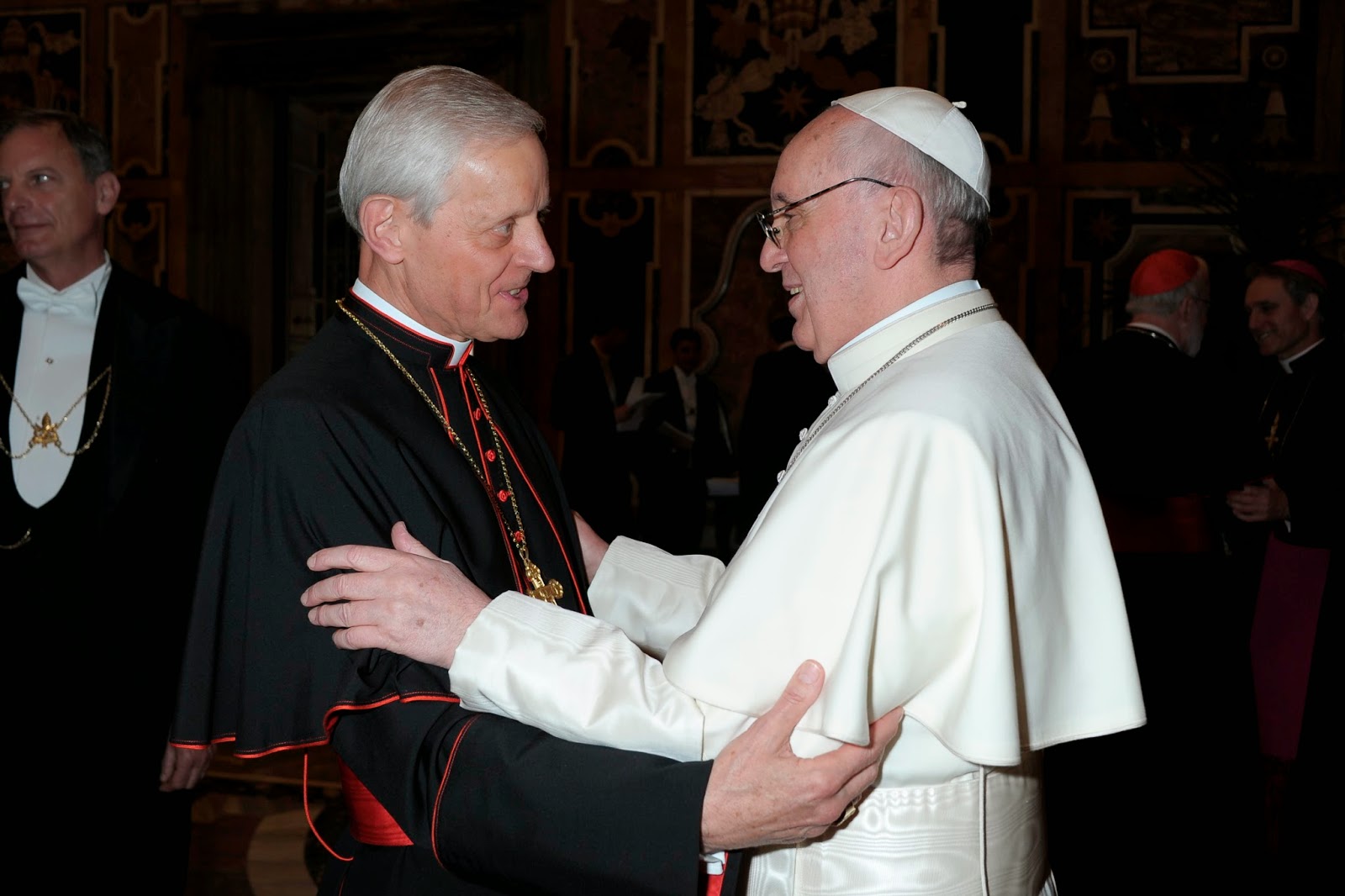
(CNS photo/L'Osservatore Romano)

By Cardinal Donald Wuerl

Early Sunday morning I watched our Holy Father, Pope Francis, give his Angelus talk – the comments he shares before praying the Angelus with the huge crowd – tens of thousands – gathered in Saint Peter’s Square each Sunday. Here, this enormously popular and revered successor to Peter spoke about the tenderness of Jesus, his loving compassion and at the same time our need to be caring and compassionate to our fellow human beings. The Holy Father clearly is admired not only by the crowds in Saint Peter’s Square but by people around the world. But apparently that admiration is not shared by all.

As I was watching the Holy Father on TV, my inbox was filling with a number of emails including an interview and an article by brother bishops who are less than enthusiastic about Pope Francis. Those emails reminded me of a much, much earlier time in my life when I first experienced dissent from the teaching and practice of a pope. As a young seminarian (20 years old) doing graduate work at The Catholic University of America, I read for the first time the encyclical letter of Saint John XXIII, Mater et magistra. Its teaching was not well received by some. One of the pundits offered the observation that became rather widespread in those circles, “Mater si, Magistra no,” – Latin for “Mother yes, Teacher no.”

Along with a number of my classmates, I remember being so scandalized by this rejection of the encyclical that we spoke to one of the priests at the seminary. He gently chided us for our naivety and pointed out that there has always been a current of dissent in the Church, some of it as high as the College of Cardinals. It was then that I first heard of Cardinal Louis Billot who was less than discrete in his opposition to Pope Pius XI who had condemned the political and religious movement, Action Française, which involved many people who longed for the restoration of the monarchy in France and a stronger role for the Church in civil government. In 1927, as the Catholic Encyclopedia puts it, Cardinal Billot “was persuaded to renounce his cardinalitial dignity.” Unhappiness with a Pope’s position on issues whether doctrinal, pastoral, canonical or as simple as clerical vesture, seems always to be present in some form. In 1963 Saint John XXIII again became the object of wrath of those who disliked his encyclical Pacem in terris, as did Blessed Paul VI for his encyclical, Populorum progressio in 1967 and certainly for his encyclical Humanae vitae in 1968. Dissent by some priests from the teaching in Humanae vitae led to their departure from priestly ministry.

On a much less important level, there was, nonetheless, considerable dismay among some in 1969 when the Secretary of State of Pope Paul VI issued an instruction concerning the vesture of bishops and cardinals. The effort to streamline and do away with things like the cappa magna (long outer garment of bishops and cardinals with a long, long train) upset some.

Even the short reign of Pope John Paul I was not without critique. Some wrote that they found his smile unbefitting a Pope since it diminished the gravitas (gravity or seriousness) of his office. One commentator lamented that this dear and kind Pope actually waved at people as he processed to celebrate Mass.

Then of course came Saint John Paul II. Everything he wrote had some critic whether it involved his social encyclicals such as Laborem exercens in 1981 or Sollicitudo rei socialis in 1987 or Centesimus annus in 1991 or his encyclical on the permanent validity of the Church’s missionary effort, Redemptoris missio. There were some who continually criticized him for his travels even though he helped in his nearly 27 years as Pope revitalize the Church. Personally, I always found the criticism of Saint John Paul II particularly painful because I have such an affection and admiration for him. In fact, the brand new seminary in this archdiocese that was opened just a few years ago bears his name, Saint John Paul II Seminary.

I will not belabor the point by going through the critiques, challenges, disapproval and dissent that faced so much of what Pope Benedict XVI taught and published during his pontificate. Again, I find myself greatly perplexed at the negative critique of him whom I saw as such a good, brilliant and holy Shepherd of the Church.

Hardly then should we expect that Pope Francis would be immune from what appears to be something that “comes with the territory.”

One of the things I have learned though over all of these years since those early naïve days in 1961 is that on closer examination there is a common thread that runs through all of these dissenters. They disagree with the Pope because he does not agree with them and therefore follow their position.

Dissent is perhaps something we will always have, lamentable as it is, but we will also always have Peter and his successor as the rock and touchstone of both our faith and our unity.
---

Note: This entry first appeared on Cardinal Donald Wuerl's blog, Seek First The Kingdom and is reprinted with permission from the Archdiocese of Washington.


- See more at: http://cardinalsblog.adw.org/2015/02/pope-touchstone-faith-unity/#sthash.Ulivqf7s.dpuf

Friday, November 14, 2014

Catholic and Orthodox, Two Traditions Gradually Growing Together

By Father Ronald Roberson, CSP

When the Second Vatican Council was convened, there had been virtually no relationship at all between the leadership of the Catholic Church and the Orthodox Churches of the East for over 500 years. The last time a pope and Patriarch of Constantinople had met was in 1438. But when he convoked the Council, Pope John XXIII made sure that the unity of Christians was high on its agenda. This was due in part to his personal experience during the years he lived in Bulgaria, Turkey and Greece as papal representative to those countries, where he gained an appreciation of Eastern Christianity.

In its final form, the Decree on Ecumenism (Unitatis Redintegratio) has a separate section dedicated to relations with the Orthodox entitled, “The Special Position of the Eastern Churches” (paragraphs 14-18).  These churches are special first and foremost because the Catholic Church recognizes the validity of Orthodox sacraments. In fact, since we share the same Eucharist and sacrament of Holy Orders, the Orthodox Churches “are linked with us in closest intimacy.” The decree goes on to praise the many spiritual and theological treasures that are found in the Christian East and recognizes that these churches “have the power to govern themselves according to the disciplines proper to them, since these are better suited to the character of their faithful, and more for the good of their souls.”  The decree also calls for a gradual realization of unity between Catholics and Orthodox, “especially by prayer, and by fraternal dialogue on points of doctrine and the more pressing pastoral problems of our time.”

The centuries-long icy silence between Catholics and Orthodox had already been broken in January 1964, when Pope Paul VI and Ecumenical Patriarch Athenagoras met in the Holy Land. Now the process of reconciliation was quickly moving forward. The excommunications of 1054 were “erased from the memory of the church” in 1965, and Pope Paul and Patriarch Athenagoras exchanged visits in Rome and Istanbul in 1967.

In 1979, an official theological dialogue between the Catholic Church and the Orthodox Church was established by Pope John Paul II and Patriarch Demetrios of Constantinople. It produced some important agreed statements in its early years, but has run into difficulty following the clashes between Catholics and Orthodox after the collapse of communism in Eastern Europe. It is now looking at the vexed question of primacy in our churches.

The most fruitful Catholic-Orthodox dialogue begun after Vatican II has been the one in North America.  Founded in 1965, it has produced about 30 agreed statements over the years on a wide variety of topics. Its most recent major study was its “Steps Towards a Reunited Church” document that outlines what a reconciled Orthodox and Catholic Church might look like and the role that the pope would play in it. In early June, it issued a brief agreed statement calling for the restoration of the faculty of Eastern Catholic bishops in North America to ordain married men to the priesthood. This would not only recognize an authentic Eastern Christian tradition, but would also serve as an assurance to the Orthodox (most of whose parish clergy are married) that the Catholic Church would respect their longstanding traditions.

Relations between Catholics and Orthodox have improved immeasurably since the Decree on Ecumenism was issued nearly 50 years ago. As Pope Francis and Patriarch Bartholomew put it so well in their Joint Declaration in the Holy Land in May, “While fully aware of not having reached the goal of full communion, today we confirm our commitment to continue walking together towards the unity for which Christ our Lord prayed to the Father so 'that all may be one' (Jn 17:21)."

Father Ronald Roberson, CSP is associate director of the Secretariat for Ecumenical and Interreligious Affairs of the U.S. Conference of Catholic Bishops. He is also a consultor to the Vatican's Congregation for the Oriental Churches. This post is part of a series commemorating the 50th anniversary of Unitatis Redintegratio, the Decree on Ecumenism of the Second Vatican Council.

CNS Photo/Paul Haring

Friday, October 17, 2014

Something Nice for Paul VI

On October 19, at the close of the Extraordinary Synod of Bishops on the Family in Rome, Pope Francis will beatify Pope Paul VI (1963-78), who oversaw most of the Second Vatican Council and its implementation.

To commemorate this milestone, this blog is featuring posts on Pope Paul -- honoring his legacy by reflecting on his individual and lasting contributions to the life of the Church. These posts are authored by bishops and lay Catholics:
and a bonus...

Note to diocesan editors and webmasters: These commentaries are free for your reprinting and posting. Please note the source as this blog, linking back where possible.

(CNS Photo/Giancarlo Giuliani)

A Church That Must Go Out -- Pope Paul's Final Exhortation

By Bishop David Ricken

Pope Francis has repeatedly spoken of the need for a Church that goes out from itself, bringing mercy to the margins of society. This call is evident in his apostolic exhortation Evangelii Gaudium (Joy of the Gospel), in which he states, “An evangelizing community gets involved by word and deed in people’s daily lives; it bridges distances, it is willing to abase itself if necessary, and it embraces human life, touching the suffering flesh of Christ in others.”

These words, like much of Pope Francis’s thought, draw heavily from Pope Paul VI (1963-78), whom Pope Francis will beatify, or bring one step closer to being declared a saint, October 19.

On December 8, 1975, Pope Paul issued Evangelii Nuntiandi, “On Evangelization in the Modern World.” This apostolic exhortation was shared with the hope of fostering “a new period of evangelization.” Pope Francis has called Evangelii Nuntiandi “the greatest pastoral document that has ever been written to this day.”

Evangelii Nuntiandi advanced the call of the Second Vatican Council to become a Church that reaches outside of itself and transforms the world around us (see Decree on the Apostolate of Lay People, 2). Through proclaiming Christ to the world, the Church and those who accept her message will experience a profound change of mind and heart.

Paul VI was keenly aware that evangelists had to first be evangelized. The self-righteous, the judgmental, those who feel they are better than others would not bear fruit. Repentant sinners, those who realize they can’t live life on their own and need Christ, those willing to listen to others and share their own stories of how Christ has touched their lives – those would be the needed witnesses who experience continual conversion.

Paul VI also challenges us to see evangelization as more than just a one-on-one encounter, but also the transformation of society and culture. Evangelization calls for a new way of living personally and as a people. The power of the Gospel affects, or as Paul VI states, upsets “mankind’s criteria of judgment, determining values, points of interest, lines of thought, sources of inspiration and models of life which are in contrast with the Word of God and the plan of salvation.”

Yet Paul VI realized that even as the Gospel transforms peoples and societies, “the conditions of society in which we live oblige all of us therefore to revise methods, to seek by every means to study how we can bring the Christian message to modern man.” In other words, the way the Church spreads the Good News is always evolving. This has been evident recently in the calls for “new language” at the Synod of Bishops in Rome. It’s also the case with the many Catholics, bishops, clergy and lay people alike, who have generated a powerful witness through their use of social media, Pope Francis chief among them.

The vast and immediate reach of digital technology means today’s evangelizers have more tools than ever at their disposal. This is a gift, especially because proclaiming Christ to the world is not optional for the Church. All Christians are called to share the joy of Christ and his Gospel. Bishop Paul Bradley of Kalamazoo, Michigan, recently said on Twitter: “It’s not that the Church has a mission; rather the Mission, of spreading the Good News of Jesus, has a Church to carry out the mission.” Or as Paul VI said, “She exists in order to evangelize.”

Paul VI prayed that evangelization would become our “daily preoccupation” and “a way of life and action." With the Lord Jesus Christ as the center of our lives, may we go forth boldly, sharing the joy of the Gospel with all we meet.

Bishop Ricken is bishop of Green Bay, Wisconsin, and chairman of the U.S. bishops’ Committee on Evangelization and Catechesis. He tweets @BpDavidRicken.

CNS photo/Michael Alexander, Georgia Bulletin

Tuesday, October 14, 2014

How Paul VI Shaped my Ministry

By Bishop Howard J. Hubbard

In 1963, as a seminarian in Rome, I was present in St. Peter’s Square when the white smoke emerged from the Sistine Chapel. Shortly thereafter Cardinal Giovanni Montini, the archbishop of Milan, appeared on the balcony of St. Peter’s Basilica as Pope Paul VI.

The most pressing issue confronting Pope Paul was his relationship to the Second Vatican Council, which was preparing for its second session. Would Pope Paul stay the course of aggiornamento set by Pope John XXIII, or would he revert to the more traditional approach preferred by many of his former colleagues in the Roman curia? Pope Paul was more vigilant and involved in monitoring the deliberations of the Council. However, he cautiously supported reform, but sought to do so in a balanced way that did not alienate others.

Pope Benedict XVI referred to Paul’s encyclical Populorum Progressio as the “Rerum Novarum of the present age” of globalization. This is high praise, as Pope Leo XIII’s encyclical Rerum Novarum, issued in 1891, launched the modern period of papal social teaching. In Populorum Progressio, Paul VI underlined the indispensable importance of the Gospel for building a society according to peace and justice.

Paul VI’s vision communicated two important truths:
  1. Promoting human development is integral to the Church’s mission, not something added or peripheral.
  2. Authentic human development concerns the whole person in every dimension (personal, social, political, economic, and spiritual). 
Paul’s encyclical had a major impact on my own priestly ministry, helping me to appreciate how exercising the ministry of social work was not distinct or separate from my priestly ministry but a concrete and tangible way of exercising this ministry. Thus, at Providence House, a storefront information, referral and social action center in Albany’s inner city, and Hope House, an addiction treatment facility for those hooked on heroin or other hard core illegal drugs, I realized my ministry was not distinct or separate from my priestly call.

Pope Paul’s vision for this type of ministry was reinforced further by the 1971 Synod of Bishops on Social Justice, which he convoked, proclaiming that social justice advocacy is as much a part of the mission of the church as the proclamation of God’s Word and the celebration of the sacraments.

Finally, I would note another document issued by Pope Paul continues to be as relevant today as it was when it was first issued in 1975: Evangelii Nuntiandi. Pope Paul made it abundantly clear in this document that the Church must always be a missionary church and that the responsibility for proclaiming the Good News of Jesus Christ belongs not just to the clergy and religious but to every member of the church.

Pope Paul helped me to understand that you don’t need to be a brilliant theologian, a charismatic speaker or have the courage of a martyr to evangelize. You just need to believe that Jesus always releases grace whenever we testify to Him, and that this grace has the power to draw people to His side. This perspective informed my efforts at evangelization in the Diocese of Albany.

As we celebrate Pope Paul’s beatification, I hope that his visionary and courageous leadership will prompt us to recall the outstanding and indispensible contributions he made to implementing the reforms of Vatican II and laying the framework for addressing the issues facing the Church today.

Bishop Hubbard served as bishop of Albany, New York, from 1977-2014. At the time of his retirement, he was the last remaining bishop appointed by Pope Paul VI heading a U.S. diocese.

Friday, October 10, 2014

Pope Paul's Call for Peace and Justice Challenges us More Than Ever

By Jill Rauh

Pope Paul VI spent the first years of his pontificate shepherding the Second Vatican Council to its conclusion, visiting the United States and the Holy Land and, in doing so, brought the Catholic Church into the modern world, began healing ancient divisions among Christians and challenged the entire world to peace. It shouldn’t be a surprise, then, that his 1967 contribution to the Church’s social tradition, the encyclical Populorum Progressio (On the Development of Peoples) has been called the “Magna Carta on development.”

Paul VI, who will be beatified October 19, builds on the already rich social teaching of Pope Leo XIII (1878-1903) and his successors and focuses on inequality and underdevelopment. Pope Paul offers a global vision for economic justice, development and solidarity. This vision is as challenging in 2014 as it was almost 50 years ago.

Here are a few major themes of enduring relevance:

Ending poverty: a mandate for all.
Paul VI writes: “The hungry nations of the world cry out to the peoples blessed with abundance. And the Church, cut to the quick by this cry, asks each and every man to hear his brother's plea and answer it lovingly.” Ending poverty is the responsibility of all of us.

Economic justice
We must work towards a world where all people can be “artisans of their destiny” and where “the needy Lazarus can sit down with the rich man at the same banquet table.” The economy must be made to serve the human person (instead of the other way around).  We must address inequality and restore dignity to workers.  And we must remember that the needs and rights of those in poverty take precedence over the rights of individuals to amass great wealth. The Church has a preferential option for the poor.

'Development is the new name for peace'
Pope Paul’s challenge on poverty leads directly into his appeal for peace. Development is “the new name for peace,” he writes. Development leads to peace, since “peace is not simply the absence of warfare.” And war, which destroys societies and the individuals who inhabit them, and which the pope railed against in his 1965 address to the United Nations, is, to borrow a phrase, human development in reverse. Authentic development responds to the needs of the whole person, including both material and spiritual needs. It results instead from fighting poverty and establishing justice. Pope Paul would distill this in his theme for World Day of Peace 1972: “If you want peace, work for justice.”

Solidarity
True development requires a true commitment to solidarity—the idea that we are one human family, each responsible for all. Without solidarity, “there can be no progress toward complete development.” Those who are wealthy can also be poor—morally poor—as they live blinded by selfishness.  We have to overcome our isolation from others, so that “the glow of brotherly love and the helping hand of God” is reflected in all our relationships and decisions.

Think global, act local
Inequality is a global issue, and wealthy countries should act to help nations in need through “aid,” relief for poor countries “overwhelmed by debt,” “equitable trade relations,” “hospitable reception” for immigrants, and, for businesses operating in foreign countries, a focus on “social progress” instead of “self-interest.”  Sadly, these are all issues still in need of our attention.

So enduring was Paul VI’s vision, John Paul II revisited it in Sollicitudo rei Socialis (1987), as did Benedict XVI in Caritas in Veritate (2009). Its themes are also strongly apparent in the teaching of Pope Francis, who witnessed the “globalization of indifference” and lives destroyed by war and poverty in Latin America. Pope Paul and Pope Francis both challenge our current response to poverty and violence. They challenge us with the alternative of a vision that is cohesive and global, Catholic in the truest sense.

Jill Rauh is assistant director of education and outreach of the Department of Justice, Peace and Human Development of the U.S. Conference of Catholic Bishops.

Finding the Challenges and Joys of Paul VI's Teaching on the Family

By Maria Wiering

Looking back, I’m sure the moment was awkward.

My now-husband and I were on our second date: evening coffee at a laid-back café in St. Paul, Minnesota. We had been friends for years, and I wanted to investigate potential roadblocks as we moved from friendship to something more.

So, I asked, with the coolness of the Grand Inquisitor: did he agree with the Church’s teaching on contraception?

Graciously, my husband has no recollection of this moment. I recall him looking slightly uncomfortable, but he affirmed that yes, he trusted the Church.

Whew, I thought, probably searching for the next conversation non-starter.

The truth is, if he had said no, it probably would have been a deal breaker. I felt strongly about avoiding contraception, and realized I needed a like-minded spouse. The question wasn’t like asking his feelings on vegetarianism, or another lifestyle preference, even one with ethical components. I was asking him, essentially, if he was willing to surrender decisions about our family size – and therefore our personal plans and aspirations – to God’s providence.

Admittedly, it was a big ask.

In Humane Vitae, the 1968 encyclical affirming the Church’s teaching on birth control, one gets the impression Pope Paul VI also knew he was putting in a steep order. He acknowledged that abiding by the Church’s teaching could be a burden for some couples, and told them to focus on eternal life – not a card one usually has to play if the immediate upside of something is blatantly obvious. However, the encyclical is incredibly pro-woman, pro-child and pro-family, which is what has convinced me, and many others, to shape our lives around it.

After Paul VI explained contraception was an unacceptable means to prevent births, he acknowledged that couples who wished to avoid pregnancy must practice self-discipline. He promised it would bear fruit: “It fosters in husband and wife thoughtfulness and loving consideration for one another. It helps them to repel inordinate self-love, which is the opposite of charity. It arouses in them a consciousness of their responsibilities.” And, he added, it’s a good example for their kids, too.

By contrast, he pointed to the potential characteristics of a world rife with contraception use, including marital infidelity; a “general lowering of moral standards”; disrespect of women, making them “mere instruments of selfish enjoyment”; and governmental endorsement (imposition even) of artificial contraception.

Looking around today, it’s hard to argue he wasn’t right.

In March, Pope Francis said Pope Paul VI’s “genius was prophetic.” He cautioned, however, that the encyclical should be pastorally applied with great mercy – something Paul VI called for as well.

As Catholics, we often think of this mercy being expressed in the confessional, but it should be an attitude we in the pews embrace as well. We Natural Family Planning promoters must avoid a better-than-thou air of haughtiness. A certain sense of pride is understandable, given our minority status and the kind of dedication it requires to practice it. NFP is, however, only a tool to space births, not the marital end game. A merciful attitude towards Catholics who struggle to keep this teaching, instead of an us-and-them approach, would serve all lay Catholics well.

That’s not to say we shouldn’t widely extol the benefits of NFP. I love understanding how my body works, and that my husband understands it as well. It also appeals to my crunchy, organic-produce-loving self, as it requires thought and time, but nothing artificial – and potentially harmful – in my body. It also has helped numerous friends pinpoint fertility problems and eventually become pregnant.

I’ve been married – and a mom – long enough to know that this vocation does entail burdens, some that the girl at the coffee shop six years ago couldn’t have anticipated. Those burdens, however, deepen my admiration of my husband and appreciation for my son, and are lightened by the quiet comfort and joy of cooperating with God’s plan for our family.

Maria Wiering is a staff writer at the "Catholic Review," newspaper of the Archdiocese of Baltimore. USCCB offers resources for finding a national NFP provider and local NFP classes.

Paul VI and Dialogue -- We Wouldn't Be Here Without Him

By Bishop Denis Madden

When Pope Paul VI, who will be beatified October 19, inherited the Second Vatican Council from John XXIII in 1963, his challenges included fulfilling the late pope’s wishes to “open a window” in the Church and to reach out to “our separated brethren.” Pope Paul’s approach to both of these was to introduce the concept of dialogue.

The Church hasn’t been the same since.

John O’Malley recounts in his book “What Happened at Vatican II” that the Council’s early draft on ecumenism didn’t use the word dialogue once. Then Pope Paul issued his first encyclical, Ecclesiam Suam (On the Church) on August 6, 1964. In it, he repeatedly stressed the importance of dialogue, stating, “The Church must enter into dialogue with the world in which it lives. It has something to say, a message to give, a communication to make.” The Council championed dialogue from then on.

November 1964 saw the Council’s Decree on Ecumenism (Unitatis Redintegratio), which called on “all the Catholic faithful to recognize the signs of the times and to take an active and intelligent part in the work of ecumenism,” that is, dialoguing with, praying together and simply building friendships with non-Catholic Christians.

In October 1965, the Council took dialogue beyond other Christians and applied it to the world’s religions with Nostra Aetate, a brief but groundbreaking document that swept away centuries of erroneous negative teaching about the Jewish people and held up examples, essentially starting points for dialogue, where the Catholic Church saw positive elements of Hinduism, Buddhism and Islam. The document noted that all religions seek answers to the big questions: What is the meaning of life? Why do people suffer? What is the road to true happiness? All of these call for dialogue.

Pope Paul put the call for dialogue with the world into action through his apostolic journeys to places including India, Portugal, the United States, Colombia, Turkey and the Holy Land. His reason for taking the name Paul as pope was to emulate the journey of the missionary disciple. His historic January 1964 meeting with Eastern Orthodox Ecumenical Patriarch Athenagoras in Jerusalem renewed the Catholic dialogue with Orthodox Christians and led the following year to the mutual rescinding of the excommunications of 1054 that had divided the churches.

In October 1965, during his visit to the United States, Pope Paul became the first pope to address the United Nations. His remarks, essentially to the entire world, included the famous call: “No more war, war never again!” The implications are clear. The Catholic Church does not simply engage in dialogue for dialogue’s sake, but because the fruits of dialogue—engagement, friendship, respect, recognizing the human dignity of people different than ourselves—are the seeds of peace and the Kingdom of God.

Through our dialogues with others, the Catholic Church has seen much good fruit over the past 50 years. We owe it to the grace of the Holy Spirit. But in a very practical way, we also owe it to Pope Paul.

Bishop Madden is an auxiliary bishop of Baltimore and chairman of the U.S. bishops' Committee on Ecumenical and Interreligious Affairs.

Wednesday, March 19, 2014

When a Pope Meets a U.S. President: 2014

Note: This post is an update of an earlier piece we wrote in anticipation of President Obama's July 10, 2009 meeting with Pope Benedict XVI.

President Obama's upcoming meeting with Pope Francis at the Vatican, March 27, marks the 28th time  a sitting U.S. President has met with a pope. The meetings, which will now include 12 presidents and 6 popes, are replete with historical odds and ends:

1. Woodrow Wilson met Benedict XV, the Vatican, January 4, 1919. Meeting just after the end of World War I, Wilson had pushed for a lasting peace via his League of Nations proposal, and Pope Benedict had been a powerful advocate for peace throughout the war.

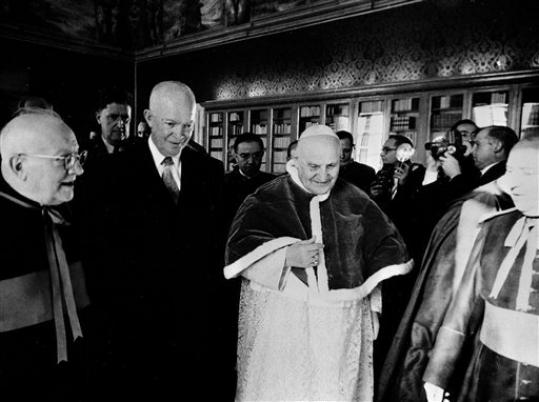
2. Dwight D. Eisenhower met John XXIII, the Vatican, December 6, 1959. Following a 40-year hiatus, this meeting would begin in earnest the precedent of every pope (except John Paul I) and every president meeting. While apparently very genial, this meeting also faced the challenge of Eisenhower not knowing Italian and John XXIII not knowing English.

3. John F. Kennedy met Paul VI, the Vatican, July 2, 1963. While Jacqueline Kennedy met John XXIII in a private audience, JFK missed him by a month, instead visiting the newly-elected Pope Paul. They reportedly discussed civil rights.

4. Lyndon Johnson met Paul VI, New York, October 4, 1965. This meeting took place in the historical context of the first visit by a pope to the United States. Paul VI would visit and address the United Nations while he was in town.

5. Lyndon Johnson met Paul VI, the Vatican, December 23, 1967. This was the first repeat encounter between a particular pope and president. Johnson's record will be matched by Nixon and shattered by the likes of Reagan, Clinton and George W. Bush. Pope Paul will go on to meet two more presidents.

6. Richard Nixon met Paul VI, the Vatican, March 2, 1969.

7. Richard Nixon met Paul VI, the Vatican, September 29, 1970.

8. Gerald Ford met Paul VI, the Vatican, June 3, 1975. Ford was the fourth and final U.S. president met by Pope Paul. John Paul II would meet five.

9. Jimmy Carter met John Paul II, the White House, October 6, 1979. Along with being the first of 15 meetings between Pope John Paul and a sitting president, this was the first time a pope visited the White House, which would go unrepeated until 2008.

10. Jimmy Carter met John Paul II, the Vatican, June 21, 1980.

11. Ronald Reagan met John Paul II, the Vatican, June 7, 1982.

12. Ronald Reagan met John Paul II, Fairbanks, Alaska, May 2, 1984. Pope John Paul was stopping to refuel on his way to Seoul. President Reagan was on his way back from China. While quick and in passing, this meeting still allowed the two to speak about the pressing issues of the time. It also followed shortly after the U.S. and the Holy See formally opened diplomatic relations.

13. Ronald Reagan met John Paul II, the Vatican, June 6, 1987.

14. Ronald Reagan met John Paul II, Miami, September 10, 1987.

15. George Bush met John Paul II, the Vatican, May 27, 1989.

16. George Bush met John Paul II, the Vatican, November 8, 1991.

17. Bill Clinton met John Paul II, Denver, August 12, 1993. Pope John Paul was in town for World Youth Day.

18. Bill Clinton met John Paul II, the Vatican, June 2, 1994.

19. Bill Clinton met John Paul II, Newark, October 4, 1995.

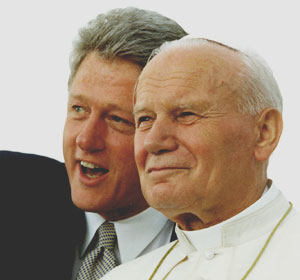
20. Bill Clinton met John Paul II, St. Louis, January 26, 1999. President Clinton met with the pope more times on American soil than any other president. Of course, one could argue a traveler like JPII made it easy for him.

21. George W. Bush met John Paul II, Castel Gandolfo, July 23, 2001. This is the first and only time a pope received a president at the papal summer residence in Italy.

22. George W. Bush met John Paul II, the Vatican, May 28, 2002.

23. George W. Bush met John Paul II, the Vatican, June 4, 2004. President Bush presented Pope John Paul with the Presidential Medal of Freedom.

24. George W. Bush met Benedict XVI, the Vatican, June 9, 2007. It's worth noting that Bush, along with former Presidents Bush and Clinton, also attended the funeral of Pope John Paul II in April of 2005, which was also attended by then-Cardinals Joseph Ratzinger and Jorge Mario Bergoglio, S.J., the future Pope Benedict XVI and Pope Francis, respectively.

25. George W. Bush met Benedict XVI, the White House, April 16 2008. Bush also greeted Pope Benedict upon his arrival at Andrews Airforce Base. The White House reception included a birthday celebration for the pope.

26. George W. Bush met Benedict XVI, the Vatican, June 13, 2008. Until next week's meeting, Bush holds the distinction of being the only sitting U.S. president to meet two popes. He has also met with the pope the more times than any sitting president, six.

27. Barack Obama met Benedict XVI, the Vatican, July 10, 2009. Obama held a roundtable discussion with religion writers at the White House in anticipation of the meeting. Benedict presented Obama with a gift of the Vatican's recent document on bioethics.

CNS Photo.

Hat tip to AP for the list of historic dates and places.

Friday, January 18, 2013

Seven Markers on the Road to Christian Unity

By Father John Crossin

The Week of Prayer for Christian Unity is January 18-25. With an estimated 41,000 denominations in Christianity today, it's certainly worth praying for. Such prayer goes back to the example of Christ praying "that they all may be one" at the Last Supper (John 17:21). God has answered this prayer, and continues to answer it, if incrementally, with every new development in various ecumenical dialogues around the world. Each is another step on the road to Christian unity. Here are seven significant markers along that road:

1. Vatican II opens the door. With its 1964 decree on ecumenism, Unitatis Redintegratio (Restoration of Unity), the Second Vatican Council launched the Catholic Church on its current trajectory of dialogue and seeking increased understanding with other Christians. While the broader ecumenical movement began earlier in the 20th Century, this was where Catholics officially entered the story. The dialogues kicked off in its wake continue at the global, national and local levels today.

2. East and West begin their thaw. After a fruitful meeting in 1964, Pope Paul VI and Ecumenical Patriarch Athenagoras I declared in 1965 that they were lifting the mutual excommunications of 1054 that symbolized the official split between the Catholic and Orthodox churches, one of the oldest rifts in Christianity. Five years later, Pope Paul and Patriarch Athenagoras even considered a proposal to concelebrate the Eucharist. That plan never came to be, but the desire for unity by both parties remains an example.

3. 'Justification' question no longer divides. By the end of the 20th Century, Catholics and Lutherans had almost 500 years of experience in caricaturing what the other believed on the question of how people are justified before God. (Cardinal Francis George of Chicago explains it brilliantly in this video.) While Catholic and Protestant theologians had worked towards a convergence on this issue for decades, and early progress on this point had been made by the Catholic-Lutheran dialogue in the United States, it was the 1999 Joint Declaration on the Doctrine of Justification that finally took the issue off the table as a point of division. In 2006, the Methodists joined Catholics and Lutherans in signing the agreement.

4. The Ravenna Statement. Meeting in Ravenna, Italy in 2007, international Catholic and Eastern Orthodox delegations explored questions of authority and its exercise in the Church. The dialogue issued a statement that agreed the bishop of Rome held a place of honor among bishops in the ancient Church, and that he should also exercise some sort of primacy in the Church today. Cardinal Walter Kasper, the lead Vatican representative, called this a "breakthrough," but acknowledged that much more dialogue was necessary.

5. A road map emerges. In 2010, the North American Orthodox-Catholic dialogue issued an agreed statement that provided an unprecedented practical picture of what unity between East and West would look like and steps the two churches could take to reach that point. The document recommends collaboration on shared pastoral challenges, joint prayer and social ministry and a mutual recognition at all levels that Catholics and Orthodox belong to "sister churches."

6. Agreement on baptism. Back on the Protestant side of ecumenism, in 2010, the Catholic-Reformed dialogue (which includes the Christian Reformed Church in North America, the Presbyterian Church-USA, the Reformed Church in America and the United Church of Christ) reached a Common Agreement on Baptism, including a common formula of using flowing water and invoking the Father, Son and Holy Spirit. Practically speaking, this agreement resolved issues that stood in the way of fully recognizing each other's baptisms.

7. Next steps. On January 28-29, the next round of the Catholic-Reformed dialogue will begin to explore the 1995 encyclical Ut Unum Sint (That They All May be One). In that encyclical, Pope John Paul II highlighted the papacy as a ministry of unity (for instance, all Catholics are said to be in communion with the bishop of Rome, and even the title Pontifex Maximus means "chief bridge builder"). He called on other Christian denominations to dialogue with him about how he could exercise this ministry in a way that would promote a broader unity among all Christians. A pope for Protestants too? The Holy Spirit has brought greater surprises.

Father John Crossin is executive director of the Secretariat for Ecumenical and Interreligious Affairs of the U.S. Conference of Catholic Bishops.

Monday, October 22, 2012

The Council at 50: A New Way of Working for Bishops: Consultation


Welcome to one of the series of blogs on the Second Vatican Council. Each piece reviews one of the 16 documents produced by the Council Fathers during the extraordinary occasion in Church history. Vatican II, which drew together the world’s bishops, opened fifty years ago in St. Peter’s Basilica, October 11, 1962.
 
(Photo courtesy of Catholic News Service)

As bishops from around the world gather in Rome for the XIII ordinary Synod of Bishops, they can thank the Fathers of the Second Vatican Council for making the opportunity possible. The Synod of Bishops, established by Pope Paul VI prior to the conclusion of the Council, implemented the bishops’ desire for a permanent structure that would be available to the pope, as needed, to discuss important topics in the Church.  In this way, the pope could draw upon the experience and insights of bishops who exercise their ministry within different circumstances and conditions and make decisions that respond to the needs of the Church in the many countries where she exists.

The importance of consultation in the exercise of Church governance is a theme that echoes throughout Christus Dominus (Christ the Lord), the “Decree on the Pastoral Office of Bishops in the Church.” It was the Council’s hope that opportunities for consultation would continue to thrive at every level of the Church’s structure. If your diocese has celebrated a diocesan synod any time in the last two decades you have experienced this hope in action. You are even more likely to be familiar with the councils that exist on the diocesan and parish levels that provide regular opportunities for lay women and men, religious, priests, and deacons to offer their insights and expertise to their bishop or parish pastor to assist them in making decisions that benefit the common good. 

This very blog is a service provided by another consultative structure explicitly affirmed by the Decree, the episcopal conference. The bishops of the United States Conference of Catholic Bishops gather twice a year to discuss the pastoral needs of the nation and to offer mutual support for the exercise of their ministry as authoritative teachers, sanctifiers and pastors within their individual dioceses. Their cooperation and concern result in helpful initiatives that are best undertaken on the national level and that serve to strengthen the witness of the Catholic faith within the United States. The Decree encouraged bishops to utilize the media to promote the Church’s teaching. While the Council Fathers, in 1965, undoubtedly had in mind the print media – and perhaps also radio and television – their encouragements to adapt always to the changing needs of the times and to engage all of the means that are available to the Church continue to be relevant today.

A diocesan bishop’s ministry is most effective when it is carried out in collaboration with the auxiliary bishop(s), priests, and deacons, and with the cooperation of laity and religious. The bishop depends on their assistance to further the mission of the Church so that it is truly active and present throughout the diocese. This necessary collaboration and cooperation is enriched by the many and unique gifts that have been given by the Holy Spirit to the faithful in baptism and confirmation.

This brings us back to the Synod of Bishops meeting in Rome on the topic of the New Evangelization. The “Decree on the Pastoral Office of Bishops in the Church” has enabled the bishops to address together their concern for Catholics who may have fallen away from the regular practice of their faith or from belief in fundamental teachings of the Church. It facilitates bishops’ doing everything in their power to make certain that the needed activities of evangelization are supported and promoted by every member of the Church. We, therefore, await with anticipation the many insights and recommendations that the bishops who assembled from around the world propose to the pope as fruitful opportunities for the Church in our time.

---

Bishop Howard J. Hubbard heads the diocese of Albany, New York, and has been a bishop for 35 years.

Friday, March 18, 2011

God Doesn't Waste Popes

The upcoming beatification of Pope John Paul II on May 1 has generated an outpouring of praise for the late pope and the gift of his pontificate. While JPII raised the profile of the papacy to unprecedented, "rock star" levels, it's worth noting that his time as pope -- while extraordinary -- was not an isolated event in terms of a pope making a lasting impact on the Church. In fact a quick look at the modern papacy reveals that every pope brings unique gifts from God. Let's review ...

Pius IX (1846-1878) The longest serving pope since St. Peter, Pius IX convened the First Vatican Council, established the teaching of papal infallibility and used said infallibility to define the dogma of the Immaculate Conception of Mary (a belief that had been part of Catholic tradition for centuries). The reign of Pius IX also saw the loss of the Papal States, the territories directly under the rule of the pope. This began a period in which the pope became known as the "prisoner of the Vatican." He was also the first pope to be photographed. Pius IX was beatified by none other thath Pope John Paul II in 2000.

Leo XIII (1878-1903) The third longest serving pope since Peter, Leo XIII is probably best known as the father of modern Catholic social teaching, launched with the epic encyclical letter Rerum Novarum, which addressed the plight of workers and society in the context of the Industrial Revolution. The encyclical remains the social encyclical against which others are measures, with subsequent popes observing its anniversaries with encyclicals of their own, assessing the ongoing state of socioeconomic justice in the world. Leo XIII was the first pope to be filmed, reportedly blessing the camera afterward, and first to be audio recorded.

St. Pius X (1903-1914) The last pope to date to be canonized a sant, Pius X has been nicknamed "the pope of frequent communion" for encouraging Catholics to do just that -- receive the Eucharist regularly. He's also credited with lowering the age of First Communion to "the age of reason." Today's Catholics take both of these realities for granted.

Benedict XV (1914-1922) Pope during World War I, Benedict XV is remembered primarily as a "prophet of peace," something that led Joseph Ratzinger to take the name Benedict himself upon his 2005 election to the papacy. Along with his peace advocacy and humanitarian efforts in the face of the devastation of global war, Benedict XV also found time to promulgate the first ever Code of Canon Law in 1917. It's amazing the Church didn't get around to doing this till 20 centuries into its existence.

Pius XI (1922-1939) The pontificate of Pius XI is perhaps most notable for his signing of the Lateran Treaty, establishing the sovereign Vatican City state, as it is known today (kind of a big deal). Pius XI also inaugurated Vatican Radio, whose operations continue to present day. In the way of social teaching, Pius XI issued the 1931 encyclical Quadragesimo Anno to mark the 40th anniversary of Rerum Novarum. In his encyclical, Pius XI looked at the rebuilding of society amid the Great Depression.

Pius XII (1939-1958) Like Benedict XV, Pius XII had the challenge of leading the Church through a world war. In the midst of this, he had a reputation as a deeply prayerful man and versatile teacher, authoring many encyclicals. He also relaxed the restrictions for fasting before Communion. Perhaps most notably, Pius XII defined the dogma of the Assumption of Mary in 1954, making him the last pope to date to draw on papal infallibility.

John XXIII (1958-1963) Elected at age 76 and expected to be a mere transitional pope, the pontificate of John XXIII is better described as pivotal. Convening the Second Vatican Council, he ushered in a paradigm shift in Roman Catholicism, the most significant since the Reformation. Other Christians went from being "heretics and schismatics" to "our separated brethren." In the opening address of the Council, Pope John said the Church now prefers "the medicine of mercy" over a "spirit of condemnation." The pope himself embodied this change, traveling outside of the Vatican, even traveling to Assisi by train, and appealing to people around the world with his warmth and good humor. His groundbreaking encyclical on world peace, Pacem in Terris, was the first addressed not only to the bishops of the Church, but to all people of good will. He was beatified by John Paul II in 2000.

Paul VI (1963-1978) The pontificate of Paul VI was dominated by the completion and implementation of the Second Vatican Council, which saw sweeping reforms in liturgy, interreligious affairs and virtually every area of Catholic life. Pope Paul wrote several encyclicals, including affirmations of Catholic teaching on celibacy and birth control, and his own contribution to the body of Catholic social teaching with 1967's Populorum Progressio. In his day, Paul VI was considered the "pilgrim pope" given that he was the first pope in a long time to travel outside of Italy. His message even traveled beyond planet Earth with his blessing of Apollo 11.

John Paul I (Aug.-Sept. 1978) The proof that God doesn't waste popes might just lie with the 34-day pontificate of John Paul I. In under a month, John Paul I took two unprecedented steps. First: taking the first double name in the history of the papacy. Second: by refusing to be crowned, opting instead for a simple installation Mass. His successors to date have followed his lead on the this last point, a symbolic trajectory change at the very least.

John Paul II (1978-2005) The first non-Italian pope in 400 years and the first Polish pope ever, John Paul II outdid seemingly every papal record in his 26 years on the chair of Peter. He brought the Gospel and the papacy to nearly every corner of the globe in his expansive world travels. He wrote 14 encyclicals on topics including bioethics, Mary, the Eucharist, truth, the relationship between faith and reason, and the role of the papacy. He also oversaw the publication of the revised Code of Canon Law in 1983 and the Catechism of the Catholic Church. The illness of his later years provided a powerful witness to the dignity of suffering.

Benedict XVI (2005-present) Now coming up on six years into his pontificate, Benedict XVI has engaged in unprecedented levels of dialogue with the Muslim world, been an outspoken advocate on environmental issues, made his own contributions to Catholic social teaching, allowed wider use of the 1962 Latin Mass, and created ordinariates for traditional Anglicans to come into communion with Rome while retaining the unique character of their worship. And as one Vatican official recently noted, this is only the beginning of his pontificate ...