Showing posts with label Cardinal Donald Wuerl. Show all posts

Wednesday, June 17, 2015

'Laudato Si' Media Conference Live Stream

Archbishop Joseph E. Kurtz of Louisville, Kentucky, president of the U.S. Conference of Catholic Bishops, and Cardinal Donald W. Wuerl, archbishop of Washington, welcome Pope Francis' new encyclical "Laudato Si," Thursday, June 18, 8:30 a.m., at the National Press Club in Washington.


The event will also be streamed over Twitter via Periscope. Those on Twitter can watch by following the USCCB’s Twitter account. Shortly before the event begins, the Twitter.com/usccb will share a link via Periscope. Downloading the Periscope app via Apple and Android app stores will allow you to watch the app by following @USCCB there as well.

USCCB resources on the encyclical and environmental justice can be found at: www.usccb.org/environment

Monday, January 30, 2012

Here Comes Everybody ... on HHS

"Here comes everybody," author James Joyce once said in describing the Catholic Church.

The response to the January 20 announcement by the Department of Health and Human Services (HHS) mandating private health insurance programs to cover all FDA-approved contraceptives (including those that can induce an abortion) has brought new life to the expression. Everybody is weighing in on this.

First, the bishops:
Letters, statements and other messages also came from:

Archbishop Gregory Aymond of New Orleans; Cardinal-designate Edwin O'Brien, administrator of Baltimore; Archbishop Roger Scwietz of Anchorage, Alaska; Bishop Richard Malone of Portland, Maine; Bishop Richard Pates of Des Moines, Iowa; Cardinal DiNardo; Bishop Thomas Doran of Rockford, Illinois; Bishop Kevin Rhoades of Fort Wayne-South Bend, Indiana; Bishop Paul Loverde of Arlington (who also issued a joint letter with Bishop Francis DiLorenzo of Richmond); Bishop William Murphy of Rockville Centre, New York; Archbishop Jose Gomez and Cardinal Roger Mahony on Los Angeles; all of the bishops of Michigan (courtesy of the Michigan Catholic Conference); Archbishop John Nienstedt of St. Paul-Minneapolis; Bishop Patrick McGrath of San Jose, California; Bishop Robert Finn of Kansas City-St. Joseph, Missouri; Bishop David Kagan of Bismark, North Dakota; Bishop Thomas Tobin of Providence, Rhode Island; Bishop Peter Christensen of Superior, Wisconsin; Bishop Michael Jackels of Wichita, Kansas; Bishop Thomas Olmsted of Phoenix, Arizona; Bishop W. Francis Malooly of Wilmington, Delaware; Bishop Walker Nickless of Sioux City, Iowa; Bishop Thomas Paprocki of Springfield, Illinois; Bishop John Noonan of Orlando, Florida; Bishop Anthony Taylor of Little Rock, Arkansas; Bishop Alexander Sample of Marquette, Michigan; Bishop Michael Burbidge of Raleigh, North Carolina; Archbishop John Myers of Newark, New Jersey; Bishop Joseph McFadden of Harrisburg, Pennsylvania; Archbishop Jerome Listecki of Milwaukee, Wisconsin; Bishop David O'Connell of Trenton, New Jersey; Archbishop John Vlazny of Portland, Oregon; Bishop Lawrence Brandt of Greensburg, Pennsylvania; Bishop Robert McManus of Worcester, Massachusetts; Archbishop Joseph Kurtz of Louisville, Kentucky; Bishop Samuel Aquila of Fargo, North Dakota; Bishop Felipe Estevez of St. Augustine, Florida; Bishop Frederick Campbell of Columbus, Ohio; Bishop Joseph Bambera of Scranton, Pennsylvania; Archbishop Dennis Schnurr of Cincinnati; Bishop Matthew Clark of Rochester, New York; Bishop Gregory Hartmayer of Savannah, Georgia; Bishop George Coleman of Fall River, Massachusetts; Bishop Glen John Provost of Lake Charles, Louisiana; Bishop Roger Foys of Covington, Kentucky; Bishop Gerald Barnes of San Bernardino, California; Bishop Robert Morlino of Madison, Wisconsin; Bishop Michael Driscoll of Boise, Idaho; Bishop Larry Silva of Honolulu, Hawaii; Archbishop Thomas Wenski of Miami; Bishop Michael Sheriden of Colorado Springs; Bishop Robert Gruss of Rapid City, South Dakota; Bishop Kevin Vann of Fort Worth, Texas; Archbishop Jerome Hanus of Dubuque, Iowa; Bishop Robert Lynch of St. Petersburg, Florida; Bishop Richard Lennon of Cleveland; Bishop John Gaydos of Jefferson City, Missouri; Bishop Joe Vasquez of Austin, Texas; Bishop Frank Dewane of Venice, Florida; BIshop Terry LaValley of Ogdensburg, New York; Bishop Armando Ochoa, administrator of El Paso, Texas; and Bishop Timothy McDonnell of Springfield, Massachusetts.

And not just bishops, an array of other organizations, as well as both Catholic and secular media have weighed in on the topic:
Elizabeth Scalia at The Anchoress blog encapsulates all of this by noting that the silver lining of this rule has been how it's brought about a so much unity in an often fractious Church.

A true "here comes everybody" moment.

Note: Catholics wishing to take additional action on this matter can go here for more information and an action alert.

Wednesday, September 14, 2011

The Sambi Send-Off

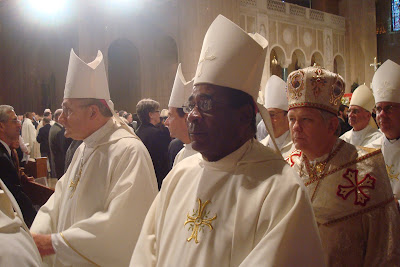
Over 85 U.S. bishops -- including seven cardinals -- gathered at the Basilica of the National Shrine of the Immaculate conception in Washington today for a memorial Mass for the late Archbishop Pietro Sambi, apostolic nuncio to the United States, who died July 27.

Archbishop Timothy Dolan of New York, president of the USCCB, celebrated the Mass and gave the homily. Upon the nuncio's death, Archbishop Dolan called Archbishop Sambi -- who served as nuncio from December 2005 till his death -- a friend of the Church in the United States. The turnout at today's Mass suggested that a good many people -- bishops and not -- agreed.

The presence of the diplomatic community and other dignitaries, including Vice President Biden, reflected the nature of the work of an apostolic (or papal) nuncio.

Some background:

The apostolic nuncio is the closest thing the Vatican has to a ambassador, except unlike an ambassador, which represents his or her country, a nuncio is the personal representative of the pope. So along with his diplomatic duties, the work of a nuncio involves being the eyes and ears of the pope, making recommendations to Rome for bishop appointments.
In this light, Archbishop Sambi's five-and-a-half-year tenure was greatly influential in shaping the U.S. Catholic hierarchy. Dioceses to receive new leadership on his watch included Washington, Baltimore, New York, Los Angeles and Philadelphia, as well as Seattle, Detroit, Milwaukee, St. Louis, New Orleans, San Antonio, Cincinnati, Louisville, Miami and Pittsburgh. This is quite a footprint.

It's worth noting that Archbishop Sambi's death comes only a few years after the deaths after not one, but two of his predecessors as nuncio to the United States.

On January 10, 2009, Cardinal Pio Laghi, nuncio to the United States from 1980-1990, died in Rome. During his tenure, Laghi established full diplomatic relations between the United States and the Holy See, making him this country's first actual nuncio (his predecessors were called apostolic delegates). After his time as nuncio, Laghi returned to Rome where he was made a cardinal and became Prefect of the Congregation for Catholic Education. His successor (Cardinal Agostino Cacciavillan, U.S. nuncio from 1990-1998) was also made a cardinal after finishing stint in the United States, and it was widely held that Archbishop Sambi was bound for a Vatican post and a cardinal's hat before his untimely death.

Eleven days after Cardinal Laghi's death, his predecessor, Archbishop Jean Jadot, died at age 99. Jadot served as apostolic delegate to the United States from 1973-1980, and true to form of being the pope's eyes and ears, his nickname was "Paul's Man in Washington."

They are followed all too quickly by Archbishop Sambi.