Wednesday, March 19, 2014
When a Pope Meets a U.S. President: 2014
President Obama's upcoming meeting with Pope Francis at the Vatican, March 27, marks the 28th time a sitting U.S. President has met with a pope. The meetings, which will now include 12 presidents and 6 popes, are replete with historical odds and ends:
1. Woodrow Wilson met Benedict XV, the Vatican, January 4, 1919. Meeting just after the end of World War I, Wilson had pushed for a lasting peace via his League of Nations proposal, and Pope Benedict had been a powerful advocate for peace throughout the war.
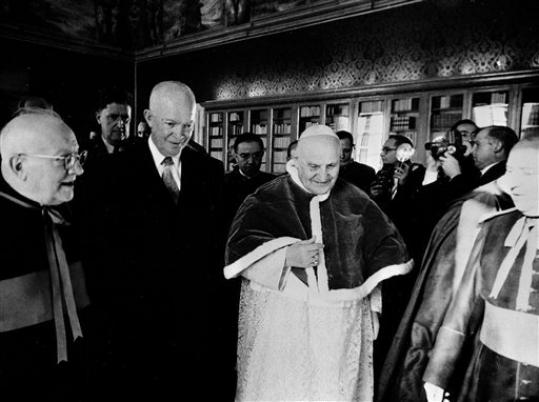
2. Dwight D. Eisenhower met John XXIII, the Vatican, December 6, 1959. Following a 40-year hiatus, this meeting would begin in earnest the precedent of every pope (except John Paul I) and every president meeting. While apparently very genial, this meeting also faced the challenge of Eisenhower not knowing Italian and John XXIII not knowing English.
3. John F. Kennedy met Paul VI, the Vatican, July 2, 1963. While Jacqueline Kennedy met John XXIII in a private audience, JFK missed him by a month, instead visiting the newly-elected Pope Paul. They reportedly discussed civil rights.
4. Lyndon Johnson met Paul VI, New York, October 4, 1965. This meeting took place in the historical context of the first visit by a pope to the United States. Paul VI would visit and address the United Nations while he was in town.
5. Lyndon Johnson met Paul VI, the Vatican, December 23, 1967. This was the first repeat encounter between a particular pope and president. Johnson's record will be matched by Nixon and shattered by the likes of Reagan, Clinton and George W. Bush. Pope Paul will go on to meet two more presidents.
6. Richard Nixon met Paul VI, the Vatican, March 2, 1969.
7. Richard Nixon met Paul VI, the Vatican, September 29, 1970.
8. Gerald Ford met Paul VI, the Vatican, June 3, 1975. Ford was the fourth and final U.S. president met by Pope Paul. John Paul II would meet five.
9. Jimmy Carter met John Paul II, the White House, October 6, 1979. Along with being the first of 15 meetings between Pope John Paul and a sitting president, this was the first time a pope visited the White House, which would go unrepeated until 2008.
10. Jimmy Carter met John Paul II, the Vatican, June 21, 1980.
11. Ronald Reagan met John Paul II, the Vatican, June 7, 1982.
12. Ronald Reagan met John Paul II, Fairbanks, Alaska, May 2, 1984. Pope John Paul was stopping to refuel on his way to Seoul. President Reagan was on his way back from China. While quick and in passing, this meeting still allowed the two to speak about the pressing issues of the time. It also followed shortly after the U.S. and the Holy See formally opened diplomatic relations.
13. Ronald Reagan met John Paul II, the Vatican, June 6, 1987.
14. Ronald Reagan met John Paul II, Miami, September 10, 1987.
15. George Bush met John Paul II, the Vatican, May 27, 1989.
16. George Bush met John Paul II, the Vatican, November 8, 1991.
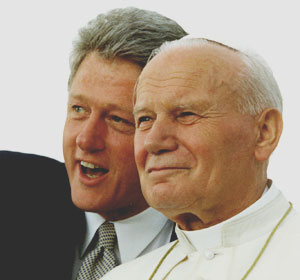
17. Bill Clinton met John Paul II, Denver, August 12, 1993. Pope John Paul was in town for World Youth Day.
18. Bill Clinton met John Paul II, the Vatican, June 2, 1994.
19. Bill Clinton met John Paul II, Newark, October 4, 1995.
20. Bill Clinton met John Paul II, St. Louis, January 26, 1999. President Clinton met with the pope more times on American soil than any other president. Of course, one could argue a traveler like JPII made it easy for him.
21. George W. Bush met John Paul II, Castel Gandolfo, July 23, 2001. This is the first and only time a pope received a president at the papal summer residence in Italy.
22. George W. Bush met John Paul II, the Vatican, May 28, 2002.
23. George W. Bush met John Paul II, the Vatican, June 4, 2004. President Bush presented Pope John Paul with the Presidential Medal of Freedom.
24. George W. Bush met Benedict XVI, the Vatican, June 9, 2007. It's worth noting that Bush, along with former Presidents Bush and Clinton, also attended the funeral of Pope John Paul II in April of 2005, which was also attended by then-Cardinals Joseph Ratzinger and Jorge Mario Bergoglio, S.J., the future Pope Benedict XVI and Pope Francis, respectively.
25. George W. Bush met Benedict XVI, the White House, April 16 2008. Bush also greeted Pope Benedict upon his arrival at Andrews Airforce Base. The White House reception included a birthday celebration for the pope.
26. George W. Bush met Benedict XVI, the Vatican, June 13, 2008. Until next week's meeting, Bush holds the distinction of being the only sitting U.S. president to meet two popes. He has also met with the pope the more times than any sitting president, six.
27. Barack Obama met Benedict XVI, the Vatican, July 10, 2009. Obama held a roundtable discussion with religion writers at the White House in anticipation of the meeting. Benedict presented Obama with a gift of the Vatican's recent document on bioethics.
CNS Photo.
Hat tip to AP for the list of historic dates and places.
Tuesday, February 28, 2012
President Obama: Render Unto God the Things that Are God’s
The current tensions over religious freedom come down to a simple fact: the First Amendment guarantees free exercise of religion. That includes the right of Catholic and other religious institutions to define and carry out their ministry.
An Obama regulation that compels virtually all employers to provide sterilization and contraceptives, including abortion-causing drugs, to employees without co-pay, has a religious exemption. But the exemption is so narrow that Jesus himself wouldn’t qualify. Religious ministries qualify for the exemption only if the people providing the service are Catholic, the ones being served are Catholic, and the service itself comes packaged with religious instruction.
So much for hospital ministry. Will “Where does it hurt?” have to be replaced with “Where were you baptized?” At the soup kitchen will “Are you hungry?” be replaced with “Are you Catholic?” Will we have to teach the hungry the Apostle’s Creed before we feed them?
It is the church, not Caesar, that defines ministry. We Catholics are called to serve others because we’re Catholic, not because they are. We help others because of their need, not their creed. For the government to hold fast to its new definition of ministry, one crafted by the American Civil Liberties Union, reflects deafness to the Constitution that is unbecoming to the man sworn to defend it.
There has been some talk of accommodation, whereby (it is claimed) some Catholic institutions would not have to pay for services that violate their religious beliefs. Apparently, their insurance companies would pay for the services instead. One doesn’t have to be a cynic to question where the money to pay for those services will come from, as the only pool of available funds seems to be the premiums subsidized by the objecting religious institutions. And the government’s problematic definition of religious ministry still remains. There also is the question of what self-insured Catholic organizations are supposed to do. What good does it do to say the dirty work will be done by the insurer rather than the employer, if they are one and the same?
The Administration’s intrusive decision about what does and does not constitute religious ministry should make every American pause. What falls after freedom of religion? Freedom of the press? Will Caesar tell you what you have to print or air?
Days before President Obama reaffirmed his commitment to the miserly religious exemption in his Administration’s regulation; the U.S. Supreme Court issued a unanimous decision pertinent to religious freedom. In the Hosanna-Tabor case, the Court upheld 9-0 the right of a Lutheran Church to decide who its ministers are. The Obama Administration had taken the opposite, and losing, side, arguing that the church had no more right of religious liberty than a secular organization. One would have expected the Court’s resounding rejection of that argument to bring the Administration’s eyes into focus on the religious liberty question. Clearly it did not.
The Bill of Rights in the U.S. Constitution makes freedom of religion the “First Freedom.” The Founding Fathers stressed that this freedom was sacred. George Washington in 1789 wrote to an annual meeting of Quakers that “The conscientious scruples of all men should be treated with great delicacy and tenderness and it is my wish and desire, that the laws may always be extremely accommodated to them.”
Certainly our government, wise as it is, can’t be expected (and shouldn’t purport) to know everything. It might well ease its burdens by leaving some things to the Almighty and rendering unto God the things that are God’s.
Monday, November 7, 2011
Memo to HHS: Show Me the Data
When Cuba Gooding Jr. and Tom Cruise yelled “Show me the money” in the movie Jerry Maguire, it was funny. When the U.S. Conference of Catholic Bishops (USCCB) cries “Show me the data,” it is serious.
“Show me the data” is an urgent request from USCCB’s Migration and Refugee Services. MRS has long worked with the U.S. Department of Health and Human Services (HHS) to help refugees, migrating children, and people trafficked to the U.S. for labor and the sex trade. The U.S. Justice Department recently lauded MRS in a brief defending HHS, which is being sued by the American Civil Liberties Union (ACLU) for working with Catholics. Said the Justice Department, as reported in the Washington Post, “the bishops have been ‘resoundingly successful in increasing assistance to victims of trafficking.’”
Despite this, a recent anti-trafficking grant application from MRS to continue serving people caught in the 21st Century’s version of human slavery was denied. MRS asks why?
I have been informed that six organizations applied for anti-trafficking grants from HHS’s Office for Refugee Resettlement (ORR). Four scored so low they did not make the cutoff when evaluated by an independent review board. Two applicants scored well. Heartland Human Care Services scored highest and MRS came in second, very close to Heartland, even after losing points for not being willing to refer for contraceptives and abortions. Yet, after finagling by Sharon Parrott, one of three politically-appointed counselors to HHS Secretary Kathleen Sebelius, ORR awarded $4.5 million, spread across Heartland, which earned the award, and United States Committee for Refugees and Immigrants and Tapestri, groups that hadn’t made the grade according to the independent review board.
HHS denies any hanky-panky. Show me the data.
Ambassador Johnny Young, who now heads MRS after a stellar career in the U.S. diplomatic corps, asked for data. Young, an African-American, has seen plenty of racial discrimination. Meeting with HHS’s George Sheldon he noted that he recognized discrimination again – this time because of his Catholic faith. When Sheldon, Acting Assistant Secretary for HHS’s Administration for Children and Families, denied the deck was stacked, Young said, in effect, show me the data. No answer yet.
USCCB filed a Freedom of Information Act request to see how these decisions were made. Still no answer.
Defenders of HHS say the government has (until now, at least) partnered with the church to help refugees and others in need in diverse programs. As they rattle off grants they sound like a thief declaring “I use banks regularly. This is the only one I’ve robbed.”
Parrott explained her unusual involvement in the grant-making decisions, telling the Washington Post that “when important issues that are a priority arise, it’s common for senior policy advisers to have a dialogue to reach the best policy decision.” So much for President Obama’s 2010 Executive Order that addressed meddling by political appointees, "Fundamental Principles and Policymaking Criteria for Partnerships With Faith-Based and Other Neighborhood Organizations." Said the President: "Decisions about awards of Federal financial assistance must be free from political interference or even the appearance of such interference and must be made on the basis of merit, not on the basis of the religious affiliation of a recipient organization or lack thereof." Something’s amiss.
ORR said that in the 2011 anti-trafficking contracts, it would favor proposals where the recipient would refer for the full range of legally permissible obstetric and gynecological services, a code for contraceptives, abortion and sterilization. It did not say it would simply exclude applicants on this basis. Even with this handicapped status, USCCB beat out USCRI and Tapestri – until apparently the rules changed.
Whether or not this pro-abortion/contraception favoritism is legal is one question. Whether there was a demand for these services is another.
In the hierarchy of needs for trafficking victims, it would seem that safety, food, shelter, legal support and medical care have priority. Do trafficking victims who fear that their traffickers will kill them for escaping think “contraceptives first”? Is it the concern of the men, who as labor-trafficking victims comprised about two-thirds of the survivors who were helped by the previous anti-trafficking grant that MRS held for more than five years? If there were an unmet need or any complaint by those served, show me the data.
HHS’s manipulation was not harmless. The new grants were to go only to programs that would be up and operating within ten days of the date of the awards. Instead, 450 enrolled victims of trafficking and their families were left without services when the new awardees were not ready to roll on time.
Abortion politics blinds some people. Now the proponents have gone so far that HHS will violate an executive order and gut a program that has successfully served thousands of vulnerable people. Someone needs to deal with this travesty. MRS and the American people have the right to demand: “Show me the data!”