Showing posts with label Pope John Paul II. Show all posts

Friday, November 14, 2014

Catholic and Orthodox, Two Traditions Gradually Growing Together

By Father Ronald Roberson, CSP

When the Second Vatican Council was convened, there had been virtually no relationship at all between the leadership of the Catholic Church and the Orthodox Churches of the East for over 500 years. The last time a pope and Patriarch of Constantinople had met was in 1438. But when he convoked the Council, Pope John XXIII made sure that the unity of Christians was high on its agenda. This was due in part to his personal experience during the years he lived in Bulgaria, Turkey and Greece as papal representative to those countries, where he gained an appreciation of Eastern Christianity.

In its final form, the Decree on Ecumenism (Unitatis Redintegratio) has a separate section dedicated to relations with the Orthodox entitled, “The Special Position of the Eastern Churches” (paragraphs 14-18).  These churches are special first and foremost because the Catholic Church recognizes the validity of Orthodox sacraments. In fact, since we share the same Eucharist and sacrament of Holy Orders, the Orthodox Churches “are linked with us in closest intimacy.” The decree goes on to praise the many spiritual and theological treasures that are found in the Christian East and recognizes that these churches “have the power to govern themselves according to the disciplines proper to them, since these are better suited to the character of their faithful, and more for the good of their souls.”  The decree also calls for a gradual realization of unity between Catholics and Orthodox, “especially by prayer, and by fraternal dialogue on points of doctrine and the more pressing pastoral problems of our time.”

The centuries-long icy silence between Catholics and Orthodox had already been broken in January 1964, when Pope Paul VI and Ecumenical Patriarch Athenagoras met in the Holy Land. Now the process of reconciliation was quickly moving forward. The excommunications of 1054 were “erased from the memory of the church” in 1965, and Pope Paul and Patriarch Athenagoras exchanged visits in Rome and Istanbul in 1967.

In 1979, an official theological dialogue between the Catholic Church and the Orthodox Church was established by Pope John Paul II and Patriarch Demetrios of Constantinople. It produced some important agreed statements in its early years, but has run into difficulty following the clashes between Catholics and Orthodox after the collapse of communism in Eastern Europe. It is now looking at the vexed question of primacy in our churches.

The most fruitful Catholic-Orthodox dialogue begun after Vatican II has been the one in North America.  Founded in 1965, it has produced about 30 agreed statements over the years on a wide variety of topics. Its most recent major study was its “Steps Towards a Reunited Church” document that outlines what a reconciled Orthodox and Catholic Church might look like and the role that the pope would play in it. In early June, it issued a brief agreed statement calling for the restoration of the faculty of Eastern Catholic bishops in North America to ordain married men to the priesthood. This would not only recognize an authentic Eastern Christian tradition, but would also serve as an assurance to the Orthodox (most of whose parish clergy are married) that the Catholic Church would respect their longstanding traditions.

Relations between Catholics and Orthodox have improved immeasurably since the Decree on Ecumenism was issued nearly 50 years ago. As Pope Francis and Patriarch Bartholomew put it so well in their Joint Declaration in the Holy Land in May, “While fully aware of not having reached the goal of full communion, today we confirm our commitment to continue walking together towards the unity for which Christ our Lord prayed to the Father so 'that all may be one' (Jn 17:21)."

Father Ronald Roberson, CSP is associate director of the Secretariat for Ecumenical and Interreligious Affairs of the U.S. Conference of Catholic Bishops. He is also a consultor to the Vatican's Congregation for the Oriental Churches. This post is part of a series commemorating the 50th anniversary of Unitatis Redintegratio, the Decree on Ecumenism of the Second Vatican Council.

CNS Photo/Paul Haring

Wednesday, March 19, 2014

When a Pope Meets a U.S. President: 2014

Note: This post is an update of an earlier piece we wrote in anticipation of President Obama's July 10, 2009 meeting with Pope Benedict XVI.

President Obama's upcoming meeting with Pope Francis at the Vatican, March 27, marks the 28th time  a sitting U.S. President has met with a pope. The meetings, which will now include 12 presidents and 6 popes, are replete with historical odds and ends:

1. Woodrow Wilson met Benedict XV, the Vatican, January 4, 1919. Meeting just after the end of World War I, Wilson had pushed for a lasting peace via his League of Nations proposal, and Pope Benedict had been a powerful advocate for peace throughout the war.

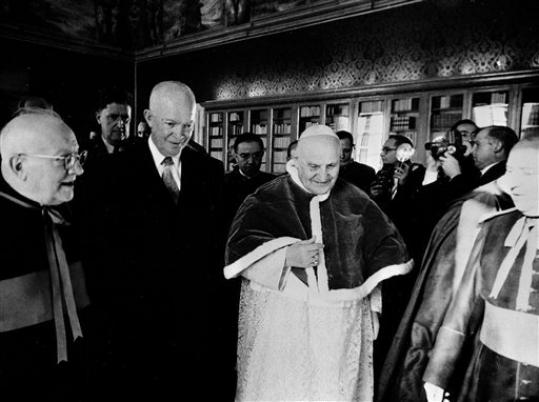
2. Dwight D. Eisenhower met John XXIII, the Vatican, December 6, 1959. Following a 40-year hiatus, this meeting would begin in earnest the precedent of every pope (except John Paul I) and every president meeting. While apparently very genial, this meeting also faced the challenge of Eisenhower not knowing Italian and John XXIII not knowing English.

3. John F. Kennedy met Paul VI, the Vatican, July 2, 1963. While Jacqueline Kennedy met John XXIII in a private audience, JFK missed him by a month, instead visiting the newly-elected Pope Paul. They reportedly discussed civil rights.

4. Lyndon Johnson met Paul VI, New York, October 4, 1965. This meeting took place in the historical context of the first visit by a pope to the United States. Paul VI would visit and address the United Nations while he was in town.

5. Lyndon Johnson met Paul VI, the Vatican, December 23, 1967. This was the first repeat encounter between a particular pope and president. Johnson's record will be matched by Nixon and shattered by the likes of Reagan, Clinton and George W. Bush. Pope Paul will go on to meet two more presidents.

6. Richard Nixon met Paul VI, the Vatican, March 2, 1969.

7. Richard Nixon met Paul VI, the Vatican, September 29, 1970.

8. Gerald Ford met Paul VI, the Vatican, June 3, 1975. Ford was the fourth and final U.S. president met by Pope Paul. John Paul II would meet five.

9. Jimmy Carter met John Paul II, the White House, October 6, 1979. Along with being the first of 15 meetings between Pope John Paul and a sitting president, this was the first time a pope visited the White House, which would go unrepeated until 2008.

10. Jimmy Carter met John Paul II, the Vatican, June 21, 1980.

11. Ronald Reagan met John Paul II, the Vatican, June 7, 1982.

12. Ronald Reagan met John Paul II, Fairbanks, Alaska, May 2, 1984. Pope John Paul was stopping to refuel on his way to Seoul. President Reagan was on his way back from China. While quick and in passing, this meeting still allowed the two to speak about the pressing issues of the time. It also followed shortly after the U.S. and the Holy See formally opened diplomatic relations.

13. Ronald Reagan met John Paul II, the Vatican, June 6, 1987.

14. Ronald Reagan met John Paul II, Miami, September 10, 1987.

15. George Bush met John Paul II, the Vatican, May 27, 1989.

16. George Bush met John Paul II, the Vatican, November 8, 1991.

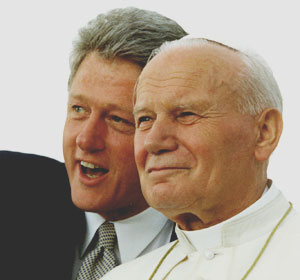
17. Bill Clinton met John Paul II, Denver, August 12, 1993. Pope John Paul was in town for World Youth Day.

18. Bill Clinton met John Paul II, the Vatican, June 2, 1994.

19. Bill Clinton met John Paul II, Newark, October 4, 1995.

20. Bill Clinton met John Paul II, St. Louis, January 26, 1999. President Clinton met with the pope more times on American soil than any other president. Of course, one could argue a traveler like JPII made it easy for him.

21. George W. Bush met John Paul II, Castel Gandolfo, July 23, 2001. This is the first and only time a pope received a president at the papal summer residence in Italy.

22. George W. Bush met John Paul II, the Vatican, May 28, 2002.

23. George W. Bush met John Paul II, the Vatican, June 4, 2004. President Bush presented Pope John Paul with the Presidential Medal of Freedom.

24. George W. Bush met Benedict XVI, the Vatican, June 9, 2007. It's worth noting that Bush, along with former Presidents Bush and Clinton, also attended the funeral of Pope John Paul II in April of 2005, which was also attended by then-Cardinals Joseph Ratzinger and Jorge Mario Bergoglio, S.J., the future Pope Benedict XVI and Pope Francis, respectively.

25. George W. Bush met Benedict XVI, the White House, April 16 2008. Bush also greeted Pope Benedict upon his arrival at Andrews Airforce Base. The White House reception included a birthday celebration for the pope.

26. George W. Bush met Benedict XVI, the Vatican, June 13, 2008. Until next week's meeting, Bush holds the distinction of being the only sitting U.S. president to meet two popes. He has also met with the pope the more times than any sitting president, six.

27. Barack Obama met Benedict XVI, the Vatican, July 10, 2009. Obama held a roundtable discussion with religion writers at the White House in anticipation of the meeting. Benedict presented Obama with a gift of the Vatican's recent document on bioethics.

CNS Photo.

Hat tip to AP for the list of historic dates and places.

Monday, September 30, 2013

Pope Francis and The Disposable Garment

By Bishop John Wester

Pope John Paul II, to be canonized on April 27 by Pope Francis, was one of many people who've decried a "culture of death" in recent decades. The description was warranted, but Catholics also believe that natural death is a part of life and can be beautiful and dignified.

So Pope Francis offers an alternative view, in which the problem isn't so much death as it is "a culture of waste," in which everything, even human beings, are treated as disposable commodities when they are no longer "useful." Pope Francis tied this mentality to throwing away excess food at his June 5 general audience and later on Twitter, saying that "throwing food away is like stealing it from the poor and hungry." He revisited the "throwaway culture" July 22, en route to Brazil for World Youth Day, this time using the term in reference to society's treatment of young people. He invoked it yet again on September 20, regarding abortion.

The late Cardinal Joseph Bernardin of Chicago brought together disparate voices in the Church by showing how our teachings fit together in one "seamless garment." Pope Francis offers the flip side, how the Church's teachings fit together even when the world ignores them. "Pope says wasting food is a sin" may make for entertaining headlines, but it misses the genius of the cohesive Catholic vision Pope Francis offers the world, of how much Catholic teaching can be encapsulated in this "disposable garment."

It applies to how we relate to:
  • The poor, who have been a focus of Francis' pontificate, explicitly mentioned by the pope as those excluded from society at a local, national and global level.
  • The unborn, whether they are destroyed in the name of convenience or personal freedom with abortion or in the name of scientific progress with embryonic stem cell research.
  • The elderly, sick and disabled, when voices in our society suggest that physician assisted suicide ought to be the law of the land because some lives just aren't worth living.
  • Immigrants, who have been treated as a convenient source of menial labor, but have not been recognized by society or rewarded for their contributions.
  • Workers, who are not a means to an end, profit, but people deserving of a living wage and whose work deepens their sense of human worth.
  • The imprisoned, who are easier to write off and forget, or even dispose of altogether, than to rehabilitate and restore. Pope Francis showed us, through the gesture of washing feet, that these people are still to be loved and supported.
  • The environment, not a commodity to be used up as we please, but something precious, created by God and left in our care.
  • Young people: as Pope Francis has explicitly pointed out, young people are the future, and yet society perpetuates circumstances in which they cannot find jobs and face crushing educational debt.
  • Our relationships: Cardinal Timothy Dolan of New York has spoken frequently of a vocations crisis, not just in the priesthood, but in marriage. Many people treat their marriages as disposable, not as lifelong commitments. Fewer people are bothering to get married at all. News stories profile "hook-up culture" on college campuses in place of young people pursuing lasting relationships.
  • The Internet: Whether it's pornography, a news story or even a meme, the Internet provides endless opportunities to use people as disposable pleasure objects, laugh derisively at them, yell at them or otherwise dismiss them. Digital technology can build up human interconnectivity like never before. It also allows us to demean on a dizzying scale, whether by perpetuating the "rape culture" that trivializes violence toward women or through a political discourse built on demonizing people. Which brings us to...
  • People who are different from us: whether it's unrest in places like Syria and Egypt, conflict between countries or our own discourse, people of different cultures, countries, religions and points of view deserve our respect, not acts of intolerance and violence that degrade or even eliminate them.
  • Our vocations, both religious, personal and professional: Archbishop Claudio Celli, president of the Pontifical Council for Social Communications, told members of the Catholic Press in 2012 that a new problem exists in the world today: "people have forgotten how to dream." People have lost the sense that God has a plan for every person. We are not here to waste time, but to pursue the vocation that makes us ever more the person that God intends us to be.
Benedict XVI frequently emphasized all the Church says yes to, because Christianity ultimately is a positive proposition of God loving every person and drawing the entire world to himself through Jesus. For Pope Francis, this means saying yes to a "culture of encounter." To overcome a throwaway culture, every person must go out into the world, encounter other people as more than commodities, and learn to treat everyone with the dignity they deserve. For Catholics, this pervades the teachings of our Church and is fundamental to our ability to encounter Jesus Christ.

Bishop Wester is bishop of the Diocese of Salt Lake City and chairman of the Communications Committee of the U.S. Conference of Catholic Bishops.

(CNS Photo/Paul Haring)

Tuesday, June 25, 2013

World Youth Day: Twenty Years Ago


By Sister Mary Ann Walsh

Twenty years ago this August Denver hosted World Youth Day, the first time the world event took place in the U.S. As WYD director of communications, I was on a core team from Washington with Father Dennis Schnurr, WYD executive director and now archbishop of Cincinnati, and Paul Henderson, WYD director of programming and now director of planning and communication operations at the USCCB. We’ve remained friends, with the kind of friendship borne of going to war together.

When I speak about WYD, I compare it to an elephant, one you gently prod to move where you’d like it to go, but knowing at any moment it could overpower you. If we knew how big WYD would become, we would have been afraid. With blissful ignorance, we set off for a fun adventure.

Though founded in Rome in 1985, WYD hadn’t quite caught on. The Vatican thought that holding the event in the USA would establish it. They counted on the immense media presence and U.S. ingenuity and organization. Their confidence was well placed.

As a reporter in Rome, I had traveled with Pope John Paul II. But sitting on a plane with him was a far cry from organizing media for an event to draw about 2,000 journalists and setting up a structure for TV and radio coverage. Early on, I took my concerns to Tim Russert, enthusiastic Catholic and host of NBC’s Meet the Press. With an analysis reflective of a man used to working within walls of power, he explained how to work with the media. “You own the pope, so you’re in charge,” he said.

Now if you want to be empowered, convince yourself you own the pope. When TV producers would balk at our plans, I would remain calm because, as Russert had assured me, I owned the pope. Russert also offered the help of veteran NBC special events producer Bob Asman, who had just organized the TV pool coverage of the Democratic National Convention in New York City. “We’ll call him the ‘secret missionary for God,’” Russert laughed. Asman so impressed the TV stations in Denver that had formed a consortium to deal with the largest event they’d ever known, that they hired him almost as soon as they met him.

When Catholic youth heard about WYD, they responded in force and surprised the bishops. Youth begged to go to the church event instead of church leaders begging them to go. Bishops who traveled with them found it life changing. It was a booster shot for the shepherds to be surrounded by energetic sheep. Their enthusiasm caught reporters up short. Media geared up for protests, but they never materialized. When one reporter asked a girl about her feelings on birth control and abortion, she told him teen-style, “Get a life!” The days were for prayer, not protest. The Washington Post reported the event was like Woodstock, with all of the good and none of the bad of the 1969 rock concert at a farm in the Catskills.

When I returned home, I had WYD on my mind. I must have overdone it because a friend told me one evening as we went down to Washington’s Union Station that all I talked about was World Youth Day. “I’m sure it was wonderful for you,” she said, “but let it go.” When we got to the station, a teenager bounded toward me across the Main Hall. “Hey, Sister Mary Ann,” he shouted. “Remember me? We met at World Youth Day. It was great.” My friend laughed, “Case closed,” she said, “I guess it was an event to last a lifetime.”


Tuesday, January 22, 2013

Bridging Unity and Love: the Pope and Other Christians

Easily the most significant issue dividing Catholics from other Christians is the role, and even the mere existence, of the pope. Even popes have weighed in on this. In 1967, Pope Paul VI acknowledged that the papacy was "the gravest obstacle in the path of ecumenism."

The tragedy here is that the papacy is a ministry of unity, not division. While most of the world looks at the pope and sees some kind of "supreme ruler," the actual papal job description, if you will, is more like the hub of a wheel that connects all the spokes, the point that brings everything together. This is why, in Catholicism, local dioceses and their bishops are said to be "in communion" with the bishop of Rome. Even the Latin name for the pope, Pontifex Maximus, means "chief bridge builder."

Which is why Pope John Paul II tackled the thorny question of the papacy and other Christians in his 1995 encyclical Ut Unum Sint (That They All May Be One). The challenges of this letter will be one focus of the next round of the Catholic-Reformed dialogue in the United States, beginning January 28.

What John Paul II said

Pope John Paul issued an invitation to other Christians to dialogue with him about the nature of his office. How could he exercise his authority as pope, he wanted to know, in a way that would promote unity among all Christians, not just Catholics?

To illustrate what he meant, the pope described the papacy in biblical and pastoral terms, as a ministry of love that helps the authentic voice of Christ to be heard. He added that the pope must have the authority necessary to carry out this role and ensure unity among Christians.

Other Christians respond

  • The Church of England responded in 1997, noting that their dialogue with Catholics had already agreed on the need for a universal primate at the center of the Church. Such a bishop, they said, would work in communion with the rest of the world's bishops and ensure that local or regional churches didn't strike out on their own or take positions abhorrent to the rest of the Church.
  • The Lutheran bishops of Sweden noted in their response that, despite the historically negative view of the papacy taken by Lutherans, progress was possible if the pope's ministry were clearly integrated into the college of bishops. Even Martin Luther, they said, wrote that the papacy would be acceptable if it were clearly subordinate to the Word of God and if an agreement could be reached on the question of justification (which happened in 1999).
  • The Presbyterian Church-USA welcomed the inviting spirit of John Paul II's encyclical, as well as the new language he used to describe his ministry. They expressed doubt over concepts like infallibility and entrusting a universal ministry to one person, but left room for an essentially spiritual ministry exercised by a person of "extraordinary spiritual insight and incandescent personhood."
  • Orthodox Christians have never officially responded to the encyclical, but in 2007, an international dialogue of Catholics and Orthodox approved the Ravenna Statement, which agreed the bishop of Rome held a place of honor among bishops in the ancient Church, and that he should also exercise some sort of primacy in the Church today. While much more dialogue between Catholics and Orthodox is required, this document is still a breakthrough.

The way forward

As Catholics and Reformed Christians meet this month to discuss this challenge from John Paul II, perhaps the best response from Catholics and other Christians is to take seriously the Week of Prayer for Christian Unity (January 18-25) and ask God to help the leaders and scholars gathered in dialogue to see old questions with new insight and move closer to each other as they move closer to Christ.

This post is adapted from "A Pope for All Christians?" a resource developed by the Committee for Ecumenical and Interreligious Affairs of the U.S. Conference of Catholic Bishops, which is available from USCCB Publishing.

Friday, January 18, 2013

Seven Markers on the Road to Christian Unity

By Father John Crossin

The Week of Prayer for Christian Unity is January 18-25. With an estimated 41,000 denominations in Christianity today, it's certainly worth praying for. Such prayer goes back to the example of Christ praying "that they all may be one" at the Last Supper (John 17:21). God has answered this prayer, and continues to answer it, if incrementally, with every new development in various ecumenical dialogues around the world. Each is another step on the road to Christian unity. Here are seven significant markers along that road:

1. Vatican II opens the door. With its 1964 decree on ecumenism, Unitatis Redintegratio (Restoration of Unity), the Second Vatican Council launched the Catholic Church on its current trajectory of dialogue and seeking increased understanding with other Christians. While the broader ecumenical movement began earlier in the 20th Century, this was where Catholics officially entered the story. The dialogues kicked off in its wake continue at the global, national and local levels today.

2. East and West begin their thaw. After a fruitful meeting in 1964, Pope Paul VI and Ecumenical Patriarch Athenagoras I declared in 1965 that they were lifting the mutual excommunications of 1054 that symbolized the official split between the Catholic and Orthodox churches, one of the oldest rifts in Christianity. Five years later, Pope Paul and Patriarch Athenagoras even considered a proposal to concelebrate the Eucharist. That plan never came to be, but the desire for unity by both parties remains an example.

3. 'Justification' question no longer divides. By the end of the 20th Century, Catholics and Lutherans had almost 500 years of experience in caricaturing what the other believed on the question of how people are justified before God. (Cardinal Francis George of Chicago explains it brilliantly in this video.) While Catholic and Protestant theologians had worked towards a convergence on this issue for decades, and early progress on this point had been made by the Catholic-Lutheran dialogue in the United States, it was the 1999 Joint Declaration on the Doctrine of Justification that finally took the issue off the table as a point of division. In 2006, the Methodists joined Catholics and Lutherans in signing the agreement.

4. The Ravenna Statement. Meeting in Ravenna, Italy in 2007, international Catholic and Eastern Orthodox delegations explored questions of authority and its exercise in the Church. The dialogue issued a statement that agreed the bishop of Rome held a place of honor among bishops in the ancient Church, and that he should also exercise some sort of primacy in the Church today. Cardinal Walter Kasper, the lead Vatican representative, called this a "breakthrough," but acknowledged that much more dialogue was necessary.

5. A road map emerges. In 2010, the North American Orthodox-Catholic dialogue issued an agreed statement that provided an unprecedented practical picture of what unity between East and West would look like and steps the two churches could take to reach that point. The document recommends collaboration on shared pastoral challenges, joint prayer and social ministry and a mutual recognition at all levels that Catholics and Orthodox belong to "sister churches."

6. Agreement on baptism. Back on the Protestant side of ecumenism, in 2010, the Catholic-Reformed dialogue (which includes the Christian Reformed Church in North America, the Presbyterian Church-USA, the Reformed Church in America and the United Church of Christ) reached a Common Agreement on Baptism, including a common formula of using flowing water and invoking the Father, Son and Holy Spirit. Practically speaking, this agreement resolved issues that stood in the way of fully recognizing each other's baptisms.

7. Next steps. On January 28-29, the next round of the Catholic-Reformed dialogue will begin to explore the 1995 encyclical Ut Unum Sint (That They All May be One). In that encyclical, Pope John Paul II highlighted the papacy as a ministry of unity (for instance, all Catholics are said to be in communion with the bishop of Rome, and even the title Pontifex Maximus means "chief bridge builder"). He called on other Christian denominations to dialogue with him about how he could exercise this ministry in a way that would promote a broader unity among all Christians. A pope for Protestants too? The Holy Spirit has brought greater surprises.

Father John Crossin is executive director of the Secretariat for Ecumenical and Interreligious Affairs of the U.S. Conference of Catholic Bishops.

Monday, November 19, 2012

The Council at 50: The Priest: Ever Growing for His People


Welcome to one of the series of blogs on the Second Vatican Council. Each piece reviews one of the 16 documents produced by the Council Fathers during the extraordinary occasion in Church history. Vatican II, which drew together the world’s bishops, opened fifty years ago in St. Peter’s Basilica, October 11, 1962.

(Courtesy of Catholic News Service)

The qualities of today’s priest stood out in Presbyterorum Ordinis (of the Order of Priests), the “Decree on the Ministry and Life of Priests” promulgated December 7, 1965 by the Second Vatican Council.

The decree highlighted the call to preach the Gospel to all people as the “first task of priests.” The Council refocused the Church on the centrality of the Word of God and raised the Liturgy of the Word to greater prominence within the Mass. Since then, priests have worked to improve the quality of preaching to move the hearts of both priest and the faithful to conversion and a more dedicated fidelity to Jesus Christ.

The “Decree on the Ministry and Life of Priests” speaks of priests as the “indispensable helpers and advisers” of the bishops in the ministry of teaching, sanctifying and shepherding the People of God. Since this decree, the Church has developed the Presbyteral Council, a group of priests chosen by the bishop to advise him in diocesan matters.

The most important development occurred with Pope John Paul II’s Apostolic Exhortation I Will Give You Shepherds. The pope wrote that within the Church, the priest is a “man of communion.” This phrase captures the heart of priesthood: a man in communion with God who is called to become a mediator of this relationship, bringing God to people and people to God. This happens in many ways, and especially at Mass. As a man of communion the priest also is called to become “a man of mission and dialogue.” Priesthood is never simply about the priest. It is about mission – carrying the message of Jesus Christ into a world hungry for meaning and purpose. It is about dialogue – bringing people within the Church and outside of it into community. The priest is to be a man of witness and a man of peace.

The “Decree on the Ministry and Life of Priests” called for the Church to engage in the “progressive formation” of priests. Since then, a great deal of vision and effort has gone into the formation of priests after their ordination. Blessed John Paul spoke with eloquence on this need for the ongoing formation of priests quoting St. Paul in his Second Letter to Timothy: “I remind you to rekindle the gift of God that is within you.”  The U.S. Bishops promulgated the Basic Plan for the Ongoing Formation of Priests in June 2000 to implement the pope’s vision for the renewal of priests here in the United States.

This “rekindling” must happen in several areas. The priest is called to grow in human formation, the decree said, “to develop and sharpen his human sensitivity” to understand the needs and unvoiced questions of his people. He needs spiritual formation, to deepen his relationship to the Father through the Son and in the Holy Spirit. He needs intellectual formation to be an ongoing student of Scripture, theology, and the culture in which he lives. And he needs on-going pastoral formation to help him grow in his pastoral charity, exercising a shepherd’s care for his people. In other words, he is to grow in the virtue of love.

Each priest is called to engage in this formation as a young, middle-age, or older priest.

Finally, “The Decree on the Ministry and Life of Priests” calls priests once again to imitate Jesus the Master: They are to serve and not be served. They are called to improve their ability to listen before they speak. This humility is central to the spirituality of the priesthood and is an ever-present challenge to any attitudes of superiority or pride. Clericalism has no place in a Church that seeks to evangelize – to bring Christ and his love to the world.

---

Archbishop Robert Carlson of St. Louis chairs the U.S. bishops’ Committee on Clergy, Consecrated Life and Vocations.


Tuesday, July 17, 2012

Faith, Science and a Grownup's God

As Americans celebrated Independence Day, the world's scientists celebrated the discovery of the elusive Higgs-bosun, a sub-atomic particle first theorized half a century ago that would help explain why some particles gain mass. Popular culture has nicknamed the Higgs "the God particle."

In a July 9 Newsweek article, a physicist says this nickname for the Higgs is particularly unfortunate because, he argues, its discovery might actually help eliminate the need for God: "...it validates an unprecedented revolution in our understanding of fundamental physics and brings science closer to dispensing with the need for any supernatural shenanigans all the way back to the beginning of the universe," he writes, concluding: "The Higgs particle is now arguably more relevant than God."

While believers would understandably take issue with this assertion, perhaps one of the better qualified to tackle it is Jesuit Brother Guy Consolmagno, a.k.a. the Vatican astronomer.

Like the author of the Newsweek piece, Brother Consolmagno sees the importance of the discovery of the Higgs particle. He explains in an interview with Catholic News Service that "It indicates that reality is deeper and more rich and strange than our everyday life." While he doesn't directly rebut the assertion that the Higgs particle makes God obsolete, he does criticize the thinking behind it, saying it's bad religion to employ a "God of the gaps," i.e. to explain the missing parts of scientific discovery by saying that's where divine intervention occurred.

Father Thomas Weinandy, OFM Cap., head of the U.S. bishops' Secretariat on Doctrine, cites another  issue: "While the Higgs particle may help us in understanding the relationship between mass and matter, it does not explain why the Higgs particle itself exists." He notes that nothing in the nature of the universe, from a tree or a person to the cosmos themselves, demands that things exist. "There must be a being whose very nature demands that it exists and, because of this, is able to bring other beings into existence," he says. "That being is God."

To better understand these points about faith, science and the nature of existence, it's helpful to look at another infamous faith/science flash point: evolution. Like the discovery of the Higgs particle, evolution involved scientific discovery seemingly stepping into territory reserved for God in the Genesis creation accounts. And as the ensuing culture wars have played out from the Scopes Monkey Trial of the 1920s down to the various Intelligent Design-themed skirmishes on school boards, one suspiciously absent player has been the Catholic Church.

From the 1950 encyclical of Pope Pius XII, Humani Generis, to the 1996 address by Pope John Paul II to the Pontifical Academy of Sciences, the position of the Catholic Church has ranged from openness to acceptance, seeing no clash between science and theology on the question of evolution. In fact, when the Pontifical Council for Culture held a symposium on Darwin in 2008, it invited leading scholars in biology and theology, but pointedly didn't include either biologists with aggressively secular views of their field or proponents of creationism and Intelligent Design.

One could argue that the Church learned the lessons of the Galileo dust-up of 400 years ago and started recognizing that science and faith seek to answer different sets of questions about human existence and ultimate reality. In making this important distinction between empirical fact and revealed truth, the Church moved to a deeper understanding of a God who is ever in control and works implicitly through the natural phenomena of creation, as opposed to clumsily and cartoonishly shoehorning Himself over them.


(Similar to science and religion, last year this blog tackled the topic of how faith perspectives fits into public policy debates.)

In both the origins of the universe and the species, the Catholic Church affirms the important work of science and, implicitly, calls on everyone, Catholic or not, to a more mature understanding of who God is and how God works. It's easy for physicists (and just about anyone, for that matter) to write off religion as somewhere between outdated and laughable when its adherents insist on presenting God, in the words of singer-songwriter Regina Spektor, "like a genie who does magic like Houdini or grants wishes like Jiminy Cricket and Santa Claus."


With this perception, there is nothing surprising about a lopsided commentary that couples an advanced grasp of science with an elementary grasp of God. It should challenge believers to approach their faith in such a way that, the next time something as tiny as a subatomic particle has universe-defining implications, no one will be able to say, in  the the words of the Anglican scholar J.B. Phillips: "Your God is too small."

Friday, April 20, 2012

Catholics Care. Catholics Vote: Strengthening and Defending Marriage is a Matter of Justice

By Bethany Meola

Marriage is clearly a big deal for Catholics.

Even many non-Catholics know that, for instance, the Catholic Church doesn’t recognize divorce and that being married in the Church is important to Catholics. Delving into Catholic teaching itself, Scripture is filled with references to marriage, and the Church presents it as a vocation and as one of the Sacraments, a visible sign of God’s gift of grace.

What might be more surprising is that, for Catholics, marriage is also a key public policy issue, in fact one of six raised by the U.S. bishops when they reissued Forming Consciences for Faithful Citizenship, their call to political responsibility. This means marriage is not only something that matters to the doctrine of the Church and the private lives of the people entering into it. It matters to all society.

The reason it matters is because marriage affects the common good. In fact, the two are inseparably intertwined. As the Second Vatican Council put it, “The well-being of the individual person and of human and Christian society is intimately linked with the healthy condition of that community produced by marriage and the family.” In fact, because the union of husband and wife is uniquely capable of welcoming new life into the world, the Church describes marriage as the very “condition” for society’s existence.

The family founded on marriage plays a profound educational role in society. Pope John Paul II taught that the family is “the first and irreplaceable school of social life,” where each person “learns what it means to love and to be loved, and thus what it actually means to be a person.” This “dynamic of love” emanates from the total self-giving union between husband and wife.

Because of marriage’s unique contribution to society, all people should be concerned with its well-being. In Forming Consciences for Faithful Citizenship, the bishops write that, in light of the tragic consequences of marriage’s breakdown or disappearance, especially for children, “policies on taxes, work, divorce, immigration, and welfare should help families stay together.” They also advocate for wages that “allow workers to support their families” and for public assistance for struggling families.

In addition to urging policies that strengthen marriages and families, the bishops are deeply concerned with “intensifying efforts” to redefine marriage, namely proposals to remove sexual difference from marriage. This is not “expanding” marriage, as the bishops see it, but rather redefining it and in effect dismantling it. Sexual difference is not an optional component of marriage but rather an essential element, rooted in the nature of the human person created male and female.

Both the bishops of the United States and Pope Benedict XVI have stated that defending marriage as the union of one man and one woman is, as the Pope taught in one ad limina talk, “ultimately a question of justice, since it entails safeguarding the good of the entire human community and the rights of parents and children alike.” Defending marriage does justice to the child by providing him or her with the best possibility of knowing and being loved by both mother and father together. In contrast, redefining marriage asserts that mothers and fathers are interchangeable and denies a child the right to know both a father and a mother. It also obscures the core of marriage, namely the union of husband and wife founded on sexual difference.

Standing up for marriage can be difficult and often uncomfortable in today’s cultural climate, but it’s essential for the good of marriage itself and for the common good, especially for the welfare of children. The USCCB offers resources to help Catholics understand and articulate what marriage is and why it matters. Preserving, strengthening and defending marriage are matters of justice that should matter to everyone.

Bethany Meola is program specialist for the USCCB’s Subcommittee for the Promotion and Defense of Marriage.

Thursday, September 29, 2011

The Footprint of Francis

This weekend, the usual human foot traffic around Catholic parishes will be joined by the paws of numerous dogs and cats, as well as hamsters, birds and whatever other pets the faithful choose to bring along for the annual blessing of the animals in conjunction with the feast of St. Francis of Assisi (the great saint who gave up everything to live in poverty) on October 4.

USCCB Communications has even brought the tradition into the digital realm this year by gathering photos of pets from fans of the Conference's Facebook page and turning them into an online photo album and video slideshow. As the blessing of animals -- not to mention his ubiquitous presence in countless backyard birdbaths -- attests, Francis, the patron saint of animals and the environment, is also one of the most popular, beloved saints in history.

The influence of Francis is everywhere. The order he founded has branches and communities all over the globe (including one for laypeople). The bishops of the United States have two Capuchin archbishops among them. Churches, hospitals, charitable organizations and universities bear his name.

Sayings are associated with the saint, such as, "Preach the Gospel always, and if necessary use words." While we don't know if Francis actually said this, his lifestyle certainly reflects it, as does the the story of his preaching to the birds. From a communication standpoint, one has to wonder if this makes him the first saint ever to "tweet."

St. Francis also worked with live animals when he initiated the tradition of the Christmas creche in the village of Greccio around the year 1220. Not everyone knows that such a holiday staple as the manger scene has ties to Francis of Assisi.

St. Francis is also associated with peacemaking. The popular "Lord, make me an instrument of your peace" prayer has long been attributed to him. Another famous animal-related incident involves St. Francis taming a wolf that had been terrorizing the nearby village of Gubbio. On a human scale, he reached out to a sultan whose armies were besieging the Egyptian city of Damietta, which seemingly makes him a pioneer in interreligious dialogue as well.

Pope John Paul II followed this lead when representatives of different religions gathered in Assisi for a day of prayer for peace on October 27, 1986. Holding this meeting in the hometown of Francis testified to the saint's legacy. In a nod to the significance of this event, Pope Benedict XVI plans to mark its 25th anniversary with a similar gathering.

One quality that made St. Francis a peacemaker might have been his ability to recognize God in everyone and everything around him. This is highlighted beautifully in his "Canticle of the Sun," in which he praises God through the wonders of creation, personifying different aspects of nature as "Brother Sun," "Sister Moon," "Brother Wind," and so on. It's no wonder he's patron saint of the environment.

This part of his legacy also lives on in the teachings of Pope Benedict XVI, who's made care for creation a notable part of his pontificate. It also lives on, one could argue, in the crowds of people with dogs on leashes, cats in carriers or even farm animals gathered outside of church on Sunday. Pets are one way that people can care for and feel close to God's creation.

So, whether as nature lover, prophet of peace, or starter of Christmas traditions, St. Francis remains immensely popular. Perhaps the honest simplicity with which he answered the Gospel call to leave everything and follow Christ is refreshing to people. Perhaps his focus on living in poverty resonates with Christians in a consumerist-materialist culture. Or maybe by identifying himself with the poor, Francis simply brings many Christians to a feeling of closeness to Christ, who also identified himself as among the "least of these."

Whatever the case, this weekend, a great many Catholics will also identify St. Francis with the furriest and most cuddly of these.

Thursday, September 22, 2011

The Inconsistency of the Death Penalty

Depending on who your friends are, you couldn't log onto Facebook this week or check a major news source without becoming acutely aware of the impending execution of Troy Davis, who was executed in Georgia September 21. Online petitions, shows of support and other social media memes worked together to underscore the death penalty's status as a perennial, if sporadic hot button in our culture. The issue crops up predictably whenever a death row inmate is about to be executed -- with righteous cries for clemency on one side of the issue and indignant assertions of justice being served on the other -- before fading from the popular consciousness yet again.

This is a shame. In the Church today, the death penalty is addressed with abortion, physician-assisted suicide, embryonic stem cell research, etc. as a "life issue," a practice that runs counter to building a culture of life. Granted, the death penalty doesn't have the same history of condemnation as an issue like abortion, which the Church has considered an intrinsic moral evil throughout its tradition. In fact, a quick look at the Old Testament provides quite a precedent for the use of the death penalty.

But then the question becomes why the ancients put people to death in the first place. Execution was a fitting punishment for someone who'd committed a violent crime because it protected the rest of society from said violent, dangerous person. These were, after all, the days before maximum security prisons. The Catechism of the Catholic Church draws from this point a contemporary conclusion when addressing the issue:

"If bloodless means are sufficient to defend human lives against an aggressor and to protect public order and the safety of persons, public authority should limit itself to such means, because they better correspond to the concrete conditions of the common good and are more in conformity to the dignity of the human person." (#2267)

This line would appear verbatim in Blessed John Paul II's 1995 encyclical Evangelium vitae, and both pope and catechism essentially say, while a state has the right to exercise the death penalty, why would we ever really need to use it in contemporary societies with life without parole at maximum security prisons?

This emerging anti-death penalty stance by the Church has been reason enough for the U.S. bishops (and Georgia bishops), as well as other Catholics to speak out against the death penalty. But there are other reasons that the Church holds up to illustrate why death-as-punishment isn't something that should be sought out at every opportunity.

For instance, the catechism notes that punishment for any crime should serve the purpose of redressing the disorder caused by the offense, reparation by the offender, public safety (which we've already covered), and the rehabilitation of the offender.

On redressing/repairing the disorder caused by the crime, one can raise real questions about whether the death penalty itself really promotes true healing or closure.

The other item that jumps off that list in terms of the death penalty is the last one. Killing someone completely eliminates the possibility of ever affecting a positive change in a person. This goes from unfortunate to tragic when one considers the number (not necessarily a large number, just any number) of death row inmates exonerated each year. With room for error, it's inconsistent with logic to err on the side of death.

And consistency seems to be key.

In building a consistent ethic for life, society should not respond to killing with killing. It should model respect for human life by refusing to take human life. It should consistently embrace the vision of Christ, who rejected "an eye for an eye" in favor of mercy and forgiveness. As Pope Benedict XVI said of this issue in 2009, "It cannot be overemphasized that the right to life must be recognized in all its fullness."

Tuesday, August 9, 2011

World Youth Day: Life-Changing Moment with Pope Benedict

World Youth Day this year is in Madrid, Aug. 16-21, and almost 30,000 young people from the United States alone will participate. Thousands others can join the virtual World Youth Day on Facebook, www.facebook.com/virtualworldyouthday.

I have affection for World Youth Day because I was on the leadership group that launched the event in 1993 in Denver. Pope John Paul II founded World Youth Day in 1985 as a biennial event starting in Rome, with subsequent meetings in Buenos Aires; Santiago de Compostela, Spain; and Czestochowa, Poland. When the event did not catch on worldwide, Vatican organizers asked the U.S. bishops to host it in America. They thought that U.S. media might give it the profile it needed. Were they ever right!

This was a new experience for the church in the United States. Bishops met a from-the-ground-up movement. Instead of leaders urging youth to participate, they found youth all but demanding to go. Many in the hierarchy were taken aback. What the youth sought was unusual and unprecedented. Some lay leaders questioned bringing raging hormones together and said we were looking for trouble. Fortunately, the U.S. bishops decided to take the risk.

In Europe the event had been designed for young adults; minors were discouraged from attending. The U.S. bishops, who from experience with Catholic schools and religious education programs recognized potential in this group, successfully argued for lowering the minimum age for attendees from 18 to 16, and added the component of youth leaders to head delegations.

The U.S. Conference of Catholic Bishops was asked to organize the three-day event and initially guesstimated about 60,000 youth would be interested. In a few months, local organizers presented the bishops with a budget problem. About 120,000 young people had registered for the event in the first few months alone.

The thousands of participants changed the bishops’ view of young people. Until then, the bishops had seen youth as the church of tomorrow. After they met them together, they began to refer to them as the church of today. Idealism en masse offered hope. The young people brought out the best in one another and in the adults privileged to be with them.

Before the event, media reported the trite but seemingly eternal story of a church divided. But, when media got to Denver, that story wasn’t there. Graying editors at home demanded to know what youth thought about birth control and abortion. Some reporters dutifully interviewed people along these lines. The youth were incredulous. We’re not talking about things like that, youth replied. One exasperated coed told a reporter, “Get a life!” Another reporter for a newsweekly advised his editor that the youth weren’t talking about his issues. In fact, they weren’t fighting with the church at all. When World Youth Day concluded, the Washington Post reported that it was like Woodstock, with all of the good and none of the bad of the 1969 rock festival.

Pope Benedict was elected in 2005, just months before World Youth Day was to be in Germany. Youth from around the globe cheered when the German pope said he would continue the world meeting and see them in Cologne.

World Youth Day brings youth and the pope together. There is no other world leader or even national leader who has made such an outreach. The pope challenges youth, before politics, church or otherwise, can jade them. He calls them to deepen their relationship with Jesus, recognize that they are in a family comprised of a mix of languages, nations, color and even religious beliefs. World Youth Day helps them realize they have a personal relationship with Jesus at the same time it expands their concept of community beyond a coterie of friends, or even of the parish. It can be life-changing and, with its emphasis on peace and world community, world-changing as well.