Showing posts with label John XXIII. Show all posts

Tuesday, October 14, 2014

Seven Things Paul VI Did Before Pope Francis Made it Cool

Only a pope who has railed against clericalism to the extent that Pope Francis has could get away with canonizing two popes at once and then beatifying a third within six months. But that's exactly what will happen October 19, when Pope Francis moves another one of his predecessors, Paul VI (1963-1978), one step closer to official sainthood.

There's been ample consideration of how Pope Francis completes a triumvirate with his two immediate predecessors, and it's easy to compare Francis to the jovial, Council-calling, tradition-shirking John XXIII. But in numerous other ways, there's a direct line of influence from Pope Paul to his latest successor, who was ordained a priest during Paul's pontificate and largely formed by it:
  1. "A poor Church for the poor." In his first audience as pope, Francis explained his choice of name as inspired by Francis of Assisi — the man of poverty, the man of peace, the friend of creation. He has gone on to condemn on numerous occasions a "throwaway culture" linking everything from poverty to genocide to a willingness to cast people aside as disposable. Pope Paul's 1967 encyclical Populorum Progressio greatly laid the foundation for this thinking, as did his 1972 World Day of Peace message, "If you want peace, work for justice."
  2. Atheists in Heaven. Pope Francis got headlines (and a Vatican clarification) in May 2013, when he asserted in a homily that God's saving grace was also available to atheists. Maybe surprising, salvation for unbelievers was hinted at in Paul VI's first encyclical, Ecclesiam Suam (1964), in which he ponders (#104) whether atheists have truly rejected God or have rejected a poor representation of God made by Christians.
  3. Birth control and mercy. In March, Pope Francis addressed Humanae Vitae, Paul VI's 1968 encyclical on marriage by characteristically saying the encyclical should be applied "with much mercy, attention to concrete situations." Anyone who thinks this is a new approach to Humanae Vitae, however, hasn't gotten to #29 of the letter, in which Pope Paul encourages priests to bring the mercy of Christ to the couples they serve. He says priests should draw confidence from the fact that the Holy Spirit is also working in the hearts of these couples.
  4. Mission Church. If Pope Francis' vision of Church could be boiled down to one phrase, it would be: a mission of mercy to the margins. It's not enough for the Church to simply welcome people. It must go out. Pope Paul addressed this in what could now be called his prequel to Francis' Evangelii Gaudium, the 1975 apostolic exhortation Evangelii Nuntiandi. (Pope Francis calls it the greatest pastoral document ever written.) Pope Paul summarized the outward focus on the Church in one sentence: "She exists in order to evangelize."
  5. The Patriarch. When Francis met with Ecumenical Patriarch Bartholomew of Constantinople in the Holy Land in May, he was explicitly echoing the historic meeting of Paul VI and Patriarch Athenagoras in Jerusalem in 1964. Francis, however, had already met Bartholomew; the patriarch was even present at Francis' inauguration Mass. And Patriarch Bartholomew came to the Vatican, June 8, to participate in the interfaith prayer service for peace with the presidents of Israel and Palestine. With Francis and Bartholomew expected to meet in Turkey later this year, it looks like Francis is parlaying Paul's example and turning the Sees of Peter and Andrew into one dynamic duo.
  6. Bishops working together. Pope Francis made it clear at the opening of the Extraordinary Synod of Bishops on the Family in Rome this month that he wanted the bishops to speak their minds honestly and listen humbly, that in making their discussion frank they would serve the needs of the Church. He got his wish, and now the Church will engage in a year of discussion leading into yet another Synod on the family in October 2015. Paul VI instituted the Synod of Bishops as a way of continuing the collaboration of the world's bishops on the heels of the Second Vatican Council.
  7. Servant Leadership. When Paul VI discarded the triple papal tiara, he sent a message that the pope was not a king, but a bishop, a pastor, a servant. In his first days as pope, Francis turned heads by appearing on the balcony of St. Peter's sans traditional red cape and deliberately referring to himself as bishop of Rome. He also could have been channeling Paul when his inauguration homily (and one of his first tweets) asserted that "True power is service."

CNS Photo/Giancarlo Giuliani, Catholic Press Photo

Wednesday, March 19, 2014

When a Pope Meets a U.S. President: 2014

Note: This post is an update of an earlier piece we wrote in anticipation of President Obama's July 10, 2009 meeting with Pope Benedict XVI.

President Obama's upcoming meeting with Pope Francis at the Vatican, March 27, marks the 28th time  a sitting U.S. President has met with a pope. The meetings, which will now include 12 presidents and 6 popes, are replete with historical odds and ends:

1. Woodrow Wilson met Benedict XV, the Vatican, January 4, 1919. Meeting just after the end of World War I, Wilson had pushed for a lasting peace via his League of Nations proposal, and Pope Benedict had been a powerful advocate for peace throughout the war.

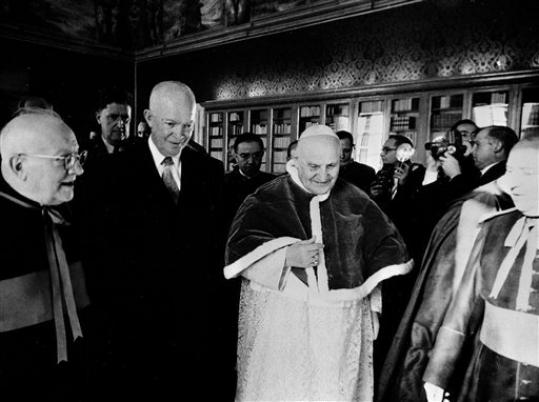
2. Dwight D. Eisenhower met John XXIII, the Vatican, December 6, 1959. Following a 40-year hiatus, this meeting would begin in earnest the precedent of every pope (except John Paul I) and every president meeting. While apparently very genial, this meeting also faced the challenge of Eisenhower not knowing Italian and John XXIII not knowing English.

3. John F. Kennedy met Paul VI, the Vatican, July 2, 1963. While Jacqueline Kennedy met John XXIII in a private audience, JFK missed him by a month, instead visiting the newly-elected Pope Paul. They reportedly discussed civil rights.

4. Lyndon Johnson met Paul VI, New York, October 4, 1965. This meeting took place in the historical context of the first visit by a pope to the United States. Paul VI would visit and address the United Nations while he was in town.

5. Lyndon Johnson met Paul VI, the Vatican, December 23, 1967. This was the first repeat encounter between a particular pope and president. Johnson's record will be matched by Nixon and shattered by the likes of Reagan, Clinton and George W. Bush. Pope Paul will go on to meet two more presidents.

6. Richard Nixon met Paul VI, the Vatican, March 2, 1969.

7. Richard Nixon met Paul VI, the Vatican, September 29, 1970.

8. Gerald Ford met Paul VI, the Vatican, June 3, 1975. Ford was the fourth and final U.S. president met by Pope Paul. John Paul II would meet five.

9. Jimmy Carter met John Paul II, the White House, October 6, 1979. Along with being the first of 15 meetings between Pope John Paul and a sitting president, this was the first time a pope visited the White House, which would go unrepeated until 2008.

10. Jimmy Carter met John Paul II, the Vatican, June 21, 1980.

11. Ronald Reagan met John Paul II, the Vatican, June 7, 1982.

12. Ronald Reagan met John Paul II, Fairbanks, Alaska, May 2, 1984. Pope John Paul was stopping to refuel on his way to Seoul. President Reagan was on his way back from China. While quick and in passing, this meeting still allowed the two to speak about the pressing issues of the time. It also followed shortly after the U.S. and the Holy See formally opened diplomatic relations.

13. Ronald Reagan met John Paul II, the Vatican, June 6, 1987.

14. Ronald Reagan met John Paul II, Miami, September 10, 1987.

15. George Bush met John Paul II, the Vatican, May 27, 1989.

16. George Bush met John Paul II, the Vatican, November 8, 1991.

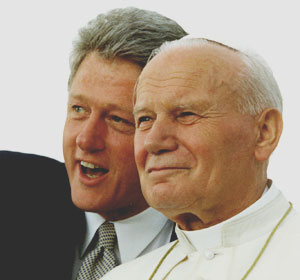
17. Bill Clinton met John Paul II, Denver, August 12, 1993. Pope John Paul was in town for World Youth Day.

18. Bill Clinton met John Paul II, the Vatican, June 2, 1994.

19. Bill Clinton met John Paul II, Newark, October 4, 1995.

20. Bill Clinton met John Paul II, St. Louis, January 26, 1999. President Clinton met with the pope more times on American soil than any other president. Of course, one could argue a traveler like JPII made it easy for him.

21. George W. Bush met John Paul II, Castel Gandolfo, July 23, 2001. This is the first and only time a pope received a president at the papal summer residence in Italy.

22. George W. Bush met John Paul II, the Vatican, May 28, 2002.

23. George W. Bush met John Paul II, the Vatican, June 4, 2004. President Bush presented Pope John Paul with the Presidential Medal of Freedom.

24. George W. Bush met Benedict XVI, the Vatican, June 9, 2007. It's worth noting that Bush, along with former Presidents Bush and Clinton, also attended the funeral of Pope John Paul II in April of 2005, which was also attended by then-Cardinals Joseph Ratzinger and Jorge Mario Bergoglio, S.J., the future Pope Benedict XVI and Pope Francis, respectively.

25. George W. Bush met Benedict XVI, the White House, April 16 2008. Bush also greeted Pope Benedict upon his arrival at Andrews Airforce Base. The White House reception included a birthday celebration for the pope.

26. George W. Bush met Benedict XVI, the Vatican, June 13, 2008. Until next week's meeting, Bush holds the distinction of being the only sitting U.S. president to meet two popes. He has also met with the pope the more times than any sitting president, six.

27. Barack Obama met Benedict XVI, the Vatican, July 10, 2009. Obama held a roundtable discussion with religion writers at the White House in anticipation of the meeting. Benedict presented Obama with a gift of the Vatican's recent document on bioethics.

CNS Photo.

Hat tip to AP for the list of historic dates and places.

Friday, October 11, 2013

John XXIII and Francis: What They Do, But Also How They Do It

October 11 marks not only the anniversary of the Catechism and the opening of the Second Vatican Council, but the feast of John XXIII, the great instigator of Vatican II and one of two popes to be canonized April 27 of next year by Pope Francis.

John XXIII hold the respective distinctions of ushering in the most significant reforms the Catholic Church had seen in a millennium and being the first Latin American and Jesuit pope. But both men are also witnesses to how Christian holiness permeates daily life in moments big and small and that it's not just what a person does, but how he or she does it, that matters.

Sure, both men provide visions of The Big Picture. John XXIII gave his recipe for sustainable global peace in his final encyclical Pacem in Terris (1963). And Pope Francis has put in place with lightning speed his program of global solidarity and a Church that goes out to the margins to serve.

But Francis has also focused much of his preaching and teaching energy -- exemplified by his daily Mass homilies especially -- on the "small things," behaviors of everyday life like gossip, laziness and cynicism. These are not lofty theological concerns, but pitfalls of human behavior that apply to everyone. And he doesn't criticize them lightly. Often the devil gets dragged into it. It's as if the last thing Pope Francis wants is a Church that "believes correctly" but is populated by otherwise miserable people.

While this may sound like "papal micromanaging" to some, it's more like a cheat sheet for the Christian life. Yes, you know the 10 Commandments and the Catechism, but just in case there was any doubt, the end result should look like this...

John XXIII had his rules for dealing with the small stuff too. His famous managerial maxim (recently quoted by Pope Francis in his interview with the world's major Jesuit journals) was "See everything. Overlook a great deal. Correct a little." His guide to living together in harmony (attributed to St. Augustine) had a similar spirit: "In essentials, unity. In doubtful matters, liberty. In all things, charity."

Pope John's leadership style was on full display at the Council. He didn't participate, wishing to promote freer discussion among the bishops, but watched the proceedings from his apartment on closed circuit television. However, when the curia proposed a highly unpopular draft for the document on divine revelation and the bishops did not have quite enough votes to reject it outright, Pope John, to the Council fathers' surprise, intervened and threw out the draft. He didn't see the point in such an unpopular schema taking up so much of the Council's time and energy. See everything. Overlook a great deal. Correct a little.

Pope Francis exercised a similar sense of discernment and freedom in the act of moving ahead Pope John's canonization without the required second miracle. Look at the witness of his life! The world has already proclaimed him a saint! This system was meant to guide us, not hinder us. Pope Francis seems to be saying. And he is, after all, the pope.

From the model of John XXIII to the current admonitions of Pope Francis, Catholics everywhere can learn from these men how to discern what is truly important in matters large and small and learn follow their lead in in exemplifying the key to a Christian witness: "See how they love another." Both men extended that love, in word and deed, to the entire world.

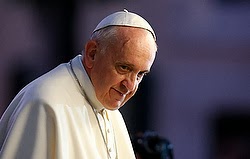
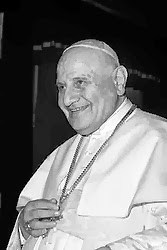
(Photo of Pope Francis CNS Photo/Paul Haring. Photo of John XXIII CNS file photo.)

Monday, September 30, 2013

John XXIII and JPII: Two Saintly Points on the Church's Trajectory

It's easy to note the distinctions between John XXIII (1958-1963) and John Paul II (1978-2005), two popes we now know will be canonized on April 27, 2014.
John XXIII was the good-humored roly poly son of Italian peasants; John Paul II was the handsome, sturdy Polish athlete and actor. John XXIII's brief pontificate "opened the windows" and sparked the most sweeping reforms in the modern history of the Church; John Paul II's quarter century on Peter's chair saw a highly visible pontiff playing a part in the fall of Communism and calling for a strident defense of Catholic teaching in the face of secular culture.

But these aren't so much differences as a reflection on how God gives us different gifts for different times. And what unites these two popes is how they both played critical roles at two different points on one trajectory: the Church in the modern world. We can see this is numerous areas:

Travel: John Paul II will always be remembered for his record-shattering
globetrotting, going on nearly 200 trips over 26 years, pioneering World Youth Day and bringing the papacy to nearly every corner of the globe. But it was John XXIII who first broke the practice of the pope as "prisoner of the Vatican," which had endured for decades. While he never traveled outside Italy as pope, John rode the rails from Rome to Assisi to pray for the success of the Second Vatican Council. Pope Francis has already followed the lead of JPII with his memorable time in Rio de Janeiro for World Youth Day. He's also traveling to Assisi in early October to pray for the success of a new round of Church reforms.

Laws and teachings: When John XXIII made his surprise announcement on January 25, 1959, at the Basilica of St. Paul Outside the Walls, he not only called for an ecumenical, but also for a synod for the Diocese of Rome and a revision to the 1917 Code of Canon Law. John would live to open the Council on October 11, 1962, but the revised Code of Canon Law would not be promulgated till nearly 20 years after his death, on January 25, 1983. In both cases, the Council and the Code, John and John Paul fit the respective roles of instigator and codifier.

Other Christians: Well before Vatican II issued its degree on ecumenism, Unitatis Redintegratio, in 1964, John XXIII had begun the thaw between the Catholic Church and other Christians. His jovial manner made him a natural at this, and in terms of rhetoric, he replaced "heretics and schismatics" with "our separated brethren" when referring to Christians who'd been divided from the Catholic Church for centuries or, in the case of the Eastern Orthodox, a millennium. Representatives of these groups were invited as official observers to the Council, and one of the long range goals of Vatican II was to promote Christian unity. John Paul II made a major contribution to the cause with his 1995 encyclical Ut Unum Sint, in which he invited non-Catholic Christians to dialogue with him about how the ministry of the pope could be exercised in a way that promoted unity between them.

Other religions: The good will surrounding the Council didn't stop with other Christians, of course. Its final document, Nostra Aetate (1965), affirmed the good of numerous world religions, including the Catholic Church's special relationship with the Jewish people. John XXIII had pushed for such a declaration. In his short pontificate, he had stunned a Jewish delegation by telling them, "I am Joseph, your brother," and removed language offensive to Jews from the Good Friday prayers. John Paul II made the first official papal visit to a synagogue in 1986 and, the same year, led a historic interfaith day of prayer in Assisi for world peace.

Communications and Charisma: Finally, both John XXIII and John Paul II exemplified how the personality of a pope can work wonders in spreading the Gospel in the mass communications age, whether at the dawn of the television era or spanning a time from the rise of cable news to the advent of the Internet and social media. Both men showed the world the face of a loving universal pastor. Now, in canonizing both men, Pope Francis is affirming the journey the Church has taken over the last 50 years and holding up two distinct, yet complementary models of holiness as we journey into the future.

(Photo of John XXIII CNS File Photo, photo of John Paul II CNS Photo/Joe Rinkus Jr.)

Wednesday, May 15, 2013

Today, a Social Teaching Triple Header

One of the pope's most prominent and important roles is to be a moral voice in the face of suffering and confusion in the world. That's the lesson the Church celebrates in triplicate today.

On May 15, three popes made major contributions to the development of Catholic social teaching: Pope Leo XIII with his landmark encyclical letter Rerum Novarum (1891), Pius XI with Quadragesimo Anno (1931) and John XXIII with Mater et Magistra (1961). The last two encyclicals honored the first on its 40th and 70th anniversaries, respectively.

So what did Leo XIII say that was so worth commemorating?

New Things

"It must not be supposed that the Church so concentrates her energies on caring for souls as to overlook things which pertain to mortal and earthly life," Pope Leo wrote in Rerum Novarum. In the wake of the Industrial Revolution, the world faced issues it hadn't faced before. Even the name of the encyclical translates "new things."

As some called for outright socialism while others insisted on an unrestrained laissez faire economy, Leo XIII applied the moral voice of the papacy and the timeless teachings of the Church to this upheaval. In doing so, he launched the modern era of Catholic social teaching, the hallmarks of which include:
  • The right of workers, which include fair wages, time off for religious and family life, safe working conditions and the ability to organize.
  • The duties of workers to perform their duties and refrain from vandalism and violence.
  • The rights and duties of property ownership.
  • The preferential option for the poor.
  • The common good.
Forty Years and What a Mess

When Pope Pius XI sat down to reflect on the 40th anniversary of Rerum Novarum, he did so against a backdrop of the worldwide economic turmoil of the Great Depression. And it shows: "Unbridled ambition for power has succeeded greed for gain; all economic life has become tragically hard, inexorable, and cruel."

In Quadragesimo Anno (literally "Forty Years"), Pius XI reaffirmed the earlier teaching on just wages, unions and the role of government (paragraph 71). He critiqued both unbridled capitalism and communism (paragraph 46). He also introduced the principle of subsidiarity (paragraph 79), which states that decisions affecting the common good of a society be made at the lowest possible but highest necessary level of authority. This means delegating to the grassroots level in some situations and action by national and international bodies in others.

Enter John

When John XXIII honored the 70th anniversary of Rerum Novarum, he didn't face the disaster of the Great Depression, but a spirit of optimism and a world feeling more confidently equipped to tackle challenges like global hunger and the development of nations.

As a result, in Mater et Magistra (literally "Mother and Teacher"), Pope John took the global view: "The solidarity which binds all people together as members of a common family makes it impossible for wealthy nations to look with indifference upon the hunger, misery and poverty of other nations whose citizens are unable to enjoy even elementary human rights. The nations of the world are becoming more and more dependent on one another and it will not be possible to preserve a lasting peace so long as glaring economic and social imbalances persist."

Down to Present Day

The development of the Church's social doctrine continued with John's Pacem in Terris (1963), issued 50 years ago in April. Subsequent popes have also carried it on in encyclicals including Paul VI's Populorum Progressio (1967) and John Paul II's Laborem Exercens and Centesimus Annus (for the 90th and 100th anniversaries of Rerum Novarum,  in 1981 and 1991, respectively). More recently, Benedict XVI's Caritas in Veritate (2009) responded to the financial crisis of 2008.

Pope Francis has already entered the narrative too, albeit in a considerably shorter length than an encyclical, a tweet on May 2 that read, "My thoughts turn to all who are unemployed, often as a result of a self-centered mindset bent on profit at any cost." However, with a name choice guided by a concern for the poor, peace and the environment, it would seem only a matter of time before he says more.

UPDATE: May 16

Well, that didn't take long.

Just this morning, Pope Francis addressed the world financial and economic crisis, telling an audience of diplomats that the source of these problems "is in our relationship with money and our acceptance of its power over ourselves and our society."


(CNS photos)

Thursday, July 2, 2009

New Encyclical -- Anybody Got a Copy?

Pope Benedict XVI’s new encyclical, “Caritas in veritate,” is due out July 7, but has been leaking out in Roman newspapers for several days now. Alas, it has not splashed across the pond and here in the United States we’re left making educated guesses about its contents.

We’re not even sure of its English-language title since Latinates can translate it either as “Charity in truth” or “Love in truth.” Vatican Radio on June 29 used the former, so my money’s on that translation. It is said that every translator is a traitor and no one wants to be the traitor with what may be a key encyclical of Pope Benedict XVI’s papacy.

Encyclical titles are tricky because their names come from the first few words of the text. Sometimes that works well in translation. Pope John XXIII’s Pacem in Terris (Peace on Earth) in 1963, revealed its content in its title. Pope Pius XI’s Quadregesimo Anno, issued in 1931 to mark the 40th anniversary of the much acclaimed Rerum Novarum, 1891, from Pope Leo XIII, is about reconstructing the social order. People don’t remember it as easily. Its title doesn’t help.
John Carr, director of the U.S. bishops’ Department of Justice, Peace and Human Development, made some attempts to figure out what’s coming in the encyclical. Media Relations asked him to do so to help us handle inquiries from reporters who want to get a start on their work before the July 4th weekend. His essay is on the USCCB Media Relations page.

As we get ready for the weekend many of us wish we had a preview copy. We’d even read it at the beach. Carr made his educated guesses after reading comments the pope himself has made on the coming encyclical as well other allusions from Pope Benedict to the current economic crisis. Social encyclicals usually build on previous ones and since “Caritas in Veritate” was said to originally be intended to mark the 40th anniversary of Populorum progressio, Pope Paul VI’s encyclical on the Development of Peoples, issued in 1967, a look at that encyclical offers signposts for this next one.

The environment was an issue for John Paul II and the issue has become even more urgent, so Carr suggests environmental issues will be important. After all, Benedict, who called for installation of solar panels at the Vatican, is the first “green pope.”

No surprise in the expectation that the pope will highlight the needs of poor people. What other world leader can speak for the majority of people who have only a minority of the resources? Pope Benedict is in a position where he can say that those having the largest share of the money are not automatically entitled to the largest share of the earth’s resources. We’re a world family, and in a healthy family, need determines who gets what.

Anybody with a bootlegged copy of the encyclical, send it my way.