1. Woodrow Wilson met Benedict XV, the Vatican, January 4, 1919. Meeting just after the end of World War I, Wilson had pushed for a lasting peace via his League of Nations proposal, and Pope Benedict had been a powerful advocate for peace throughout the war.
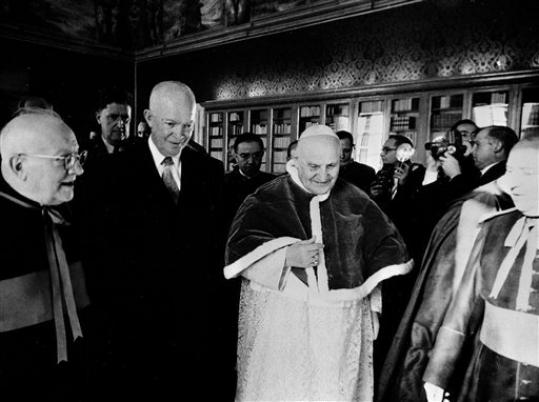
2. Dwight D. Eisenhower met John XXIII, the Vatican, December 6, 1959. Following a 40-year hiatus, this meeting would begin in earnest the precedent of every pope (except John Paul I) and every president meeting. While apparently very genial, this meeting also faced the challenge of Eisenhower not knowing Italian and John XXIII not knowing English.
3. John F. Kennedy met Paul VI, the Vatican, July 2, 1963. While Jacqueline Kennedy met John XXIII in a private audience, JFK missed him by a month, instead visiting the newly-elected Pope Paul. They reportedly discussed civil rights.
4. Lyndon Johnson met Paul VI, New York, October 4, 1965. This meeting took place in the historical context of the first visit by a pope to the United States. Paul VI would visit and address the United Nations while he was in town.
5. Lyndon Johnson met Paul VI, the Vatican, December 23, 1967. This was the first repeat encounter between a particular pope and president. Johnson's record will be matched by Nixon and shattered by the likes of Reagan, Clinton and George W. Bush. Pope Paul will go on to meet two more presidents.
6. Richard Nixon met Paul VI, the Vatican, March 2, 1969.
7. Richard Nixon met Paul VI, the Vatican, September 29, 1970.
8. Gerald Ford met Paul VI, the Vatican, June 3, 1975. Ford was the fourth and final U.S. president met by Pope Paul. John Paul II would meet five.
9. Jimmy Carter met John Paul II, the White House, October 6, 1979. Along with being the first of 15 meetings between Pope John Paul and a sitting president, this was the first time a pope visited the White House, which would go unrepeated until 2008.
10. Jimmy Carter met John Paul II, the Vatican, June 21, 1980.
11. Ronald Reagan met John Paul II, the Vatican, June 7, 1982.
12. Ronald Reagan met John Paul II, Fairbanks, Alaska, May 2, 1984. Pope John Paul was stopping to refuel on his way to Seoul. President Reagan was on his way back from China. While quick and in passing, this meeting still allowed the two to speak about the pressing issues of the time. It also followed shortly after the U.S. and the Holy See formally opened diplomatic relations.
13. Ronald Reagan met John Paul II, the Vatican, June 6, 1987.
14. Ronald Reagan met John Paul II, Miami, September 10, 1987.
15. George Bush met John Paul II, the Vatican, May 27, 1989.
16. George Bush met John Paul II, the Vatican, November 8, 1991.
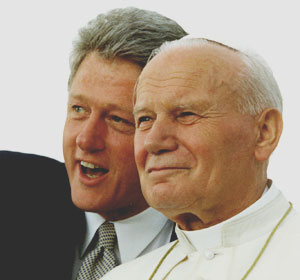
17. Bill Clinton met John Paul II, Denver, August 12, 1993. Pope John Paul was in town for World Youth Day.
18. Bill Clinton met John Paul II, the Vatican, June 2, 1994.
19. Bill Clinton met John Paul II, Newark, October 4, 1995.
20. Bill Clinton met John Paul II, St. Louis, January 26, 1999. President Clinton met with the pope more times on American soil than any other president. Of course, one could argue a traveler like JPII made it easy for him.
21. George W. Bush met John Paul II, Castel Gandolfo, July 23, 2001. This is the first and only time a pope received a president at the papal summer residence in Italy.
22. George W. Bush met John Paul II, the Vatican, May 28, 2002.
23. George W. Bush met John Paul II, the Vatican, June 4, 2004. President Bush presented Pope John Paul with the Presidential Medal of Freedom.
24. George W. Bush met Benedict XVI, the Vatican, June 9, 2007. It's worth noting that Bush, along with former Presidents Bush and Clinton, also attended the funeral of Pope John Paul II in April of 2005, which was also attended by then-Cardinals Joseph Ratzinger and Jorge Mario Bergoglio, S.J., the future Pope Benedict XVI and Pope Francis, respectively.
25. George W. Bush met Benedict XVI, the White House, April 16 2008. Bush also greeted Pope Benedict upon his arrival at Andrews Airforce Base. The White House reception included a birthday celebration for the pope.
26. George W. Bush met Benedict XVI, the Vatican, June 13, 2008. Until next week's meeting, Bush holds the distinction of being the only sitting U.S. president to meet two popes. He has also met with the pope the more times than any sitting president, six.
27. Barack Obama met Benedict XVI, the Vatican, July 10, 2009. Obama held a roundtable discussion with religion writers at the White House in anticipation of the meeting. Benedict presented Obama with a gift of the Vatican's recent document on bioethics.
CNS Photo.
Hat tip to AP for the list of historic dates and places.